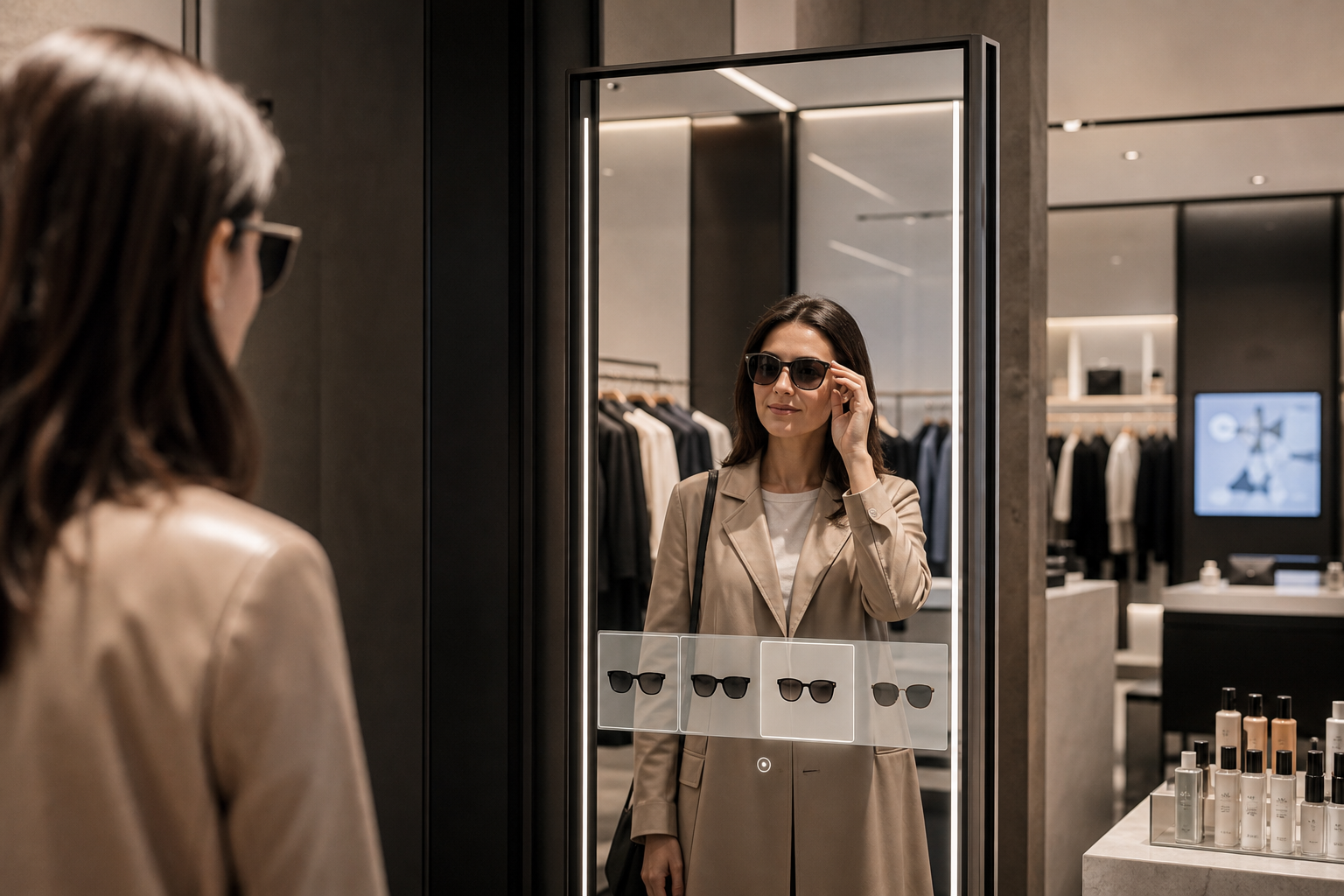
The global virtual mirror market stands at $11.2 billion in 2025 — a figure that would have seemed implausible to the small cohort of software engineers and computer vision researchers who built its earliest prototypes in the early 2000s. Today, a shopper in Seoul can use a smartphone camera to try on a pair of glasses in seconds, a luxury boutique in Paris can offer touchless makeup consultations via an AI-powered smart mirror, and an apparel retailer in São Paulo can let customers visualize dozens of outfit combinations without stepping into a dressing room. What began as a niche intersection of augmented reality and retail has become a structural component of modern commerce.
This article traces how that transformation happened — which companies laid the groundwork, which technologies unlocked scale, and how a market built on the relatively simple idea of "trying things on without touching them" grew into one of the more consequential developments in retail technology.
The Early 2000s: Foundations and Founding Companies
The first signals of what would become the virtual mirror market appeared in the early 2000s, when a handful of companies recognized that augmented reality could do something useful in retail: remove friction from the act of trying on a product. In 2001, Zugara Inc. was founded in California as one of the earliest providers of AR-powered kiosk and in-store virtual mirror services for the retail and fashion sectors. Three years later, in 2004, FXGear Inc. was established in Seoul, South Korea, with a focus on AR, VR, and computer graphics — including its FXMirror product designed specifically for augmented retail environments.
These were small, technically ambitious companies operating well before the infrastructure needed to bring their ideas to mass markets existed. Smartphones were rudimentary, cloud computing was nascent, and the consumer appetite for digital try-on was theoretical rather than demonstrated. But they established the conceptual template: use computer vision to place a digital representation of a product onto a representation of the user's body, in real time.
2006–2009: Beauty, Eyewear, and the Luxury Angle
The next cluster of founding-era milestones arrived between 2006 and 2009, and this period added two important dimensions: beauty and luxury retail.
In 2006, ModiFace was founded in Ontario, Canada. The company focused specifically on AI-powered beauty virtual try-on — makeup, hair color, nail color — applied to a user's face. In the same year, Fittingbox was founded in France, specializing in high-precision AR-based eyewear virtual try-on. Fittingbox's eventual scale — more than 4,000 corporate customers and over 306 million virtual try-ons processed per year — speaks to how durable that early focus on eyewear proved to be.
In 2009, Holition was founded in London. Its Magic Mirror and augmented retail solutions targeted luxury beauty brands directly, eventually serving clients including Charlotte Tilbury, Rimmel London, and Max Factor. Luxury retail, it turned out, was a natural early adopter: brands in that segment compete on experience as much as product, and the ability to offer a digitally immersive, touchless trial aligned well with their positioning.
2008–2013: Fashion E-Commerce and the Fit Problem
While beauty VTO was advancing through AR-based facial overlays, a separate thread was developing around the harder problem of garment fit. In 2008, Metail was founded in Cambridge, UK, developing 3D body modeling and AI-powered virtual try-on technology oriented toward garment visualization and fit analysis for fashion e-commerce. The core commercial problem Metail and companies like it were addressing was already apparent: online apparel shoppers returned items at high rates because they could not assess how a garment would actually fit before purchasing.
In 2013, Virtusize was founded in Tokyo, Japan, with a different approach — AI-driven garment-to-garment matching that allowed shoppers to compare an item they were considering against garments they already owned and knew fit them. Serving brands including Ralph Lauren, Adidas, and Uniqlo, Virtusize illustrated that solving the fit problem did not require full 3D rendering; intelligent matching logic could itself reduce return rates.
This period also saw the geographic footprint of the market begin to broaden. Founding companies were now spread across North America, Europe, and Asia-Pacific — a distribution that anticipated the eventual regional structure of the market.
2014–2017: Platform Scale and Emerging Markets
The mid-2010s brought a wave of new entrants that expanded the market's geographic reach, broadened its end-use categories, and began to operate at greater scale.
In 2014, Perfect Corp. was founded in Taiwan. Built around AI and AR-powered virtual try-on and digital beauty technology, Perfect Corp. eventually grew to serve clients including Estée Lauder, L'Oréal, and Shiseido, and went on to list on the New York Stock Exchange. The company became one of the clearest examples of a cloud-delivered SaaS model applied to virtual try-on — a deployment approach that would come to dominate the software segment.
In 2015, MirrAR was founded in India, offering AR and VR-based interactive shopping VTO solutions across jewelry, eyewear, beauty, and apparel. In 2016, Banuba was founded in Dubai, developing its Face AR SDK and computer vision technology for mobile, web, and e-commerce platforms — eventually serving brands including Gucci and Samsung. In 2017, Modaka Technologies, the company behind the Camweara platform, was founded in India, targeting jewelry, watches, and eyewear virtual try-on integrated directly into e-commerce websites and in-store retail.
The geographic spread matters. India, Taiwan, and the UAE were not peripheral to the virtual mirror story — they were generating primary market infrastructure. The eventual dominance of Asia-Pacific as a region, accounting for 47.8% of the global market by 2025, has roots in this founding-era activity.
The Market Today: Size, Structure, and Regional Leadership
By 2025, the global virtual mirror market had reached $11.2 billion in value, and the trajectory points to $20.2 billion by 2031 — a compound annual growth rate of 10.9% over the 2026–2031 period.
Asia-Pacific leads the global market at 47.8% share, supported by large-scale data center infrastructure, strong government AI investment across China, India, South Korea, Japan, and Indonesia, and prominent fashion, beauty, and e-commerce sectors. North America holds 22.5% share, driven by deep AI integration in retail — 77% of U.S. retailers have invested or budgeted for AI — and an e-commerce market that generated over $316.1 billion in Q4 2025 alone. Europe accounts for 17.1%, supported by luxury brand presence across France, Italy, and Spain, as well as a $1.6 billion EU allocation to support deep tech including AR and VR.
Within the market's segments, cloud-based software is the largest at $6,469.9 million in 2025, growing at an 11.0% CAGR. On-premises software, though smaller at $1,030.9 million, is expanding at 16.2% — a faster rate driven by large retailers and luxury brands that require tighter data control and security for sensitive consumer data. Hardware — the smart mirror and in-store device segment — stands at $2,308.6 million, growing at 10.2%, propelled by experiential retail deployments and advances in LiDAR and depth-sensing technology.
On the technology side, 3D AR and VR leads at $6,302.9 million in 2025. Photo-accurate virtual fitting rooms account for $3,492.2 million and a 12.2% CAGR, reflecting consumer preference for more realistic fit simulation. The fastest-growing technology segment is 3D body scanning at a 13.8% CAGR, driven by rising demand for measurement-accurate size recommendations. In terms of end users, apparel is the largest segment at $5,808.5 million, while eyewear is the fastest growing at a 16.0% CAGR, driven by the maturation of real-time facial mapping for precise frame overlay.
Where the Market Goes Next
The structural drivers that shaped the virtual mirror market's development are not dissipating — they are intensifying. Return rates in online retail remain a major commercial burden, and VTO technology's demonstrated ability to reduce them (a 31% reduction was reported following integration of MemoMi's VTO technology) gives retailers a clear financial case for continued investment. Conversion rate improvements of 20% to 35% reported by retailers using VTO platforms reinforce that incentive.
Generative AI is the most significant emerging force in the market. Platforms such as ModiFace's Beauty Genius and Perfect Corp.'s GenAI Clothing Try-On are enabling brands to deliver highly personalized shopping experiences at scale — AI-generated outfit combinations, personalized skincare recommendations based on skin analysis, and virtual try-on across diverse body types. These capabilities move virtual mirror technology from a visualization tool toward a genuine decision-support system.
3D body scanning is the fastest-growing technology segment for a reason: it addresses the precision gap that earlier, 2D-based VTO approaches left unresolved. The launch of Withings' Body Scan 2 at CES in January 2025 — capable of a full-body scan within 90 seconds — illustrated how rapidly this capability is maturing for consumer applications. Combined with mobile AR SDKs such as Banuba's Face AR SDK and framework-level tools such as ARCore and ARKit, the development barriers for integrating high-quality VTO into third-party applications are falling.
In physical retail, the in-store smart mirror segment is being driven by deployments like the one Spanish retailer Bershka installed in August 2025 — an AR-powered smart mirror featuring VTO and 3D visualization. LOOOK.AI's March 2026 announcement of a real-time AI clothing try-on feature designed for direct integration into physical smart mirrors and kiosks, specifically aimed at reducing in-store AR deployment costs, points to the direction: as hardware costs decline, experiential retail installations will become accessible to a broader tier of retailers beyond flagship stores.
The challenges ahead are real. The capital requirements for hardware deployment remain prohibitive for smaller retailers. Data privacy compliance across frameworks such as GDPR, CCPA, PIPL, and LGPD adds regulatory complexity for any platform collecting biometric and behavioral data. Supply chain disruptions stemming from U.S.-China trade tensions have increased component costs for sensor and display hardware. And the fundamental accuracy challenge — closing the gap between virtual and physical product appearance — remains a technical frontier that no provider has fully resolved.
Conclusion
The global virtual mirror market did not emerge from a single invention or a single market. It assembled itself over roughly two decades from the parallel efforts of companies working on beauty AR in Canada, garment fit in the UK, eyewear overlays in France, jewelry try-on in India, and cloud-based VTO platforms in Taiwan. Each segment of what is now an $11.2 billion industry traces back to specific technical problems — return rates, fit uncertainty, purchase confidence — that early founders believed technology could address.
That problem-solving orientation remains the market's defining characteristic. The technologies evolving fastest — 3D body scanning, photo-accurate virtual fitting rooms, generative AI-powered personalization — are not technology for its own sake. They are responses to persistent commercial friction in retail. As the gap between virtual and physical product experience continues to close, the market's forecast trajectory of $20.2 billion by 2031 reflects not optimism about a novel technology, but confidence in a set of solutions that are already demonstrably working.
Learn More and Take Action:
Consider becoming a member of the BCC Research library and gain access to our full catalog of market research reports in your industry. Not seeing what you are looking for? We offer custom solutions too, including our new product line: Custom Intelligence Services.
Contact us today to find out more.