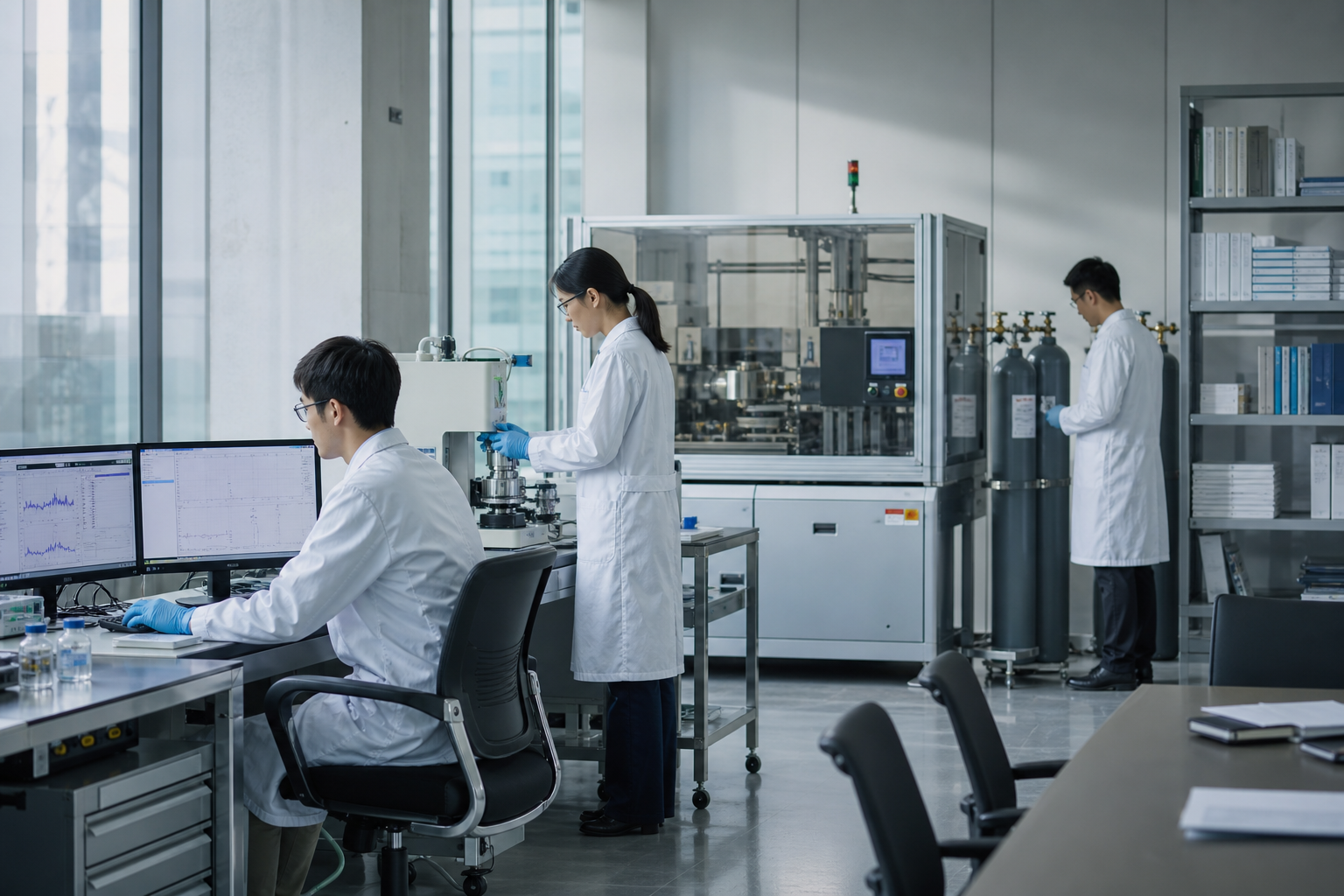
The electronic chemicals and materials industry sits at the foundation of modern technology. Every advanced semiconductor, display panel, and circuit board depends on a precise set of process chemicals, specialty gases, engineered films, and high-purity materials. As chip architectures grow more complex and manufacturing volumes scale to meet demand from AI infrastructure, electric vehicles, and next-generation communications, the performance requirements placed on these materials have intensified correspondingly. Suppliers who can deliver at advanced-node purity levels and at scale are increasingly central to the technology supply chain.
The global electronic chemicals and materials market was valued at $75.9 billion in 2025 and is forecast to reach $109.4 billion by 2031, growing at a compound annual growth rate of 6.5% over the 2026–2031 period. That trajectory reflects sustained structural demand rather than a cyclical upturn. AI infrastructure buildout, semiconductor reshoring programs across the United States, Europe, South Korea, and India, and the accelerating adoption of EUV lithography are all pulling forward consumption of specialty materials at rates that broad-based market averages only partially capture.
The companies best positioned to capture this growth share a few common characteristics: deep integration with leading chipmakers and display manufacturers, the ability to produce at ultra-high purity levels, and active investment in the next generation of materials for advanced packaging, EUV lithography, and high-frequency communications. The ten companies profiled below represent a cross-section of the global industry's most consequential players.
Market Context: Segments and Regional Dynamics
Among product segments, photoresist chemicals are growing fastest at an 8.8% CAGR (2026–2031), propelled by rising EUV lithography adoption and increasing photolithography step counts at leading-edge nodes. Polymers follow closely at a 7.8% CAGR, driven by their expanding role in advanced packaging, PCB substrates, and high-frequency assemblies. Semiconductors and ICs represent the largest single product application segment at $50.4 billion in 2026, growing at 7.3% CAGR on the back of AI accelerator demand and advanced logic and memory node transitions. CMP slurries are a standout in the Asia-Pacific region specifically, where they are expanding at an 11.6% CAGR through 2031, reflecting intensive advanced logic planarization requirements.
Asia-Pacific is by a wide margin the dominant consuming region, accounting for 71.6% of global demand. China is the largest single country market at $25.5 billion in 2026 with an 8.0% CAGR, followed by Taiwan at $9.3 billion and South Korea at $7.8 billion. India is the fastest-growing Asia-Pacific country at a 10.5% CAGR, reaching an estimated $5.2 billion by 2031. Outside Asia-Pacific, North America accounts for 12.8% of the global market and is accelerating due to CHIPS Act incentives and major fab commitments by TSMC and Texas Instruments. Europe holds a 9.7% share, with Germany as its largest market at $2.4 billion in 2026, supported by semiconductor investments in Dresden and Munich.
Top 10 Companies in the Electronic Chemicals and Materials Market
1. AGC Inc.
• Headquarters: Tokyo, Japan
• Founded: 1907
• Revenue: $13,773.6 million (FY2025)
• Employees: 52,896
• Focus: Electronics, Chemicals, Life Science, Automotive Glass, Architectural Glass, LCD Glass Substrates
AGC is one of the world's largest glass and specialty materials manufacturers, with a significant presence in electronic chemicals and display materials. Its electronics business supplies LCD glass substrates and specialty chemical products to semiconductor and display manufacturers across Asia-Pacific. The company's most prominent recent initiative is a joint development with SoftBank of a Functional Beam Shaping Lens Antenna integrating AGC's metasurface lens technology, positioning the company as a materials contributor to future 6G communication infrastructure.
2. Air Liquide
• Headquarters: Paris, France
• Founded: 1902
• Revenue: $30,470.0 million (FY2025)
• Employees: 65,168
• Focus: Ultra-high-purity gases, advanced semiconductor materials, chemical precursors, industrial gases, healthcare gases
Air Liquide operates one of the most globally extensive electronics gas and advanced materials businesses in the industry. The company supplies ultra-high-purity gases and chemical precursors to semiconductor fabs across Asia-Pacific, Europe, and North America. Recent commitments include its first large-scale Advanced Materials plant in Taichung City, Taiwan; a €130 million gas facility in Singapore; and a €250-million-plus electronics investment in Dresden, Germany - its largest European electronics project - all aimed at serving AI-driven semiconductor demand.
3. Air Products and Chemicals Inc.
• Headquarters: Allentown, Pennsylvania, U.S.
• Founded: 1940
• Revenue: $12,037.3 million (FY2025)
• Employees: 21,300
• Focus: Industrial and specialty gases, electronics gases, semiconductor gas supply
Air Products supplies nitrogen, hydrogen, helium, argon, and oxygen to semiconductor manufacturers globally, with electronics gases forming a key pillar of its business. The company was selected by Samsung to supply industrial gases for a new advanced fabrication facility in Pyeongtaek, South Korea, with phased operations from 2028 to 2030. Air Products is also building a new air separation unit in Cocoa, Florida, to serve the space launch industry, extending its reach into high-reliability, high-purity gas supply for technically demanding applications.
4. BASF
• Headquarters: Ludwigshafen, Germany
• Founded: 1865
• Revenue: $67,473.4 million (FY2025)
• Employees: 108,251
• Focus: Electronic chemicals, semiconductor process chemicals, display materials, CMP, photolithography materials, electroplating chemistries, engineering plastics
BASF brings one of the broadest portfolios of electronic chemicals to market, spanning photoresists, CMP materials, wet chemicals, OLED and MicroLED display materials, and copper metallization chemistries. The company is applying AI-driven molecular simulation and computational chemistry - through its Ultrasim platform - to accelerate material design across these categories. In 2026, BASF launched a next-generation yellow-light material solution for photolithography applications and is actively developing PFAS-compliant alternatives in response to European regulatory changes.
5. Celanese Corp.
• Headquarters: Irving, Texas, U.S.
• Founded: 1912
• Revenue: $9,544 million (FY2025)
• Employees: 11,434
• Focus: Engineered Materials, Acetyl Chain
Celanese participates in the electronic chemicals and materials market primarily through its Engineered Materials segment, supplying high-performance polymer compounds - including POM, LCP/PCT, PPS, and PA grades - used in electronic assemblies and advanced packaging applications. The company is expanding its Michigan Technology Center to integrate pilot-scale development and advanced prototyping. Celanese has achieved ISCC Carbon Footprint Certification for select POM grades and is implementing selective price increases across its engineered materials portfolio in response to supply chain pressures.
6. Entegris Inc.
• Headquarters: Billerica, Massachusetts, U.S.
• Founded: 1966
• Revenue: $3,196.6 million (FY2025)
• Employees: 7,700
• Focus: CMP slurries and consumables, deposition materials, cleaning solutions, contamination control, advanced purity systems
Entegris is a focused semiconductor materials supplier with deep expertise in contamination control, CMP consumables, and deposition materials. The company is investing $700 million in U.S.-based R&D and capital expenditures, including a new Technology Center in Aurora, Illinois. A cross-licensing agreement with JSR Corp. is advancing EUV lithography material development, and a Korea Technology Center at Hanyang University ERICA Campus strengthens regional technical support for customers in South Korea's dense semiconductor manufacturing corridor.
7. FUJIFILM Holdings Corp.
• Headquarters: Tokyo, Japan
• Founded: 1934
• Revenue: $20,996.4 million (FY2025)
• Employees: 73,526
• Focus: Semiconductor lithography materials, CMP slurries, ultra-high-purity specialty solvents, PV precursors
FUJIFILM has built a substantial semiconductor materials business centered on photolithography chemicals and CMP slurries. The company launched an advanced packaging CMP slurry optimized for hybrid bonding in 2025, which has been adopted by major semiconductor manufacturers for AI processor production. FUJIFILM is also expanding its specialty solvent portfolio for EUV and advanced lithography applications, positioning itself across the photolithography and planarization steps that grow in importance with each new logic node generation.
8. Linde PLC
• Headquarters: Dublin, Ireland
• Founded: 1879
• Revenue: $33,986 million (FY2025)
• Employees: 65,177
• Focus: Industrial and specialty gases, wet chemicals, electronics gas delivery, semiconductor and flat-panel display gases
Linde is among the largest suppliers of ultra-high-purity gases to the global semiconductor industry. Its integration with Samsung's Pyeongtaek manufacturing complex is deepening, with construction of an eighth on-site air separation unit commencing mid-2026. Linde is simultaneously expanding into adjacent high-purity gas applications, including long-term liquid oxygen and nitrogen supply for U.S. rocket launch operations from an expanded facility in Mims, Florida, scheduled for Q1 2027. Electronics, chemicals, and energy and metals end markets are focal points for volume growth.
9. Merck KGaA
• Headquarters: Darmstadt, Germany
• Founded: 1668
• Revenue: $23,866.8 million (FY2025)
• Employees: 62,461
• Focus: Semiconductor Solutions, Display Solutions, specialty chemicals, delivery systems, process equipment
Merck KGaA's Electronics segment is a major supplier of advanced materials, specialty chemicals, and process solutions for semiconductor fabrication and display manufacturing. The company operates 29 electronics-related manufacturing sites and holds approximately 13,200 patents across its electronics-related portfolio. Customer collaboration on material innovation for AI, high-performance computing, 5G, and autonomous mobility is central to its strategy. The Electronics segment experienced some revenue softness in FY2025 partly due to the divestment of the Surface Solutions business unit.
10. Mitsubishi Chemical Group Corp.
• Headquarters: Tokyo, Japan
• Founded: 2005
• Revenue: $24,613.0 million (FY2025)
• Employees: 56,678
• Focus: Electronic chemicals, semiconductor solutions, display materials, engineering polymers, advanced packaging materials, flame-retardant compounds
Mitsubishi Chemical Group Corp. (MCGC) serves the semiconductor and display industries with a broad portfolio spanning precision-cleaning chemicals, specialty polymers, photoresists, and advanced packaging materials. The company is expanding semiconductor cleaning operations in Japan, increasing polymer compound capacity in China and France, and deploying AI-driven molecular simulation to accelerate materials development. In 2026, MCGC developed a lightweight heat dissipation device using carbon fiber prepreg and graphite sheet composite for Non-Terrestrial Network applications, extending its materials reach into emerging communications infrastructure.
Conclusion
The is undergoing a structural expansion driven by forces that are unlikely to reverse on any near-term horizon: the scale of AI infrastructure investment, the complexity of advanced semiconductor nodes, the capital commitments behind semiconductor reshoring, and the relentless material intensity increases that accompany each new generation of chips, displays, and high-frequency boards. The companies profiled here - spanning industrial gas majors, specialty chemical groups, and focused semiconductor materials suppliers - are each investing to meet that demand through capacity expansion, R&D programs, and deepening integration with leading chipmakers and OEMs.
At the same time, the industry is navigating real headwinds. PFAS regulatory disruption is forcing material reformulation across multiple product categories. Geopolitical pressures and export controls are fragmenting supply chains and increasing the cost of serving global customers. Pricing pressure persists in several engineered material segments. How individual companies manage these constraints - through product innovation, geographic diversification, and regulatory foresight - will substantially determine their standing in a market that is projected to exceed $109.4 billion by 2031.
Learn More and Take Action:
Consider becoming a member of the BCC Research library and gain access to our full catalog of market research reports in your industry. Not seeing what you are looking for? We offer custom solutions too, including our new product line: Custom Intelligence Services.
Contact us today to find out more.