Transparent displays are no longer a novelty confined to trade show floors. Across automotive cabins, retail environments, manufacturing facilities, and portable computing, AI is being integrated into transparent display technology in ways that are measurably changing how these systems are designed, produced, and used. The convergence of AI with transparent OLED, Micro-LED, and AR/VR display platforms is enabling a level of interactivity and manufacturing precision that static or conventional display systems simply cannot achieve.
This is a pulse report — BCC Research's qualitative assessment of AI's impact on the transparent displays market — and the signals it captures point clearly to accelerating momentum. LG Electronics realized savings of over $144.4 million through AI-based manufacturing processes in 2024 alone, with an expected $144.3 million in annual value generation from AI production systems going forward. LG Display announced in August 2025 an AI-based real-time production system targeting a 30% productivity improvement over three years, compressing design blueprint timelines from four weeks to eight hours. Bosch's AI-powered visual inspection system achieved a 25% reduction in scrap rate and saves over $1.2 million annually. These are not projections — they are documented outcomes that signal where the industry is heading.
Across 7 emerging technologies, the picture that emerges is one of structural transformation: AI is not being layered on top of existing transparent display processes, it is being embedded within them, from raw material selection through to end-customer interaction.
Edge AI and Neural Processing Units (NPUs) for Digital Signage: Enabling Real-Time Personalization Without the Cloud
Edge AI systems use on-device neural processing units to analyze data from cameras and sensors locally, without routing information to a central cloud. For transparent digital signage, this means content can respond to real-time foot traffic, environmental conditions, and audience demographics in milliseconds rather than minutes. BrightSign LLC deployed exactly this architecture in June 2025, enabling real-time foot traffic analysis and dynamic content personalization across retail, healthcare, and hospitality deployments.
• Retail digital signage that adapts content to audience demographics in real time, improving advertising effectiveness
• Healthcare environment displays that adjust information based on patient flow and facility conditions
• Hospitality sector automated content scheduling that updates promotions or wayfinding without manual intervention
• Corporate environment interactive signage delivering relevant information based on occupancy and context
AI-Powered Transparent OLED Displays: Merging Intelligence with See-Through Panels
Transparent OLED displays integrated with AI processors combine see-through panel technology with intelligent content and audio enhancement. LG's Signature OLED T series, for instance, incorporates the A11 AI processor to deliver real-time picture and audio adaptation within a panel that remains visually transparent. At HITEC 2025 in June 2025, LG Display showcased a 30-inch AI-powered transparent OLED display specifically targeting retail and hospitality, demonstrating how these systems enable interactive experiences that blend digital content seamlessly with physical surroundings.
• Smart retail product information displays that surface FAQs and specifications without requiring staff involvement
• Hospitality interactive service displays enabling guests to access menus, booking options, and concierge services
• Home entertainment transparent TV panels that deliver AI-enhanced picture quality while maintaining see-through aesthetics
• Commercial window displays and storefronts that present dynamic content without blocking natural light or sightlines
AI-Integrated Transparent Micro-LED Kiosks: High-Brightness Intelligence for Customer Engagement
Transparent Micro-LED kiosks combine the high-brightness and high-contrast characteristics of Micro-LED panel technology with agentic AI capable of supporting real-time, domain-specific video-based interactions. In 2026, AUO Corp., Faytech Tech Co., Ltd., and Napster announced a strategic partnership to develop an AI-powered Transparent Micro-LED Kiosk offering over 60% transparency and a contrast ratio exceeding 1,000,000:1. This level of display performance makes the technology viable in high-ambient-light indoor settings where conventional transparent displays wash out.
• Retail interactive product kiosks that guide customers through selections with real-time video-based AI responses
• Corporate information and wayfinding kiosks with intelligent, context-aware navigation assistance
• Hospitality concierge and service kiosks offering automated check-in, recommendations, and service requests
• Commercial interactive advertising displays that engage passers-by with personalized, dynamic content
AI-Driven Head-Up Displays (HUDs) for Automotive: Projecting Intelligence onto the Driver's Sightline
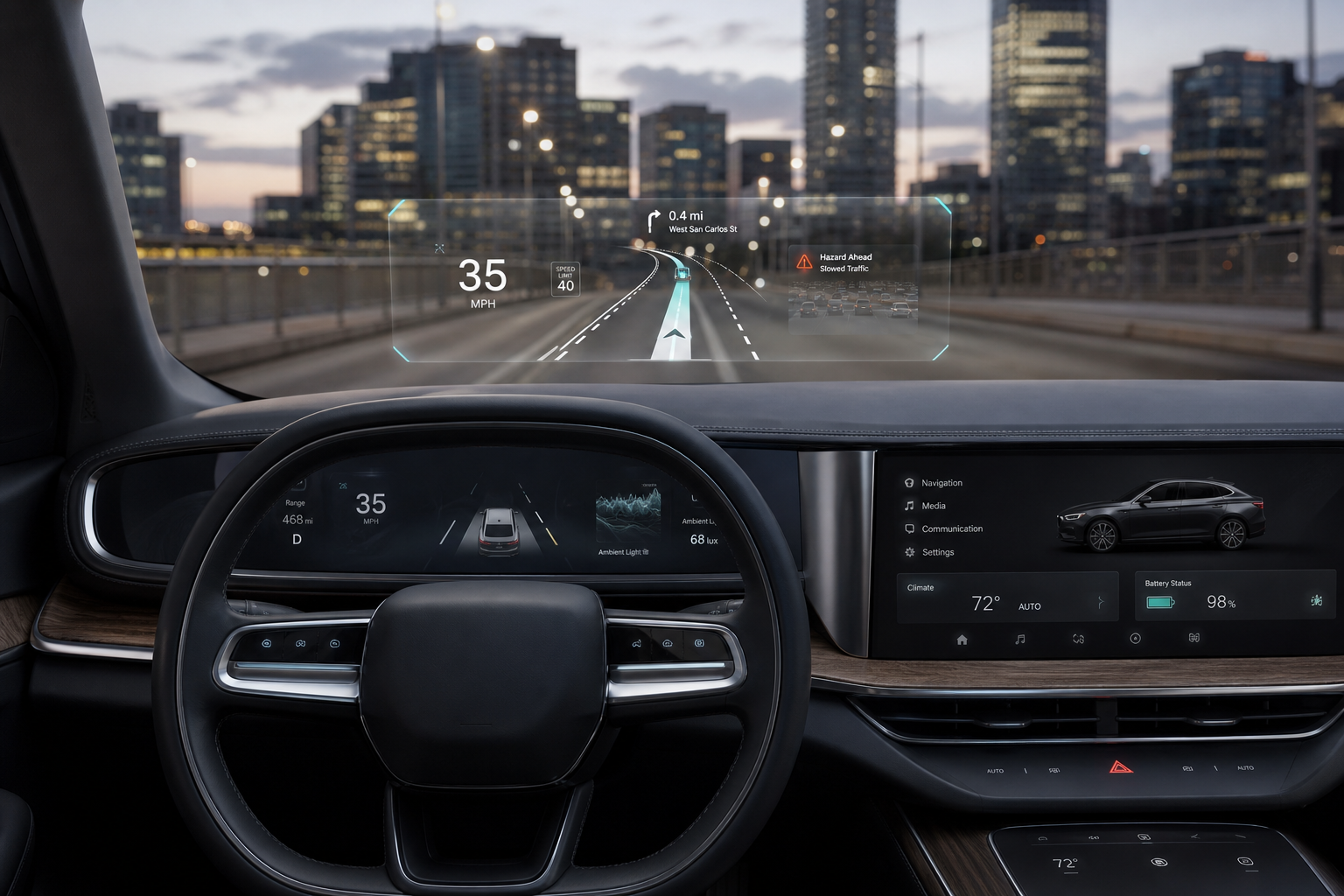
AI-enhanced transparent OLED windshield HUD panels use edge computing and AI processors to project real-time environmental awareness information directly within the driver's field of vision, integrating with ADAS and self-driving systems. The adoption rate underscores the scale of this shift: between January and June 2025, over 60% of vehicles manufactured in China included ADAS solutions such as HUDs and HMDs, according to China's Ministry of Industry and Information Technology. LG Display showcased AI-powered in-vehicle transparent OLED windshield panels at CES 2026, and Bosch's AI-powered visual inspection system has achieved a 97.6% defect-detection accuracy rate for automotive HUD and HMD components.
• Transparent OLED windshield HUD panels in passenger vehicles displaying navigation, hazard alerts, and speed data
• Self-driving car HUD integration that incorporates predictive maintenance algorithms to anticipate system faults
• Aviation head-up display systems providing pilots with AI-calibrated environmental and instrument data
• ADAS lane guidance and hazard alert overlays that adapt to real-time road and traffic conditions
Machine Learning-Powered Production Planning and Predictive Maintenance: Optimizing the Manufacturing Line
ML algorithms dynamically optimize display assembly production by estimating manufacturing risks, predicting supply chain disruptions, and providing real-time visibility into production lines via IoT and remote sensing technologies. Display panel manufacturing involves more than 140 sub-processes, and traditional diagnostic methods can take weeks to months to identify quality issues. LG Display's AI-based real-time production system, announced in August 2025, is designed to eliminate that lag — moving blueprint timelines from four weeks to eight hours and targeting a 30% productivity improvement over three years.
• OLED and LCD display panel manufacturing scheduling that dynamically adjusts to real-time production conditions
• Predictive maintenance of robotic manufacturing machinery to prevent unplanned downtime before failures occur
• Real-time defect detection in transparent conductive film production, catching micro-cracks and electrode misalignment at accuracy levels exceeding 97%
• Supply chain disruption risk estimation for display OEMs, improving synchronization between suppliers and assembly plants
AI-Powered Material Selection and Formulation for OLED Manufacturing: Replacing Trial and Error with Precision
AI-assisted algorithms select optimal material ratios for OLED emissive layers, balancing device efficiency, color accuracy, product lifespan, and blue light emission — replacing the manual and trial-based processes that have historically made OLED manufacturing time-intensive and yield-inconsistent. Visionox demonstrated this in late 2024, integrating AI-assisted material selection into its production process and achieving a 10% increase in device efficiency, a 22% increase in product lifespan, and a 50% improvement in apparent color deviation — concrete gains that translate directly to panel quality and manufacturing economics.
• OLED emissive material selection for transparent displays, optimizing for efficiency and longevity simultaneously
• Transparent conductive film quality optimization using AI-driven formulation analysis
• Glass substrate defect detection and material inspection to identify structural anomalies before assembly
• Reduction of apparent color deviation in display panel manufacturing, improving consistency across production runs
AI-Generated Content (AIGC) for Transparent Display Laptops: Expanding Beyond Signage and Automotive
AI-generated content technology integrated into transparent display laptops represents a distinct direction for the market — applying AI not to large-format signage or vehicle systems but to portable computing. Lenovo's ThinkBook Transparent Display Laptop Concept, unveiled in 2024, incorporates dedicated AI acceleration for security and power efficiency on a see-through computing device. This positions transparent displays within productivity and human-computer interaction contexts that the market has not historically addressed.
• Transparent display laptops with AI-enhanced security, using on-device AI to manage access and authentication
• Power-efficient see-through computing interfaces that use AI acceleration to optimize battery usage
• AI-accelerated content rendering on portable transparent devices for productivity and creative applications
Where Growth Is Concentrated: Segments and Regional Leadership
The strongest near-term commercial signals are in retail and automotive. AI-powered decision-making solutions in the retail sector are expected to grow by at least 50% by end of 2026, driven by companies including Alibaba, Walmart, and Target using AI for demand forecasting and inventory analytics in conjunction with transparent display deployments. Automotive HUD adoption is advancing rapidly, with ADAS integration in over 60% of Chinese-manufactured vehicles in the first half of 2025 and LG Display actively commercializing transparent OLED windshield solutions.
Regionally, Asia-Pacific leads in manufacturing-side AI integration, with OEM panel suppliers Samsung Display, LG Display, and BOE Technology Group deploying AI for real-time defect detection, predictive maintenance, and data-driven production management. North America shows broad adoption across AI-enabled quality control, with over 52% of U.S. manufacturer facilities having adopted AI as of early 2025, and companies including Cognex Corp., Intel Corp., Bosch, and Planar Systems driving automation in display component inspection. Europe's AI adoption in this market is structurally reinforced by Industry 4.0 mandates and environmental regulations, with over 72% of European manufacturers positive about AI's potential and over 98% of U.K. manufacturers implementing it — achieving defect reductions of 90%, per Rockwell Automation. In the Rest of the World, the Middle East is advancing rapidly, with over 98% of manufacturers either using AI or planning to implement it.
Conclusion
The 7 technologies profiled in this report collectively represent a fundamental shift in how transparent displays are manufactured, deployed, and experienced. The gains are already measurable: Bosch saves over $1.2 million annually from improved defect detection. Visionox extended OLED product lifespan by 22% through AI-assisted material formulation. LG Electronics documented over $144.4 million in manufacturing savings. These outcomes are pushing AI adoption from early-mover experimentation into standard operating practice for panel manufacturers and display integrators alike.
Over the forecast period, the convergence of edge AI, advanced OLED and Micro-LED panel technology, and AI-assisted manufacturing will continue to erode the barriers — yield inconsistency, high scrap rates, static content limitations — that have historically constrained transparent display commercialization. Industries from automotive to retail to portable computing are moving toward transparent display integration at a pace that would not be sustainable without AI underpinning the production and interaction layers. For manufacturers, integrators, and brands evaluating their position in this market, understanding which technologies are driving that convergence and where adoption is already concentrated is the essential starting point.
Learn More and Take Action:
Consider becoming a member of the BCC Research library and gain access to our full catalog of market research reports in your industry. Not seeing what you are looking for? We offer custom solutions too, including our new product line: Custom Intelligence Services.
Contact us today to find out more.