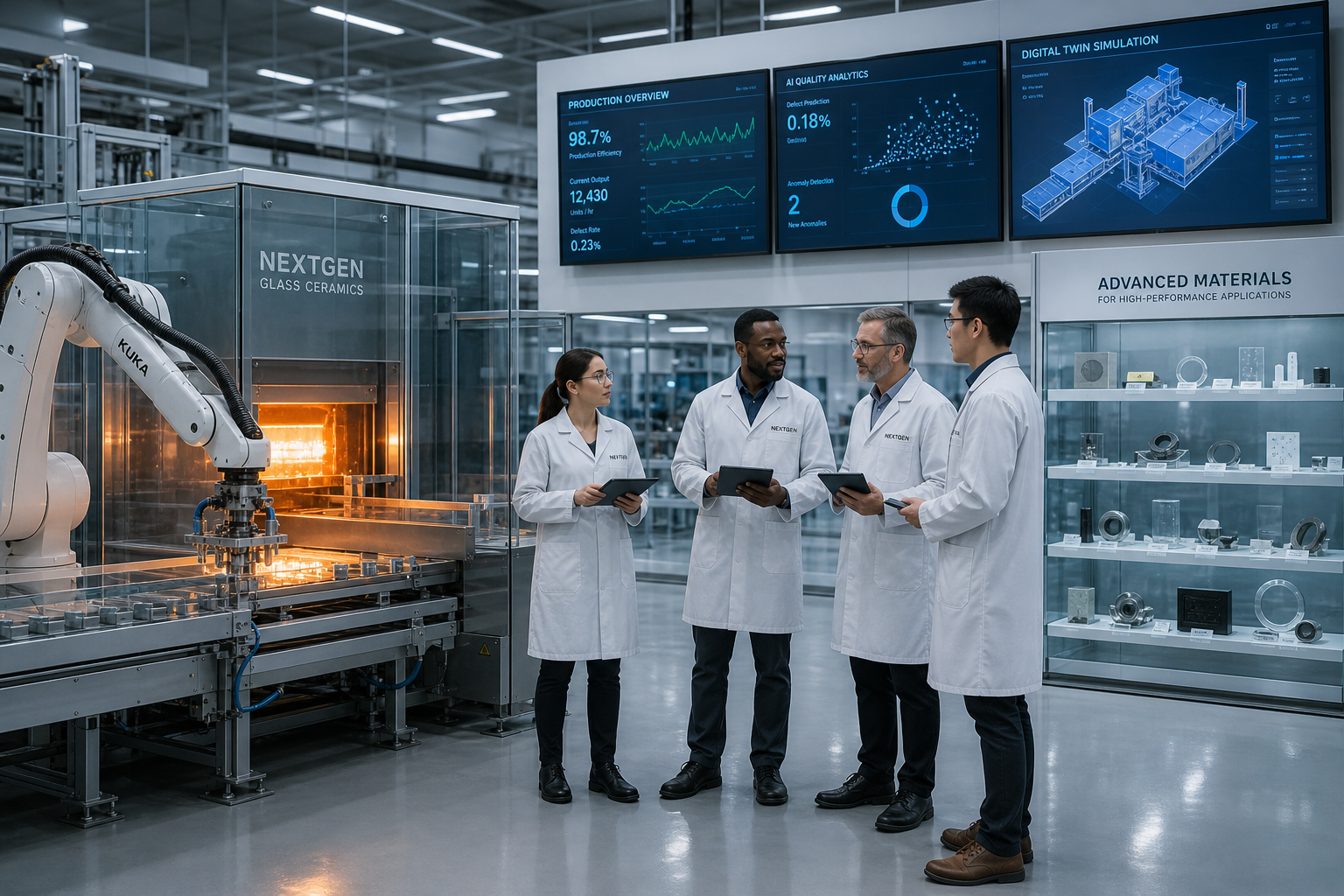
Glass-ceramics occupy a narrow but critical space in modern manufacturing. These materials — engineered by controlled crystallization of glass into partially or fully crystalline structures — deliver properties that neither conventional glass nor traditional ceramics can match alone: ultra-low thermal expansion, high mechanical strength, chemical durability, and dimensional stability under extreme conditions. That combination makes them essential to semiconductor lithography systems, aerospace optics, medical devices, dental restorations, and premium consumer appliances.
What is changing now is the role artificial intelligence plays across the entire glass-ceramic value chain. AI is being applied to quality inspection, materials discovery, process optimization, energy management, supply chain logistics, and product customization — moving from isolated pilot projects toward integrated deployment at major producers. The scale of recent investment reflects the seriousness of this shift. Corning Inc. and Meta Platforms entered a multiyear agreement valued at up to $6 billion in March 2026 to accelerate U.S. data center infrastructure for AI applications, supported by advanced glass solutions for high-speed connectivity. Two months later, Corning and NVIDIA announced a commercial and technology partnership, with Corning committing to increase U.S.-based optical connectivity manufacturing capacity by 10x and expand fiber production capacity by more than 50%, with three new facilities planned in North Carolina and Texas.
Because this is a qualitative BCC Pulse Report rather than a traditionally sized market study, no single headline CAGR or revenue figure defines the analysis. Instead, the report maps the structural forces — technological, regulatory, competitive, and geopolitical — reshaping how glass-ceramic manufacturers operate and compete. What follows is an honest assessment of where AI integration is creating real value and where it is running into genuine constraints.
The Benefits
Demand for High-Precision Semiconductor and Electronics Materials
Semiconductor fabrication and AI chip packaging impose tolerances that leave almost no margin for process variability. Ultra-low thermal expansion glass-ceramics used in lithography systems must maintain dimensional accuracy across temperature cycles; even nanometer-scale deviations can compromise chip yields. Nippon Electric Glass responded to exactly this pressure in January 2026 by developing large glass substrates specifically for AI chip applications, illustrating how directly the semiconductor buildout is pulling glass-ceramic producers toward tighter quality requirements.
AI provides the process control infrastructure needed to meet those requirements at scale. Computer vision systems detect microcracks, inclusions, surface imperfections, and dimensional deviations in real time. Machine learning models monitor and correct process parameters continuously, reducing the batch-to-batch variability that would otherwise make precision glass-ceramic production an expensive lottery. For producers that want to serve semiconductor and advanced electronics customers, AI adoption is effectively a qualification threshold, not an optional upgrade.
AI-Accelerated Materials Discovery Reducing Development Cycles
Developing a new glass-ceramic composition through conventional trial-and-error is slow and resource-intensive. Each formulation change requires physical batching, melting, heat treatment, and testing — a cycle that can take months and still produce ambiguous results when multiple variables interact simultaneously.
Materials informatics platforms apply machine learning to large datasets of chemical compositions, crystallization behaviors, thermal expansion characteristics, and mechanical performance data to predict how formulation changes will affect final material properties before a single physical sample is produced. Rescale raised $115 million in April 2025, backed by Applied Materials and NVIDIA, to expand exactly this kind of AI-enabled simulation capability. For glass-ceramic producers, the payoff is the ability to screen thousands of candidate formulations virtually and move promising compositions into commercial production significantly faster — a meaningful advantage for demanding applications such as bioactive glass-ceramics for regenerative medicine and ultra-low expansion compositions for next-generation lithography systems.
Sustainability Regulations and Decarbonization Pressure
Glass-ceramic manufacturing is thermally intensive. Melting, nucleation, crystallization, and finishing operations require sustained high temperatures that translate into substantial fuel consumption and emissions. Tightening environmental regulations in Europe and increasingly in North America are converting what was once a cost management problem into a compliance requirement.
AI-driven smart energy management systems address this by continuously analyzing consumption patterns across furnace and kiln operations and recommending adjustments that reduce fuel use and improve thermal efficiency without degrading product quality. The Glass Futures and Vector Engines Corp. partnership, announced in February 2026 with approximately $2 million in UKRI funding, targets furnace efficiency improvements and emissions reduction using advanced AI models. Glass Futures followed that in June 2026 by installing an AI-driven digital twin of its glass furnace capable of processing over 11,000 calculations simultaneously, combining real operational data with physics-based simulation to predict and optimize glass output. For European producers operating under circular economy mandates, AI is shifting from an efficiency tool to a regulatory compliance mechanism.
Growth of AI Infrastructure Driving Specialty Glass Demand
The rapid build-out of AI data centers and AI chip manufacturing is creating sustained demand for advanced optical connectivity products, fiber optic cables, and glass substrates — precisely the categories where glass-ceramic producers operate. The Corning-Meta and Corning-NVIDIA partnerships together represent billions of dollars of forward demand for advanced glass solutions tied directly to AI infrastructure expansion.
For glass-ceramic manufacturers, this dynamic creates a strong financial incentive to scale capacity and simultaneously integrate AI into manufacturing operations to meet the quality and volume requirements that major technology customers demand. Industry 4.0 investment — industrial IoT, digital twins, and machine learning platforms — is being funded through both corporate digital transformation programs and government manufacturing initiatives, particularly in North America and Asia-Pacific, where semiconductor and electronics investment is most concentrated.
Predictive Maintenance Reducing High-Temperature Process Downtime
Furnaces and kilns in glass-ceramic production cannot be stopped and restarted without significant cost and quality consequences. Unplanned interruptions in melting or crystallization cycles can ruin entire batches of high-value material and require days of controlled ramp-up before production returns to stable operation.
Predictive maintenance algorithms continuously analyze sensor data from furnaces, kilns, CNC machining centers, and polishing systems to detect early indicators of potential failure before a breakdown occurs. The financial logic is straightforward: a scheduled maintenance intervention costs substantially less than an unplanned production halt in a high-value, energy-intensive process. Corning's Manufacturing 4.0 program, expanded in June 2023, explicitly incorporates predictive modeling alongside machine learning and robotics to support manufacturing continuity across its glass and glass-ceramic operations.
The Challenges
Complexity of Multi-Stage Glass-Ceramic Production Processes
Glass-ceramic manufacturing is a sequence of tightly coupled stages, each sensitive to conditions in the stages before and after it. Raw material batching, melting, forming, nucleation, crystallization, machining, and finishing each depend on precise control of composition, temperature profiles, and reaction kinetics. A deviation introduced early can propagate and amplify through subsequent stages in ways that are difficult to detect until final inspection.
Integrating AI across all of these stages requires instrumentation throughout the production line, robust data pipelines capable of handling real-time sensor feeds, and models capable of capturing interdependencies between process stages. Building that infrastructure is technically demanding and organizationally complex, particularly for manufacturers that have historically relied on experienced process engineers rather than data systems to manage production stability. The challenge is not AI capability in isolation — it is connecting AI to a physical process that resists simplification.
Raw Material Quality Variability Undermining AI Model Reliability
AI models learn from historical data and predict based on the assumption that future inputs will be broadly consistent with what the model has seen before. Glass-ceramic manufacturing depends on critical raw materials — lithium compounds, zirconium chemicals, rare-earth oxides, and high-purity silica — whose chemical composition can vary between suppliers, between batches from the same supplier, and even within a single shipment.
Even minor compositional variations can significantly alter crystallization behavior and final product performance. When raw material quality shifts outside the range a model was trained on, prediction reliability degrades. Addressing this requires either tighter raw material specifications and supplier qualification programs, or continuous model retraining as new data arrives. Both approaches add cost and operational complexity, and neither eliminates the underlying variability in global specialty chemical supply chains.
Geopolitical Supply Risks for Critical Raw Materials
Glass-ceramic production depends on specialty raw materials that are sourced globally and concentrated in specific geographic regions. Lithium compounds, alumina, zirconium minerals, and rare-earth oxides are essential inputs whose supply can be disrupted by export controls, trade disputes, mining restrictions, or logistical breakdowns.
AI-powered procurement systems can improve visibility into supplier performance and optimize sourcing decisions under normal conditions. But when a government restricts rare-earth exports or a major lithium supplier faces operational disruptions, an AI platform can flag the risk and model alternative scenarios — it cannot make critical materials available when they are not. For manufacturers serving semiconductor, aerospace, and defense customers that have no tolerance for supply interruptions, geopolitical raw material risk remains a structural vulnerability that AI tools help manage but cannot eliminate.
Early-Stage AI Adoption in Emerging Markets Limiting Scale
AI adoption in glass-ceramics is not uniform across geographies. North America and Europe have advanced manufacturing infrastructure, established R&D programs, and regulatory environments that actively incentivize digital transformation. Asia-Pacific, particularly China, Japan, South Korea, and India, is expanding AI adoption rapidly, supported by government smart manufacturing programs and major electronics and semiconductor investment.
In South America, the Middle East, and Africa, AI adoption remains focused primarily on basic efficiency improvements and operational cost reduction rather than advanced process control, materials informatics, or autonomous production systems. This geographic unevenness limits the global rollout of AI-driven glass-ceramic innovation and means that efficiency and quality gains achieved by leading producers are not being replicated across the full global industry — constraining the scale at which AI-driven improvements translate into industry-wide benchmarks.
High Energy Intensity Creating Cost and Compliance Pressure
The extreme temperatures required across glass-ceramic production make energy costs a persistently large share of total production expenses — and a growing compliance burden as emissions regulations tighten. AI-driven energy optimization can reduce fuel consumption and improve thermal efficiency, but it cannot change the fundamental thermodynamic requirements of melting glass or driving crystallization reactions. The ceiling on achievable energy savings through operational optimization alone is real.
Manufacturers facing both volatile energy prices and increasingly stringent environmental regulations are in a position where AI optimization is necessary but not sufficient. Meeting ambitious decarbonization targets may ultimately require process technology changes — alternative fuels, furnace electrification, or significant redesign of heat treatment cycles — that go beyond what AI energy management systems can deliver on their own.
Weighing the Two Sides
The case for AI integration in glass-ceramics is structurally sound. The semiconductor and AI infrastructure buildout is generating real, sustained demand for precision glass-ceramic materials. Regulatory pressure on energy and emissions is intensifying. Materials discovery cycles that once took years can be compressed through machine learning. These are not speculative future benefits — they are documented in current capital commitments and operational programs at Corning, AGC, Nippon Electric Glass, and others.
The challenges, however, are not simply implementation friction that early adopters will work through. Raw material variability and geopolitical supply risk are structural features of the global specialty materials industry. The multi-stage complexity of glass-ceramic production means full AI integration requires sustained investment over long time horizons. And geographic unevenness in adoption means the productivity gap between leading and lagging producers is likely to widen before it narrows. The balance will shift further toward AI adoption as instrumentation costs fall, model accuracy improves with more operational data, and regulatory pressure on energy use intensifies — but the pace will vary significantly by region and producer scale.
Conclusion
AI is genuinely changing what is achievable in glass-ceramic manufacturing — in defect detection, materials development, process stability, energy management, and supply chain resilience. The investment commitments from major industry players and the breadth of emerging applications confirm that this is a sustained transformation rather than a passing enthusiasm.
At the same time, the challenges are substantive. Glass-ceramic production is physically complex, raw material supply is geographically concentrated and geopolitically exposed, and the full benefits of AI integration require infrastructure and organizational capabilities that take time and capital to build. Understanding both the real advantages and the genuine constraints is essential for any producer, investor, or technology provider assessing where AI creates durable value in this market versus where the current conversation is running ahead of operational reality.
Learn More and Take Action:
Consider becoming a member of the BCC Research library and gain access to our full catalog of market research reports in your industry. Not seeing what you are looking for? We offer custom solutions too, including our new product line: Custom Intelligence Services.
Contact us today to find out more.