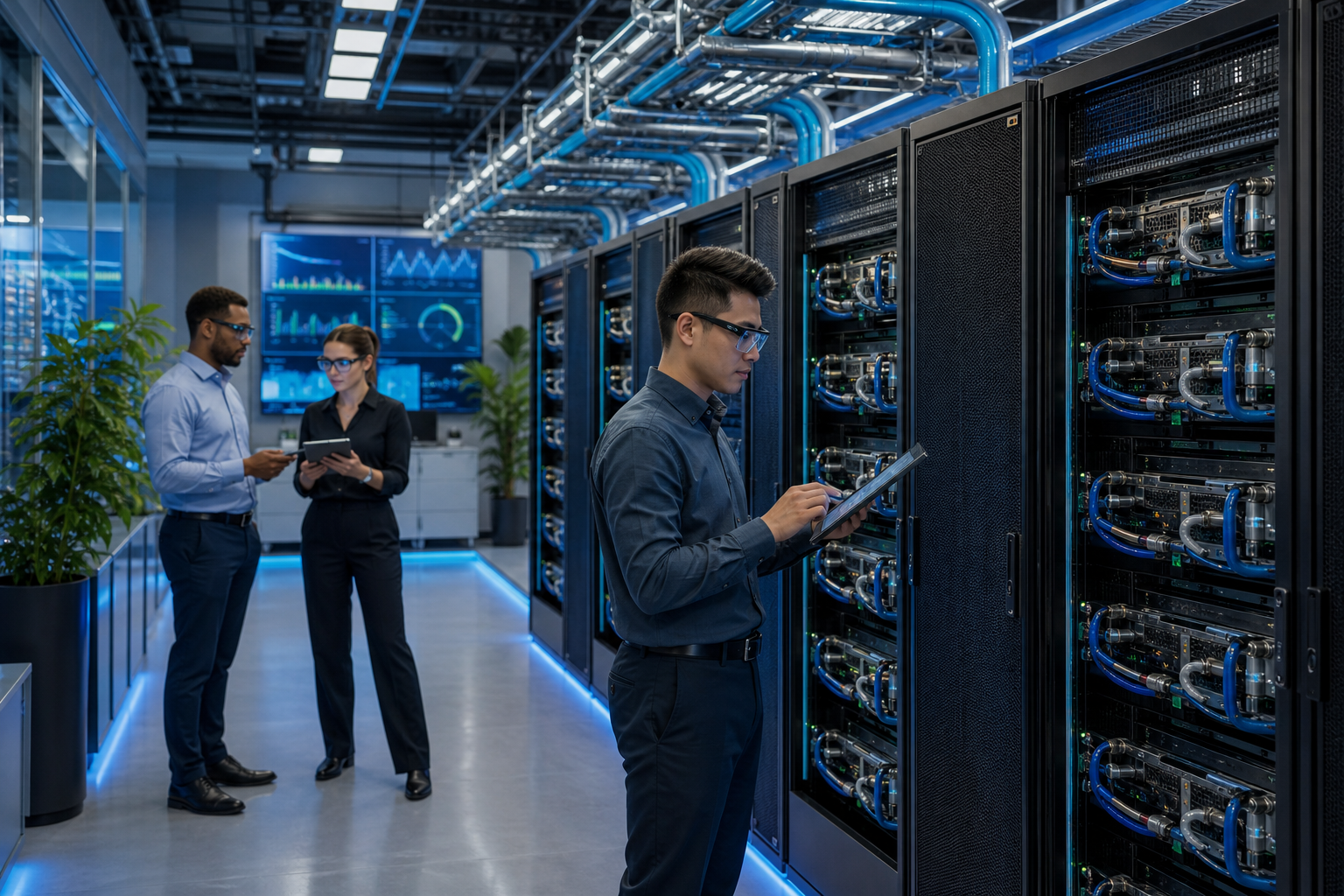
The data center accelerator market is undergoing a fundamental shift driven by the compute demands of modern AI. What were once specialized components deployed in research environments are now the operational backbone of hyperscale cloud infrastructure, enterprise AI services, and national supercomputing programs. The practical effects are already visible: AI model training times that once spanned months have been compressed to weeks or days, with direct implications for how quickly AI products reach deployment.
Because this is a pulse report rather than a traditionally sized market study, the clearest measure of momentum is investment. Amazon announced plans to invest approximately $200 billion in capital expenditures during 2026, focused on AI infrastructure, data centers, AI chips, and cloud expansion. Anthropic committed to spending more than $100 billion over the next decade on AWS infrastructure, including extensive use of Trainium AI accelerators. Microsoft announced a $30 billion investment to expand AI and cloud infrastructure across the U.K., including the construction of the nation's most powerful supercomputer with over 23,000 Nvidia GPUs. These are not speculative signals - they represent locked-in procurement and construction programs that will shape accelerator demand well into the next decade.
Six technologies are central to how this market is evolving: custom AI ASICs and purpose-built AI accelerator chips, high-bandwidth memory integration, advanced packaging technologies, AI-powered data center infrastructure management, AI-driven electronic design automation for chip design, and liquid cooling technologies for high-density accelerator deployments. Each addresses a distinct constraint - compute efficiency, memory throughput, packaging density, operational management, design speed, and thermal management - and together they define the engineering agenda for the accelerator industry.
Custom AI ASICs and Purpose-Built AI Accelerator Chips: Delivering Performance Where It Counts
Application-specific integrated circuits designed exclusively for AI workloads - such as Google's TPU family and Amazon's Trainium chips - are increasingly competing with general-purpose GPUs for share of hyperscale data center deployments. Unlike GPUs, which are designed for broad parallel compute, custom ASICs are architected around the specific mathematical operations that dominate AI training and inference, enabling substantially higher performance per watt for those tasks.
This specialization matters because energy is one of the most consequential cost factors in hyperscale operations. A chip that delivers equivalent inference throughput at lower power consumption reduces operating costs at scale and frees capacity in existing power and cooling infrastructure. For providers competing on AI service price and latency, this is a meaningful competitive lever.
• Large-scale foundation model training using purpose-built accelerator architectures optimized for matrix operations
• Generative AI inference at hyperscale, where latency and throughput targets demand hardware-level optimization
• Search algorithm optimization, as demonstrated by Google's deployment of TPUs across Search and Gemini services
• Recommendation engine processing for platforms such as YouTube, where real-time personalization requires sustained inference throughput
• Enterprise AI cloud services built on provider-specific accelerator stacks, reinforcing platform differentiation
High-Bandwidth Memory (HBM) Integration: Removing the Memory Bottleneck
High-bandwidth memory is stacked directly on or adjacent to accelerator chips using advanced packaging, enabling data transfer rates between memory and compute cores that far exceed what traditional DRAM can deliver. As AI models have grown in size and complexity, the speed at which a processor can access model weights and activations has become as important as raw compute throughput.
Without sufficient memory bandwidth, even the most capable compute cores sit idle waiting for data. HBM integration addresses this directly and has become a prerequisite for competitive GPU and AI accelerator designs. Supply chain constraints around HBM production capacity and advanced substrates are among the most closely watched bottlenecks in the accelerator ecosystem.
• Large language model training, where billions of parameters must be continuously streamed through compute pipelines
• AI inference at scale, where model weight access patterns demand sustained high-throughput memory connections
• High-performance scientific computing, including climate modeling and molecular dynamics simulations
• Generative AI workloads that require holding large model states in fast-access memory during generation
• Real-time data analytics applications that process high-volume streaming data against trained models
Advanced Packaging Technologies (2.5D, 3D Stacking, Chiplets): Pushing Density Without the Tradeoffs
Next-generation semiconductor packaging - including 2.5D interposers, 3D stacking, and chiplet architectures - allows multiple specialized dies to be integrated into a single high-density package. Rather than designing a monolithic chip that attempts to do everything, chiplet approaches let designers combine best-in-class compute, memory interface, and interconnect dies from different process nodes into one functional unit.
This matters because transistor scaling alone can no longer deliver the performance and power efficiency gains that next-generation AI workloads require. Advanced packaging expands the design space, allowing engineers to increase compute density while managing thermal output and improving manufacturing yield by using smaller, more precise dies.
• GPU and AI accelerator fabrication, where chiplet designs allow modular performance scaling
• HBM memory integration via 2.5D silicon interposer layouts that minimize communication latency between memory and compute
• Custom ASIC development for cloud providers designing proprietary AI chips at advanced nodes
• High-density server design where rack-level power and space constraints push for maximum compute per unit volume
• AI chip manufacturing yield optimization, since smaller chiplet dies achieve higher per-unit yield than large monolithic designs
AI-Powered Data Center Infrastructure Management (DCIM): Bringing Intelligence to Operations
AI-powered data center infrastructure management platforms use machine learning to monitor and optimize workloads, energy consumption, cooling systems, and resource allocation in real time. As accelerator cluster density increases and power demands escalate, manual management of these variables becomes operationally untenable. DCIM platforms provide the automation layer that makes high-density accelerator deployments manageable at scale.
Real-time cooling optimization reduces energy waste during periods of variable load. Predictive maintenance catches hardware degradation before it causes unplanned downtime during critical AI training runs. Intelligent workload scheduling ensures expensive accelerator capacity is utilized efficiently. Middle East operators are already deploying AI accelerators alongside DCIM platforms to manage energy consumption, cooling, and workload allocation simultaneously.
• Real-time workload scheduling and resource allocation across heterogeneous accelerator clusters
• Cooling system optimization that adjusts dynamically to heat loads generated by dense GPU arrays
• Power consumption management to keep facilities within grid capacity limits and sustainability targets
• Predictive maintenance that identifies failing components before they disrupt multi-week AI training jobs
• High-density accelerator cluster management in hyperscale environments where thousands of GPUs must be coordinated continuously
AI-Driven Electronic Design Automation (EDA) for Chip Design: Accelerating the Next Accelerator
AI-powered electronic design automation tools automate and optimize the design, simulation, and validation of semiconductor chips. Developing a next-generation GPU, ASIC, or FPGA involves billions of design decisions across architecture, physical layout, power delivery, and timing - a process that traditionally required years and thousands of engineering hours. AI-enhanced EDA compresses parts of this cycle by identifying optimal design configurations faster than human engineers can explore manually.
Shorter design cycles mean chip companies can respond more rapidly to evolving AI workload demands. If a new model architecture creates demand for a specific memory access pattern or precision format, an accelerator generation validated with AI-assisted EDA can reach production faster. In an industry where competitive advantage often hinges on a single chip generation, this is a structural advantage.
• GPU architecture optimization, where AI tools explore layout and routing tradeoffs across vast design spaces
• ASIC design and validation for custom AI chips under development at hyperscale providers and AI companies
• FPGA IP development for reconfigurable compute applications in telecommunications and enterprise inference
• AI processor performance tuning, identifying pipeline bottlenecks before tape-out
• Advanced packaging design verification, ensuring signal integrity and thermal performance meet specifications before manufacturing
Liquid Cooling Technologies for High-Density Accelerator Deployments: Managing Heat at Scale
Liquid-based thermal management systems dissipate heat generated by dense GPU and AI accelerator clusters more efficiently than air cooling. As racks that once drew 10 to 20 kilowatts now approach 100 kilowatts or more, conventional air cooling reaches its physical limits. Liquid cooling - whether through direct-to-chip cold plates, immersion systems, or rear-door heat exchangers - is becoming a standard infrastructure requirement rather than a niche option.
The relevance extends beyond thermal management. Microsoft's initiative to repurpose retired power stations into AI data centers is made viable in part by liquid cooling's ability to maintain operating temperatures in facilities not originally designed for high-density compute. Energy recovered from cooling loops can also support district heating programs, reinforcing the sustainability credentials that are increasingly a condition of data center permitting in Europe and elsewhere.
• Hyperscale GPU cluster cooling for facilities deploying thousands of high-density accelerator nodes
• AI supercomputer thermal management, as seen in installations such as the JUPITER system at the Julich Supercomputing Centre
• High-density enterprise data center operations where air cooling infrastructure cannot scale to required power densities
• Energy-efficient AI infrastructure programs designed to meet corporate and regulatory sustainability targets
• Repurposed power station data centers, where liquid cooling enables AI workloads in non-traditional facility formats
Where Growth Is Concentrated: Segments and Regional Leadership
Among end-user segments, cloud service providers represent the largest and most immediate demand channel. The scale of capital commitments from Amazon Web Services, Google, and Microsoft - individually exceeding tens of billions of dollars - reflects a dynamic where cloud providers function simultaneously as accelerator customers, custom chip developers, and AI service vendors. Financial services is a significant and growing segment, with institutions deploying accelerators for fraud detection, algorithmic trading, risk assessment, and real-time transaction processing. Healthcare and scientific research are active deployment environments, with the JUPITER supercomputer at the Julich Supercomputing Centre representing accelerator-based supercomputing applied to climate research, drug discovery, and engineering simulations. Telecommunications operators are expanding accelerator use for network optimization, predictive maintenance, and 5G traffic management.
Regionally, North America leads adoption, anchored by the hyperscale operations of Microsoft, Amazon, Meta, and Google. Europe is building momentum through sovereign AI infrastructure investments and sustainability-focused computing programs, with Microsoft's $30 billion U.K. commitment a prominent example. Asia-Pacific is among the fastest-growing regions, with government-led AI initiatives and hyperscale investments across China, Japan, South Korea, and India - including Google's $6 billion hyperscale campus in Visakhapatnam. Latin America, the Middle East, and Africa are at an earlier adoption stage, with smart city programs and cloud expansion driving demand, though infrastructure gaps, power constraints, and talent shortages remain significant limiting factors.
Conclusion
The data center accelerator market is being shaped by a convergence of forces that reinforce one another. The compute requirements of generative AI drive accelerator procurement, which drives investment in supporting technologies such as HBM, advanced packaging, and liquid cooling, which in turn enable denser and more capable clusters that support still-larger AI workloads. The six technologies examined here - custom ASICs, HBM integration, advanced packaging, AI-powered DCIM, AI-driven EDA, and liquid cooling - each address a distinct constraint in this cycle, and progress in any one of them expands what is achievable across the others.
For industry professionals, the investment figures already committed establish that this market is well past the validation stage. The infrastructure being built today will define the operational baseline for AI services for years. The engineering and operational questions - how to cool denser racks, how to design chips faster, how to manage thousands of accelerators efficiently, how to close the memory bandwidth gap - are the problems that organizations in this space will be solving throughout the forecast period, and the six technologies above represent where the most consequential progress is likely to emerge.
Learn More and Take Action:
Consider becoming a member of the BCC Research library and gain access to our full catalog of market research reports in your industry. Not seeing what you are looking for? We offer custom solutions too, including our new product line: Custom Intelligence Services.
Contact us today to find out more.