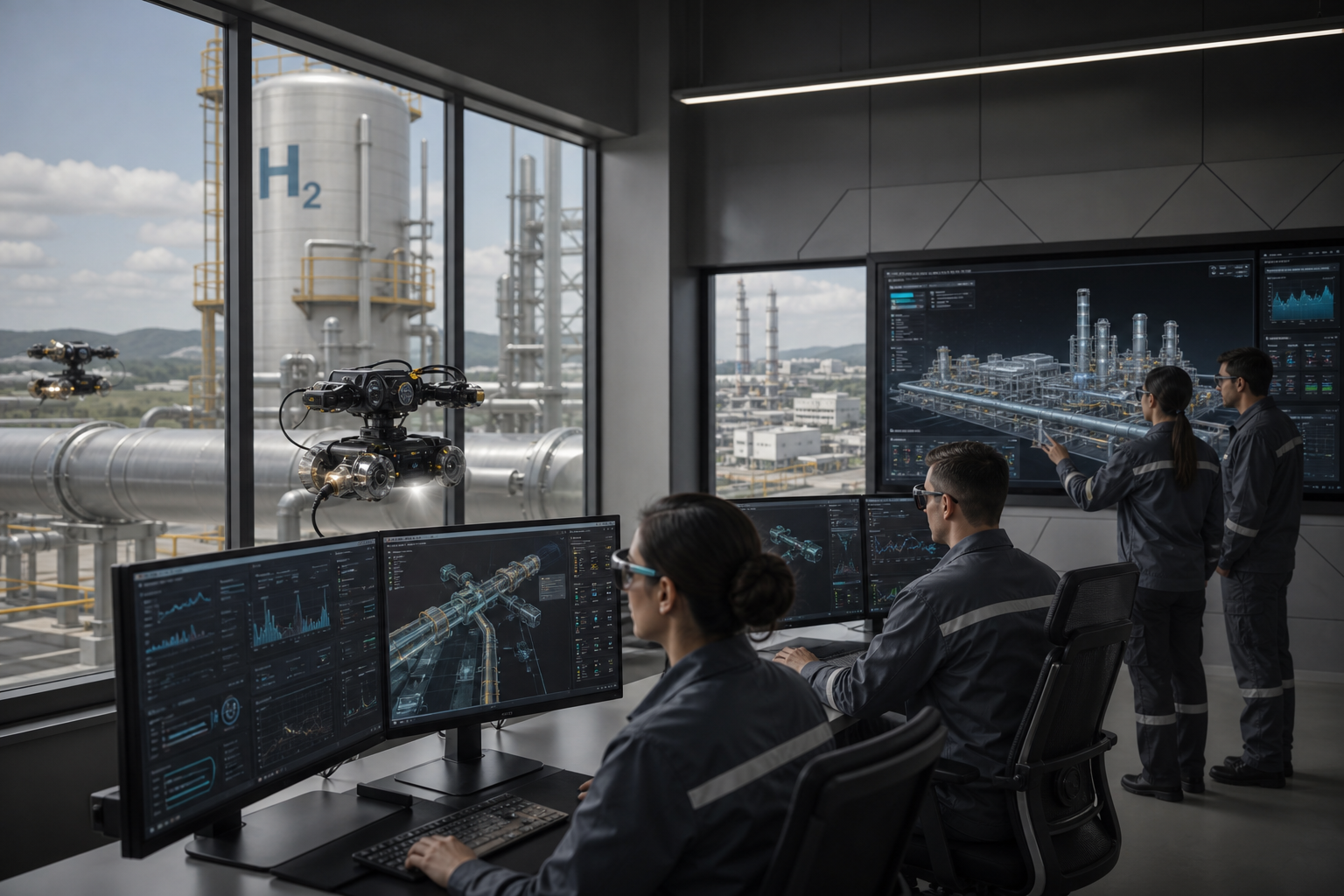
Hydrogen's role in the global energy transition has moved from theoretical to operational. Governments are funding hydrogen corridors, industrial players are scaling up electrolyzer capacity, and fuel cell vehicle infrastructure is expanding across multiple regions. As hydrogen projects multiply, so does the demand for rigorous testing, inspection, and certification — and artificial intelligence is fundamentally changing how that work gets done.
This is not a market defined by a single breakthrough. It is shaped by the convergence of several distinct technologies: predictive analytics, in-line inspection hardware, generative AI, digital twins, sensor networks, and machine learning applied to materials discovery. Together, they are shifting hydrogen TIC from periodic, calendar-based checking to continuous, data-driven assurance. The investment signals confirm the direction of travel. Intertek Group plc disclosed $346.4 million in growth investments across its TIC operations including AI in 2025. TÜV SÜD invested $173.2 million in digitalization and AI-related modernization in 2024 and reported 9.2% revenue growth after implementing OPEnAI, its largest digitalization project to date. DEKRA SE committed $143.2 million in net investments that same year, including AI initiatives and AI-enabled modeling for hydrogen pilot plants. A 2024 DNV survey found that 50% of energy organizations were preparing to implement AI within a year, and 80% believed it would deliver a profitable return within five years.
The following six technologies are the primary drivers behind this transformation, each addressing specific technical and commercial challenges in hydrogen TIC.
AI-Powered Predictive Analytics for Pipeline Inspection: Moving Beyond the Calendar
Traditional pipeline inspection programs run on fixed schedules — inspect every two years, replace on a set cycle. This approach ignores what the asset is actually doing. AI-powered predictive analytics platforms change the logic entirely by analyzing condition monitoring data continuously and forecasting when a pipeline will reach its minimum allowable wall thickness, triggering inspection only when the integrity data warrants it. Oceaneering's Inform Predict platform is a demonstrated example: by applying AI to pipeline integrity data, it safely reduced inspection scope by 44% for a national oil company while maintaining full confidence in asset safety.
• Predicting pipeline wall thickness degradation to minimum allowable levels, enabling timely intervention before failure
• Transitioning operators from calendar-based to integrity-based inspection programs that respond to actual asset condition
• Real-time integration of field inspection and integrity data via cloud-based and edge-based configurations
• Optimization of maintenance scheduling and reduction of unplanned downtime for hydrogen pipeline operators
Magnetic Flux Leakage and Geometry Inspection Tools: Closing the Coverage Gap
Hydrogen pipelines operate under physical conditions that complicate conventional inspection. Hydrogen's small molecular size enables it to permeate pipeline walls and cause embrittlement — a failure mode that natural gas infrastructure does not face to the same degree. Magnetic flux leakage (MFL) and geometry inspection tools address this by deploying in-line inspection devices that use magnetic flux leakage technology combined with AI-driven data analysis to deliver 100% sensor coverage for corrosion, cracks, and geometric anomalies. Critically, these tools can operate under non-standard pressure and flow rate conditions, which is significant given that hydrogen systems frequently run at lower-than-standard pressures.
• Detection of corrosion and material fatigue in hydrogen pipelines where embrittlement risk is elevated
• Geometry inspection for structural integrity assessment of pipeline sections
• Operation under non-standard pressure and flow rate conditions common in hydrogen transport systems
• Providing 100% sensor coverage for MFL and geometry data to support regulatory compliance and safety assurance
Generative AI for Hydrogen Plant Design and Configuration: Accelerating the Project Pipeline
Before a hydrogen facility can be inspected or certified, it has to be designed. Generative AI is entering the early project phase, where engineering decisions have the largest downstream impact on cost and risk. Siemens' Hydrogen Plant Configurator, launched in June 2024, is an AI-based chatbot that assists engineers in creating hydrogen production plant designs during the planning phase. By automating configuration choices that would otherwise require iterative manual engineering, it compresses the time between concept and construction-ready design — and every project that reaches construction becomes a TIC opportunity.
• Automated plant design for hydrogen production facilities, reducing engineering time in early project phases
• Project planning support for green hydrogen electrolysis plants, lowering barriers to project initiation
• Digital simulation of plant configurations prior to construction to identify design risks early
• Reduction of technical risk in pre-deployment phases, increasing confidence before TIC providers are engaged
Digital Twins for Hydrogen Plant Simulation: Testing Before Building
Where generative AI assists with plant design, digital twin technology takes the next step: creating a virtual replica of the plant itself. AI-enabled digital twins allow operators to simulate plant behavior, test process conditions, and identify failure modes before physical deployment begins. In the chemical industry segment, where hydrogen is produced or consumed in complex reactor environments, digital twins enable analysis of reactor performance, temperature balance, and carbon formation under varying conditions. This capability does not replace physical TIC — it raises the quality of it by identifying what needs verification before equipment is commissioned.
• Simulation of chemical hydrogen plant behavior prior to full-scale physical deployment
• Process assurance and performance verification for hydrogen chemical industry applications
• Risk reduction in advanced hydrogen pathway development by stress-testing configurations virtually
• Supporting compliance and reliability testing before plant commissioning, improving the efficiency of physical TIC processes
AI-Driven Sensor Networks for Leak Detection and Real-Time Monitoring: Continuous Assurance
Given hydrogen's physical properties — its tendency to permeate materials, its wide flammability range, and its lack of odor — leak detection is not a periodic activity. It requires continuous monitoring with hardware sensitive enough to catch deviations before they become hazards. AI-powered sensor networks meet this requirement by continuously monitoring hydrogen pipelines, storage tanks, production facilities, and refueling stations, detecting leaks, pressure deviations, temperature anomalies, and signs of corrosion with accuracy that manual inspection intervals cannot match. TÜV SÜD implemented AI models for faster detection of leaks and material fatigue in hydrogen infrastructure in 2024. The same approach applies across the value chain from pipeline distribution networks to hydrogen mobility hubs.
• Leak detection in hydrogen distribution pipelines, where undetected permeation carries significant safety and financial consequences
• Real-time monitoring of reactor pressure, temperature, hydrogen output, and carbon buildup in power generation systems
• Monitoring of hydrogen storage tankers, vessels, and refueling station infrastructure
• Detection of material fatigue in hydrogen pipelines and components subject to embrittlement
• Operational monitoring of hydrogen refueling stations to support fuel cell vehicle safety compliance
Machine Learning for Catalyst Material Discovery in Electrolyzers: Reducing the Cost of Green Hydrogen
PEM electrolyzers depend on platinum as a catalyst — effective, but expensive and supply-constrained. SOEC electrolyzers run at high temperatures that accelerate material degradation. Both factors raise the cost and frequency of TIC interventions needed to maintain operational safety and efficiency. Machine learning addresses this at the materials level: AI-driven simulations model the performance of alternative catalyst materials under varying operating conditions, accelerating the identification of substitutes that match platinum's performance at lower cost. Honeywell International launched Honeywell Protonium in April 2025, a suite of AI and ML-powered technologies designed to make green hydrogen production more efficient, cost-effective, and scalable.
• Discovery of alternative catalyst materials for PEM electrolyzers, reducing dependence on high-cost platinum
• Real-time optimization of PEM and SOEC electrolyzer operational parameters to maximize hydrogen output and minimize energy consumption
• Predictive maintenance for SOEC electrolyzer components based on AI monitoring of performance degradation patterns
• Integration optimization of electrolyzers with renewable energy sources to balance variable supply with hydrogen production demand
Where Growth Is Concentrated: Segments and Regional Dynamics
Across the five segments covered in this market — Production of Hydrogen, Supply and Distribution of Hydrogen, Transportation, Energy and Power Generation, and the Chemical Industry — AI adoption in TIC is advancing at different rates depending on infrastructure maturity and regulatory context. The energy and power generation and chemical industry segments are driving demand for continuous condition monitoring, risk-based inspection, and digital assurance services, given the complexity of reactor environments and the consequences of undetected failures. The transportation segment is generating increasing TIC requirements as hydrogen fuel cell vehicles and mobility hubs scale, creating demand for high-frequency testing of fuel quality, refueling systems, and storage units.
Regionally, Europe is currently the most advanced market for AI-integrated hydrogen TIC. Major TIC organizations including TÜV SÜD are investing heavily in digitalization, and TÜV SÜD's launch of the AI Procured platform in January 2024 reflects a broader move toward automated compliance support and smart asset monitoring. North America is at an earlier stage but moving quickly — DNV's survey data showing that 50% of energy organizations were preparing to implement AI signals accelerating readiness, and AI-driven pipeline failure prediction is particularly relevant given the scale of hydrogen transport and infrastructure projects underway. In Asia-Pacific, expansion is occurring through TIC organizations extending existing digital capabilities into hydrogen services, with TÜV Rheinland adding AI-enabled hydrogen production and certification offerings as part of broader organizational development.
Conclusion
The hydrogen TIC market is entering a period where the quality and credibility of inspection services will depend heavily on an organization's AI capabilities. The six technologies examined here — predictive analytics, MFL and geometry inspection tools, generative AI for plant design, digital twins, AI-driven sensor networks, and machine learning for catalyst discovery — address different failure modes and different phases of the hydrogen value chain, but they share a common outcome: they make TIC faster, more accurate, and more capable of keeping pace with hydrogen infrastructure that is scaling faster than traditional inspection methods can serve.
For TIC providers, the strategic implication is clear. Organizations that have already committed hundreds of millions of dollars to AI modernization — Intertek, TÜV SÜD, DEKRA — are positioning themselves to capture a growing share of a market that increasingly values data-led assurance over manual checking. For hydrogen operators, AI-powered TIC reduces costs, extends asset life, and provides the regulatory confidence needed to operate safely at scale. As the number of hydrogen projects globally continues to rise, the demand for sophisticated, AI-integrated testing, inspection, and certification services will rise with it.
Learn More and Take Action:
Consider becoming a member of the BCC Research library and gain access to our full catalog of market research reports in your industry. Not seeing what you are looking for? We offer custom solutions too, including our new product line: Custom Intelligence Services.
Contact us today to find out more.