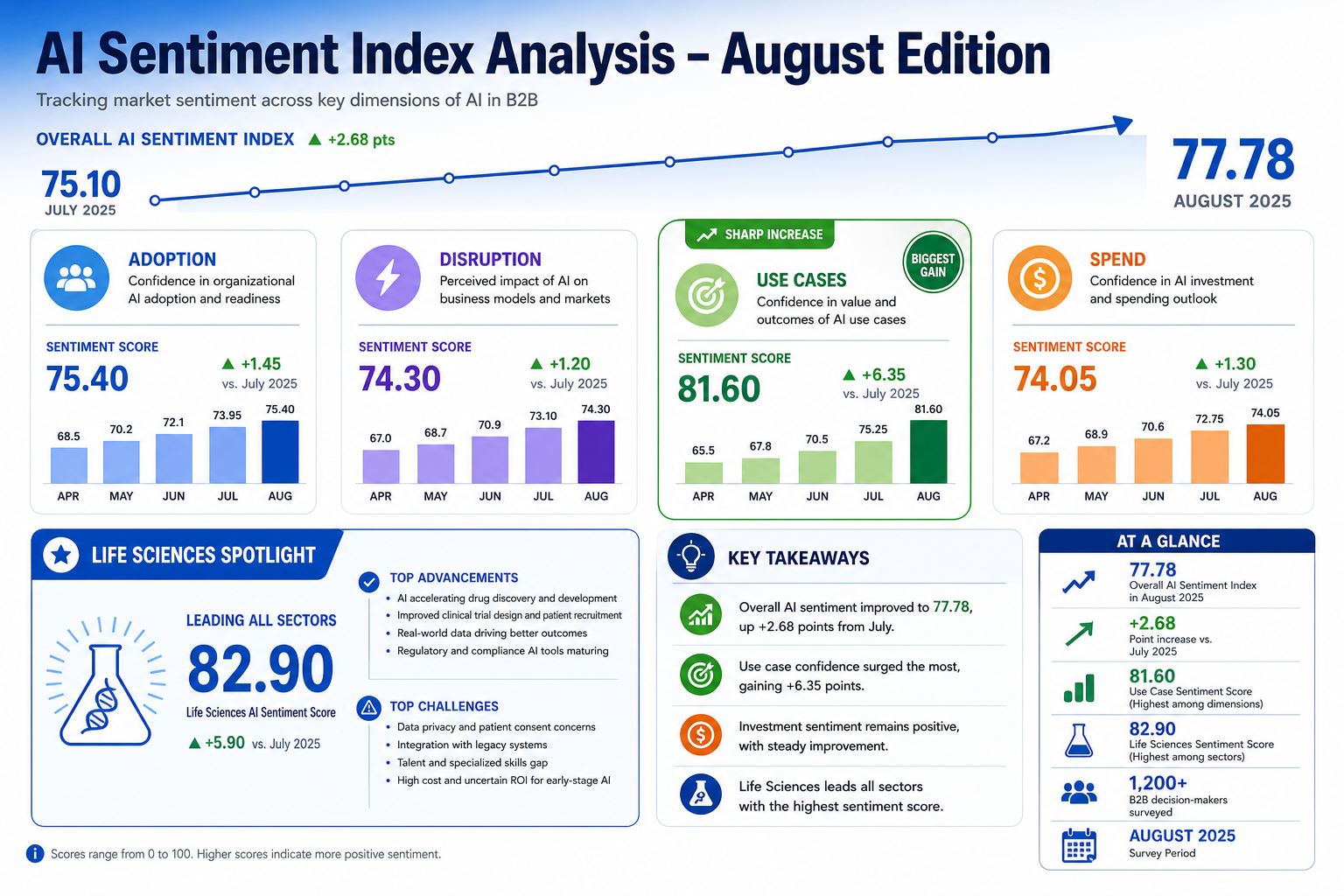
The BCC Research AI Sentiment Index is a weighted composite measure tracking how professionals across major industrial sectors assess AI's practical relevance to their operations. It captures four dimensions — adoption, disruption, use cases, and spend — aggregating responses from expert respondents spanning chemicals and energy, technology and consumer electronics, life sciences and healthcare, and advanced manufacturing. Rather than projecting market size, it measures confidence: where organizations believe AI is delivering, where it is falling short, and where capital is being deployed with conviction versus caution.
The August 2026 edition tells a relatively clear story. The overall weighted AI Sentiment Index rose to 77.78 from 75.10 in July 2026, recovering ground after a period of moderation. The sharpest movement came from use-case sentiment, which surged to 81.72 from 73.21 in July — the single largest month-on-month shift among the four dimensions. That jump suggests organizations can increasingly point to production-embedded applications rather than exploratory pilots. Adoption sentiment remained the strongest individual dimension at 80.46, only marginally below July's 81.43, while disruption sentiment rose to 74.35 from 70.23. Spend sentiment moderated slightly to 74.31 from 75.20 — indicating disciplined allocation rather than retreat.
The index draws on approximately 42 expert respondents, with analysts and verified subscribers carrying greater weight in the composite to preserve statistical integrity. What follows examines what is genuinely working in enterprise AI adoption and what continues to constrain it.
The Benefits
Shift to Practical, Production-Oriented AI Deployment
Organizations are no longer evaluating AI on theoretical promise. They are deploying it where it can demonstrate improvement in efficiency, quality, reliability, or decision-making — and pulling back where it cannot. This selectivity drove use-case sentiment to its August high of 81.72. Confidence rises when deployments are connected to operational proof, and the data suggest this is increasingly the case across all four sectors.
This transition also changes how AI is justified internally. Capital allocation follows demonstrated performance rather than strategic enthusiasm, and that discipline reinforces rather than undermines sentiment. When an application earns its place in production workflows, the confidence it generates is harder to reverse.
AI Competitive Differentiation in Chemicals and Energy
Chemicals and energy recorded the largest increase in disruption sentiment of any sector, reaching 81.56 in August — the highest disruption score across all industries. Companies in this sector are treating AI not as an operational improvement tool but as a competitive differentiator: a means of lowering operating costs, tightening process control, and accelerating materials or product development relative to peers who have not made equivalent investments.
When AI is positioned as a differentiator rather than a cost center, the urgency and scale of commitment tend to increase. In chemicals and energy, where margins are sensitive to process efficiency and reliability has direct safety implications, that framing is grounded in operational reality.
Mature Digital Infrastructure in Technology Sector
Technology and consumer electronics led all sectors in both adoption and spend sentiment, each scoring 84.38 in August. This reflects a foundation that other sectors are still building: deeply embedded AI across edge computing, cybersecurity, software development, and intelligent infrastructure. In this sector, AI is core infrastructure, and spending is oriented toward scaling what already works rather than justifying new investment categories.
The maturity of this foundation sustains high sentiment even as individual scores normalize. The technology sector's August results illustrate what a post-experimentation AI environment looks like when the underlying data and systems architecture is sufficiently advanced.
Expanding Life Sciences AI Applications
Life sciences and healthcare recorded the strongest industry-level improvement in the August index, with use-case sentiment reaching 86.54 — the highest of any sector. This was driven by expanding AI applications in image analysis, biomarker discovery, patient stratification, medication adherence, and drug discovery. These are technically demanding, data-intensive areas where AI's ability to process and pattern-match at scale provides a genuine productivity advantage over manual methods.
A score of 86.54 reflects operational confidence in specific, well-defined applications rather than general enthusiasm. Professionals in this field who are skeptical of overstated AI claims appear to be finding real value in a defined set of research and clinical support workflows.
Predictive Maintenance and Automated Inspection in Manufacturing
Advanced manufacturing's August sentiment reflects the growing footprint of AI in two concrete application areas: predictive maintenance and automated optical inspection. AI-enabled predictive control, defect detection, and intelligent equipment management connect directly to measurable improvements in uptime and asset performance — outcomes that plant operators and finance teams can evaluate without ambiguity.
These applications are appealing because the value proposition is well-contained. A system that reduces unplanned downtime or improves defect detection rates produces evidence that justifies continued investment. In a sector where ROI scrutiny is high, that directness is an advantage.
The Challenges
Data Quality and Plant Digitization Gaps
AI's ability to scale depends on the quality and consistency of the data feeding it. In chemicals, energy, and manufacturing, uneven instrumentation and analytics capabilities across facilities mean that a use case proven in one plant cannot necessarily be replicated at another. Some operations still rely on conventional processes with limited integrated data infrastructure, and no model sophistication compensates for absent or unreliable sensor data.
Retrofitting legacy industrial facilities with modern instrumentation is capital-intensive and operationally disruptive. Until digitization is more uniformly distributed across sites, AI adoption will remain patchy, and sector-wide scores will continue to reflect the gap between leaders and laggards.
Integration Complexity and Infrastructure Costs
Connecting AI with existing IT stacks, governance processes, security controls, and operational technology requires investment in high-density computing, specialized cooling, and experienced integration teams — resources that are not uniformly available. Even where the operational value of AI is clear, the path from proof-of-concept to production deployment is long and expensive.
This challenge is systemic rather than sector-specific. Integration complexity constrains adoption timelines across all four sectors and helps explain why adoption sentiment, while the strongest individual dimension at 80.46, remains below use-case confidence. Organizations believe in the applications more readily than they can deploy them at scale.
Biological Validation and Clinical Accountability Constraints
Life sciences and healthcare present a structural challenge: AI cannot bypass the regulatory, scientific, and ethical requirements governing clinical and pharmaceutical contexts. A model that identifies a biomarker or proposes a drug candidate still requires experimental validation, peer review, regulatory submission, and clinical accountability before its outputs can influence patient care at scale.
This constraint is reflected directly in the sector's disruption score of 65.38 — the lowest of any sector in August, and notably lower than its use-case score of 86.54. Professionals in this field are confident that AI improves research productivity; they are considerably less confident that it transforms the sector systemically, because transformation requires clearing hurdles AI does not control.
Uneven Implementation Maturity Across Sub-sectors
AI-driven advantages concentrate among larger organizations with stronger data infrastructure, greater automation foundations, and the technical capacity to manage complex deployments. Smaller operators and capital-intensive facilities face proportionally higher barriers — integration costs are relatively larger, implementation expertise is harder to access, and the margin for absorbing a failed pilot is narrower.
Sector-level sentiment scores can therefore be misleading if read as uniform assessments. A high adoption score reflects the experience of well-positioned operators; it does not capture the substantial portion of each sector that has not yet reached the starting conditions AI deployment requires.
Uncertain ROI and Pilot-Stage Limitations in Manufacturing
Advanced manufacturing's spend sentiment of 70.19 — the lowest among sectors — reflects the reality that many applications remain in pilot or early deployment stages. Integration costs, compatibility with existing automation systems, and uncertain return on investment continue to slow the transition from controlled testing to full-scale deployment.
The challenge is not that manufacturing organizations are unconvinced by the concept. Predictive maintenance and automated inspection are well-understood and demonstrably valuable. The problem is that the path from a successful pilot to enterprise-wide deployment involves technical, financial, and organizational complexity that takes time to resolve. Until ROI is consistently demonstrated at scale, spend sentiment will remain constrained.
SCADA, IoT, and Infrastructure Dependencies in Industrial Settings
Many industrial AI applications depend on modernized control infrastructure — specifically Supervisory Control and Data Acquisition systems and IoT integration — to function as designed. Operators who have not yet upgraded core control systems face a layered implementation problem: they must invest in foundational infrastructure before AI applications can deliver value, effectively doubling the investment required to reach operational benefit.
This sequencing problem has no shortcut. AI readiness in industrial environments is contingent on the physical and digital control architecture underneath it, and for operators running older SCADA environments, the barrier to entry exceeds the cost of the AI application itself.
Governance, Security, and ROI Scrutiny in Technology Sector
Even in the sector with the strongest adoption and spend sentiment, pressure is building. Technology and consumer electronics organizations are applying greater scrutiny to integration costs, security implications, and ROI, and spending is shifting toward platforms capable of scaling reliably rather than toward continued experimentation.
Governance and security concerns are not peripheral here — they are central to how technology organizations evaluate AI platforms. A system that performs well but introduces supply chain risk, data exposure, or compliance complexity will face internal resistance regardless of its operational capabilities. As AI becomes core infrastructure, the standards applied to it rise accordingly.
Weighing the Two Sides
The August 2026 AI Sentiment Index presents a picture of genuine but uneven progress. The overall index rising to 77.78 from 75.10 is meaningful partly because the improvement is distributed across all four dimensions. The surge in use-case sentiment is the most important signal: it reflects confidence in specific, operational deployments rather than aspirational plans — a qualitatively different and more durable kind of confidence.
The challenges, however, are structural rather than temporary. Data quality gaps, infrastructure dependencies, validation requirements, and uneven implementation maturity are not resolved by better models or more compelling vendor propositions. They require capital investment, organizational change, and in some cases regulatory evolution. Spend sentiment's moderation to 74.31 — combined with manufacturing's sector score of 70.19 — suggests organizations are choosing carefully rather than committing broadly. That is rational, but it is also a constraint on the pace of transformation. The balance currently sits toward cautious optimism: confidence is rising, but the conditions for uniform, sector-wide transformation are not yet in place.
Conclusion
The August 2026 AI Sentiment Index captures a market becoming more selective, more evidence-driven, and in key respects more confident. The shift from broad experimentation to production-embedded deployment is real, and sectors like life sciences and chemicals and energy are demonstrating that AI can deliver measurable value when applied to well-defined problems. The overall index improvement from 75.10 to 77.78 in a single month reflects that confidence finding firmer ground.
What the index also makes clear is that the obstacles to broader transformation are not primarily about AI capability. They are about the conditions under which AI operates: data infrastructure, integration architecture, regulatory accountability, demonstrated ROI, and the uneven distribution of technical capacity across organizations and facilities. Progress on those fronts will determine whether August's sentiment gains develop into durable structural improvement or remain concentrated among the organizations already best positioned to benefit.
Learn More and Take Action:
Consider becoming a member of the BCC Research library and gain access to our full catalog of market research reports in your industry. Not seeing what you are looking for? We offer custom solutions too, including our new product line: Custom Intelligence Services.