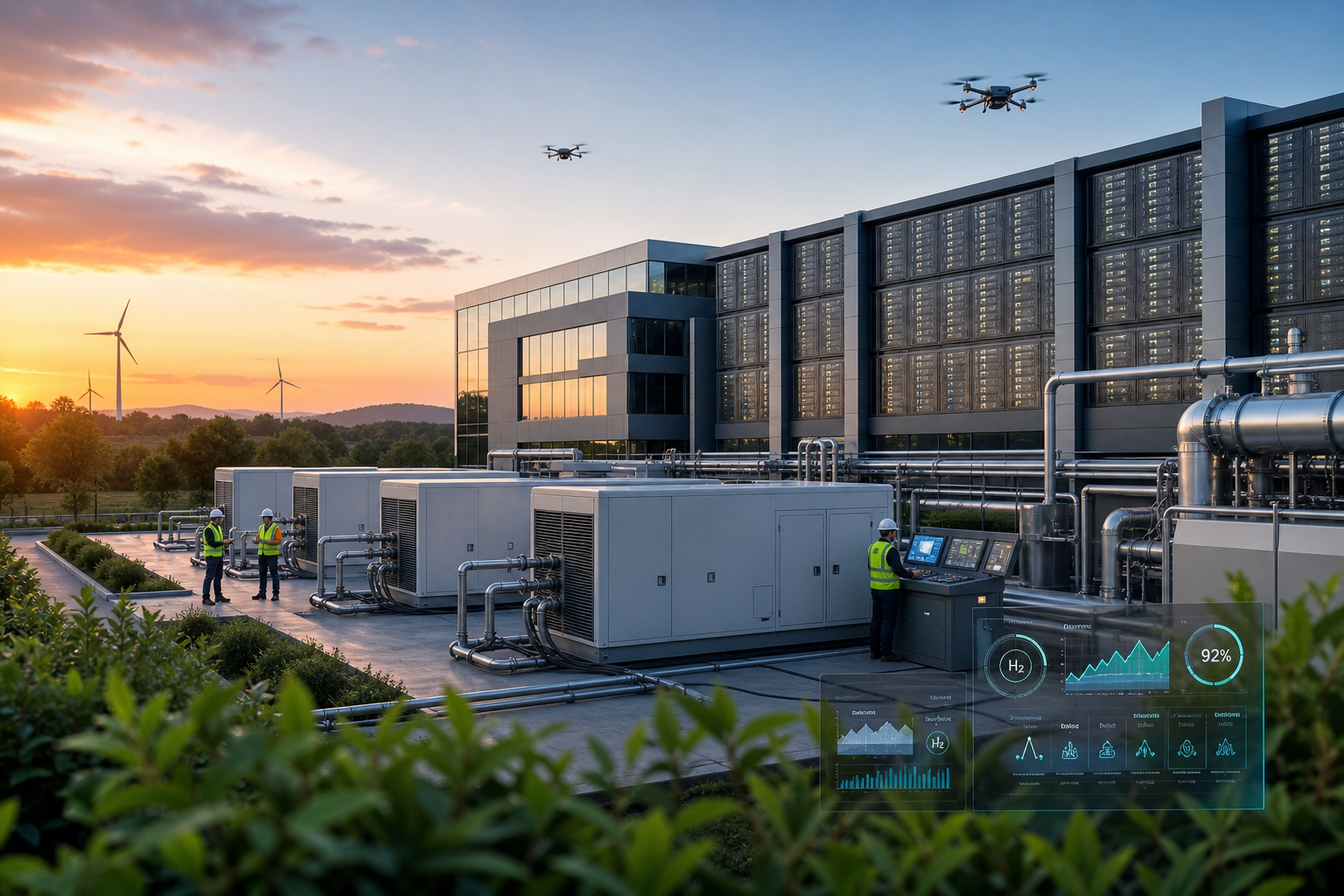
Hydrogen fuel cells have existed as a technology for well over a century, but their intersection with artificial intelligence is a story that begins in earnest only in the early 2020s. Today that convergence is reshaping how fuel cells are designed, manufactured, tested, operated, and deployed — across applications ranging from heavy-duty transport to the power-hungry data centers driving the global AI boom. Hyperscalers are expected to spend $700 billion on capital expenditure in 2026 alone, and committed clean hydrogen investments in 2025 stood at $110 billion across 510 projects. This article traces how the AI-hydrogen fuel cell relationship reached this point, milestone by milestone.
The path from isolated laboratory experiments to billion-dollar infrastructure partnerships spans just a few years, but it reflects a collision of forces: surging data center power demand, maturing AI toolsets, government funding commitments, and a fuel cell industry under pressure to reduce cost and accelerate validation. Understanding how those forces came together explains why industry participants, governments, and investors are now moving so quickly.
2022: The First Real-World Test
The modern chapter begins with a specific moment in 2022, when Microsoft partnered with Plug Power to test a hydrogen fuel cell server rack inside one of its data centers. The test ran for 48 hours and demonstrated that fuel cells could function as viable on-site power sources for digital infrastructure. Plug Power also developed a 3-megawatt fuel cell system designed specifically for data center applications, signaling that the technology was being taken seriously beyond backup power.
Data centers are voracious, continuous power consumers, and grid constraints were already emerging as a structural problem for hyperscalers planning rapid expansion to support AI workloads. A fuel cell system deployable on-site, independent of an overburdened electricity grid, addressed a real operational problem. The 48-hour test planted a seed that would grow considerably over the following three years.
2023: AI Enters the Fuel Cell Laboratory
If 2022 established that fuel cells could power data centers, 2023 established that AI could make fuel cells smarter. Two developments defined this period, pointing in different directions but converging on the same idea: AI toolsets could accelerate what had previously been slow and expensive processes.
FuelCell Energy and IBM collaborated to integrate Foundation Models — a class of generative AI — directly into fuel cell systems, producing a data-based digital twin capable of analyzing operating parameters and enabling performance improvements. For an industry where stack validation is a recognized bottleneck, the ability to monitor and predict degradation without physical testing cycles was significant. In parallel, the Korea Research Institute of Standards and Science developed DYnet++, a deep learning tool for real-time three-dimensional detection of micro defects on fuel cell surfaces during production. Quality inspection had long relied on methods too slow or imprecise to catch microcracks and surface scratches on metal separators. DYnet++ demonstrated that deep learning could perform this inspection in a single shot, in real time, without interrupting the production line. Together, these milestones defined what AI could contribute beyond simply powering the servers that run AI models: compressing R&D timelines and raising manufacturing quality simultaneously.
2024: Regulation, Scale, and Regional Signals
By 2024, signals from governments and large utilities were becoming hard to ignore. AEP Ohio signed an initial agreement with Bloom Energy for 100 megawatts of solid oxide fuel cells — a notable utility-scale procurement that would later expand dramatically. June 2024 brought the launch of the EU AI Act, the first comprehensive regulatory framework for high-risk AI applications, explicitly including critical energy infrastructure. For the hydrogen fuel cell sector, this created a defined compliance environment across Europe that encouraged structured AI integration rather than ad hoc experimentation, reinforcing momentum already building under REPowerEU and the European Green Deal.
Also in 2024, Microsoft partnered with UAE-based G42 to invest $1.5 billion in co-developing advanced AI solutions across the Middle East, Africa, and Central Asia — extending the AI-energy relationship into markets where hydrogen infrastructure was still nascent. The global public energy R&D budget reached approximately $55 billion that year, with 78% directed toward low-carbon technologies. Europe and China each contributed close to $17 billion; North America contributed $13 billion. This level of public funding was accelerating the technology base on which AI-hydrogen integration depended.
2025: Infrastructure Commitments at Scale
The pace of commitment accelerated markedly in 2025, with partnerships moving from pilot scale to infrastructure scale. AEP Ohio launched a live on-site fuel cell power generation project for AWS and Cologix data centers using natural gas-powered solid oxide fuel cells — a transition from agreement to operation demonstrating commercial readiness. Bloom Energy and Brookfield Corp. entered a $5 billion strategic partnership positioned explicitly as the first phase of a joint AI infrastructure vision, framing hydrogen fuel cells as AI infrastructure rather than simply clean energy.
Caterpillar, Microsoft, and Ballard Power Systems jointly developed a 1.5-megawatt hydrogen fuel cell and battery microgrid solution providing simulated 48-hour backup power at Microsoft's Cheyenne, Wyoming data center — building on the 2022 test with far greater capacity and a broader industrial consortium. S-Fuelcell announced planned deployment of its Grid-Free, On-Site modular proton-exchange membrane fuel cell platform across AI data centers globally. The 90-day deployment timeline for these systems, compared to 12 to 36 months for conventional alternatives, was becoming a primary selling point as hyperscalers faced acute grid connection constraints. ABB made a strategic minority investment in Edgecom Energy, a Canada-based AI-driven energy management startup, and Oracle signed a $30 billion cloud service agreement expected to drive investment in hydrogen fuel cells as its infrastructure requirements scale toward 2028. KPMG China and the International Hydrogen Fuel Cell Association launched a research project exploring AI applications across the hydrogen industry — a sign that professional services, not just technology companies, were beginning to formalize this relationship.
2026: Gigawatt Deals and Generative AI Breakthroughs
The events of 2026 represent the clearest evidence of how far this convergence has traveled. AEP Ohio executed an expanded deal with Bloom Energy for 1,000 megawatts of solid oxide fuel cells — a 900-megawatt expansion of its 2024 agreement — aimed explicitly at meeting hyperscaler data center energy demand. Bloom Energy then entered a strategic partnership with Oracle to deploy 2.8 gigawatts of fuel cell capacity across Oracle projects in the United States. In European transport, Volvo Trucks expanded testing of the H2Accelerate TRUCKS project in January 2026, with Scania, Hyundai Hydrogen Mobility Germany, and Hyliko joining the consortium to target 125 fuel cell trucks deployed across Europe by year-end.
On the materials science side, research led by Associate Professor Atsushi Ishikawa at the Institute of Science Tokyo combined atomistic simulations with a conditional variational autoencoder to autonomously design platinum-nickel catalyst structures with improved oxygen reduction reaction activity — applying generative AI to one of the most persistent technical barriers in proton-exchange membrane fuel cells. In May 2026, Acerta AI announced that its machine learning solution had reduced end-of-line testing time for hydrogen fuel cell stacks by 76%, from more than two hours to between 15 and 30 minutes. For fuel cell manufacturers, that is not an incremental improvement — it changes the economics and timelines of product development in a meaningful way.
The Market Today: Investment Scale and Segment Dynamics
This market does not yet resolve to a single global revenue figure in the conventional sense — the AI-hydrogen fuel cell intersection is still being defined as an investment and deployment category. What can be stated clearly is the scale of demand and the trajectory driving it.
The U.S. Department of Energy forecasts that energy demand from data centers could triple by 2028, from 176 terawatt-hours in 2023 to above 325 terawatt-hours. According to EPRI, data centers may consume up to 9% of U.S. electricity generation annually. Bloom Energy's own data indicates that 61% of data center operators already use on-site power as a primary choice, and 80% of utilities view on-site power as long-term infrastructure.
By segment, stationary applications — particularly data center power — are where AI-hydrogen integration is most advanced and most heavily capitalized. Transport is advancing through predictive maintenance, route optimization, and heavy-duty vehicle deployments, particularly in Europe. Portable applications, including military UAVs and drone operations, represent a smaller but growing frontier. Regionally, Asia-Pacific leads in generative AI investment intensity — 26% of APAC companies invest between $400,000 and $500,000 in generative AI, compared to 19% in North America and 17% in Europe — while North America holds the hyperscaler concentration driving data center demand, and Europe sets the regulatory framework governing how AI integration proceeds.
Where the Market Goes Next
The emerging technologies now entering commercial deployment point toward several near-term developments. Digital twin simulation and predictive degradation modeling will continue compressing stack validation timelines. Generative AI for materials discovery — as demonstrated in the Tokyo Institute research — is expected to reduce reliance on pure platinum catalysts, addressing cost barriers that have limited proton-exchange membrane fuel cell commercialization. Grid-Free, On-Site modular PEMFC platforms are positioned for rapid scaling as hyperscalers continue to outpace grid connection timelines; the 90-day deployment advantage is a structural differentiator that becomes more valuable as data center build rates accelerate.
AI-powered quality inspection tools will continue moving into manufacturing lines, reducing defect rates and improving component durability at scale. Across transport, AI-driven route planning, fueling station demand forecasting, and fuel leakage detection will extend operational intelligence across hydrogen-powered fleets as they grow in Europe and Asia-Pacific. South America and the Middle East and Africa are early-stage markets today, but the conditions for acceleration are forming — renewable energy potential attracting international companies in South America, and large-scale AI infrastructure partnerships building the foundational layer in MEA.
Conclusion
The AI-hydrogen fuel cell story is unusually compressed in time. From Microsoft and Plug Power's 48-hour data center test in 2022 to gigawatt-scale procurement deals and generative AI catalyst design in 2026, the pace of development reflects two industries finding that their needs align precisely. AI infrastructure creates power demand that strains conventional grids; hydrogen fuel cells offer fast-deployable, on-site, low-carbon power. AI toolsets simultaneously make fuel cells cheaper to validate, easier to manufacture with quality, and more effective to operate. That symmetry — AI needing fuel cells, and fuel cells needing AI — is the structural reason why investment at this intersection has moved from proof-of-concept to infrastructure-scale commitments in under four years.
The challenges that remain — high costs, lengthy validation cycles, limited expertise in developing markets, and the difficulty of catalyst design — are real, but they are also precisely the problems that AI is being deployed to solve. The trajectory established between 2022 and 2026 suggests the pace of progress at this intersection will not slow in the near term.
Learn More and Take Action:
Consider becoming a member of the BCC Research library and gain access to our full catalog of market research reports in your industry. Not seeing what you are looking for? We offer custom solutions too, including our new product line: Custom Intelligence Services.