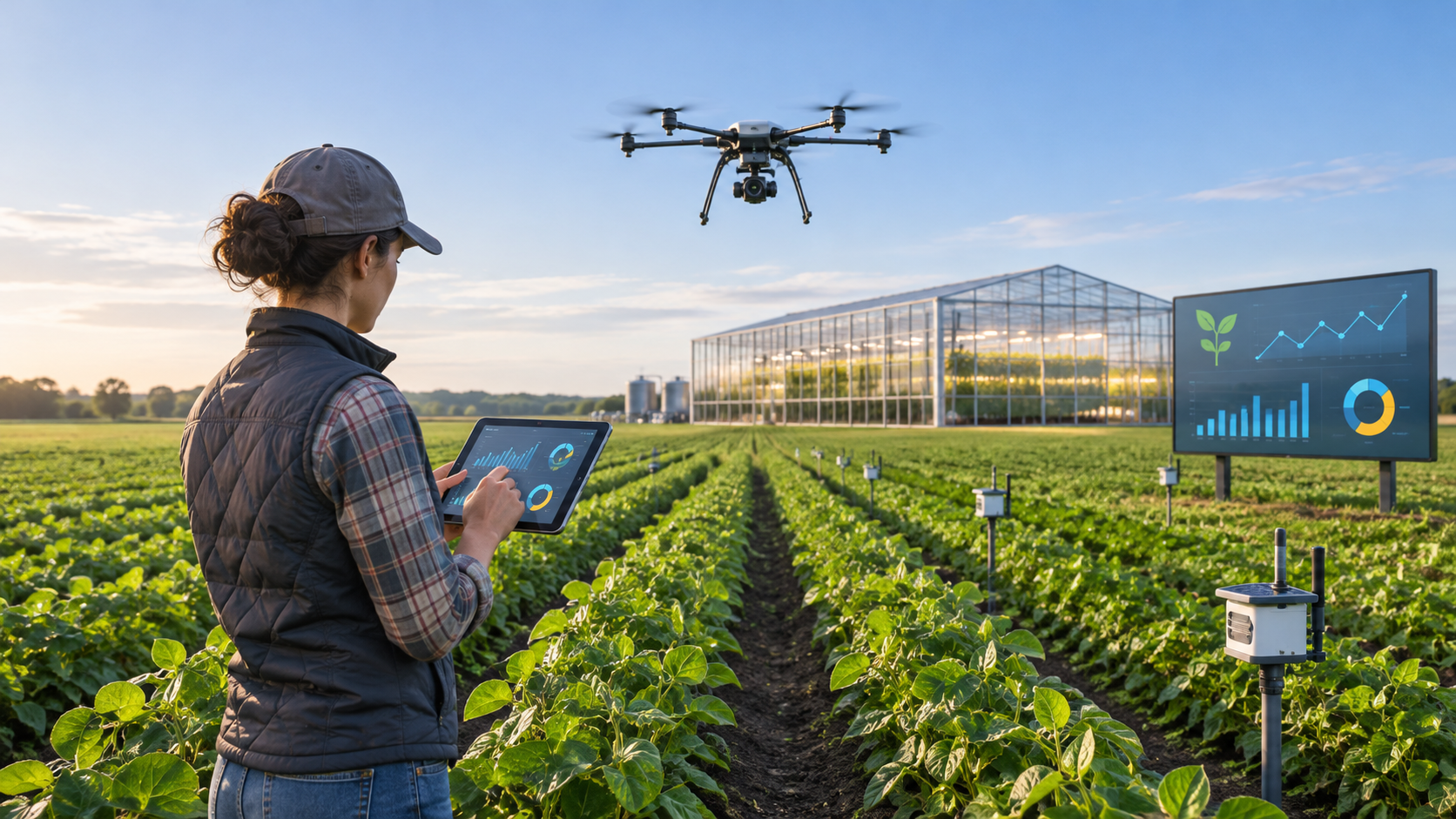
Agricultural biotechnology has long driven advances in crop genetics, disease resistance, and farm inputs. Artificial intelligence is now changing how those advances are made, replacing observation-based trial and error with data-driven prediction, automation, and precision at a previously impractical scale. AI is being applied across the full biotechnology stack, from genomic analysis in seed breeding and microbial discovery in biologicals to laboratory automation in research tools and vaccine design for livestock.
The attention this convergence is attracting is substantial:
• Venture capital: Investments in AI-focused agri-tech startups exceeded $6 billion in 2022 alone.
• Inari: One of the most prominent AI-powered seed design companies, it has raised more than $720 million in total funding.
• Greeneye Technology: The company secured $20 million in 2024 to scale precision spraying systems capable of reducing herbicide use by up to 87%.
• Governments: India's Digital Agriculture Mission carries an investment of approximately $338 million, the EU-funded AGROBOOST project is deploying robotics and AI across European farms, and the USDA has established a dedicated AI strategy for 2025 to 2026.
BCC Research's report, AI Impact on Agricultural Biotechnology, examines this intersection across four segments: biotech seeds, biologicals, biotechnology tools, and other products, including livestock vaccines and feed enzymes. It also covers all major global regions. The report is qualitative and pulse-oriented, designed to map the direction and pace of AI adoption rather than provide traditional market sizing. The picture that emerges is one of genuine, accelerating opportunity, tempered by structural constraints that will slow progress in important parts of the market.
The Benefits
Rising Global Food Demand Creates a Clear Purpose for AI
The fundamental pressure behind AI adoption in agricultural biotechnology is straightforward: the world's population is growing, arable land is finite, and yield improvements from conventional breeding are becoming harder to achieve incrementally. AI addresses this directly:
• Biotech seeds: Large-scale genomic analysis and predictive trait selection let breeders evaluate millions of genetic combinations before committing to a single field trial, compressing development timelines.
• Biologicals: AI accelerates microbial strain discovery for biopesticides and biofertilizers, enabling more targeted alternatives to synthetic inputs.
• Farm-level returns: AI-driven farming has been shown to increase crop yields by up to 30% and reduce input costs by 15% to 20%, a measurable return on investment.
When the core problem is feeding more people with fewer resources, AI's ability to do more with existing biological systems is a structural fit, not a novelty.
Government Funding Is Actively Lowering Adoption Barriers
Public investment is helping move AI agricultural biotechnology from research settings into commercial deployment:
• North America: The USDA's FY2025–2026 AI Strategy provides institutional backing for precision agriculture and biotechnology integration.
• India: The Digital Agriculture Mission, with approximately $233 million in central government funding, is building the data infrastructure needed to support AI applications across one of the world's largest agricultural economies.
• European Union: The AGROBOOST project is deploying AI, robotics, and augmented reality across European farms with a €6.5 million budget.
These programs do more than provide capital. They establish standards, build digital infrastructure, and signal regulatory legitimacy, each of which reduces friction for private adopters evaluating AI solutions.
Venture Capital Is Compressing the Innovation Cycle
Private investment is accelerating development timelines in ways that government programs alone cannot. Funding rounds in this space have grown in both size and technical specificity:
• Wild Bio: $60 million in 2025 for AI-driven precision breeding.
• Resurrect Bio: $10.3 million, led by Corteva Catalyst, for gene-edited crop disease resistance.
• Cropin: $14 million from Google and other investors to expand its AI-powered global agriculture platform.
• Cytotrait: $3.8 million for organelle-level gene editing.
This capital enables companies to move from proof of concept to commercial scale, attract scientific talent, and build the data pipelines that make AI models progressively more accurate. The result is a competitive ecosystem in which multiple platforms advance in parallel, increasing the likelihood that several technical approaches reach commercial viability within the current decade.
Measurable Farm Economics Drive Adoption
A clear financial case is among the most durable drivers of technology adoption, and AI in agricultural biotechnology provides one:
• Precision spraying: Real-time AI weed detection, such as the systems deployed by Greeneye Technology, reduces herbicide use by up to 87%, directly cutting one of farming's major variable costs.
• Targeted fungicide application: Tools that combine aerial imagery and weather data, such as SpraySense by Kelly Hills, enable targeted application rather than blanket coverage, reducing waste while maintaining crop protection outcomes.
• Breeding efficiency: AI-enabled genotype-environment interaction modeling reduces the number of field trials required to identify high-performing varieties.
For agribusinesses operating at scale, a 15% to 20% reduction in input costs across large acreages creates competitive margin differences and sustained demand for AI-based solutions.
Labor Shortages Are Pushing Automation Up the Priority List
Agricultural labor availability is declining in many major producing regions. The tasks most affected, including crop monitoring, pest detection, precision spraying, and harvest operations, are precisely those where AI and robotics offer functional alternatives.
The AGROBOOST project explicitly targets labor automation as a core objective, deploying AI and robotics to modernize agriculture and improve worker safety across European farms. Aerobotics has demonstrated AI-enabled crop monitoring tools in data-limited African environments where trained agronomists are particularly scarce. Because labor scarcity is not a cyclical problem, demand for AI-enabled automation is durable and structural.
Climate Variability Is Creating Urgency Around Trait Development
Climate change is introducing patterns of drought, heat stress, flooding, and pest pressure that conventional breeding programs, built around historical climate envelopes, are not designed to address at speed. AI changes the development economics:
• Inari's SEEDesign platform: Uses predictive AI and multiplex gene editing to develop high-yield, climate-resilient soybean, corn, and wheat seeds, reportedly accelerating breeding by up to five times compared with conventional approaches.
• Resurrect Bio's FloraFold platform: Uses deep learning to restore natural plant immunity against pathogens including soybean cyst nematode and late blight.
• Genotype-environment interaction modeling: Allows breeders to identify traits that perform consistently across projected climate scenarios rather than optimizing for a single historical baseline.
That capability becomes more valuable as extreme weather events grow more frequent.
The Challenges
Data Governance Is Constraining the European Market
Europe has genuine institutional commitment to digital agriculture, but its regulatory environment governing data use is among the most restrictive in the world. The General Data Protection Regulation and the EU AI Act impose compliance requirements on the collection, processing, and use of large-scale agricultural datasets, the very datasets needed to train and improve AI models.
Responsible AI deployment frameworks must be established before large-scale data integration can proceed, and the compliance overhead can slow integration timelines considerably. This is not a problem that can be engineered around. It requires legal and governance work that is time-consuming regardless of technical capability. For companies operating across European markets, data governance is a genuine constraint on how quickly AI agricultural biotechnology solutions can scale.
Digital Infrastructure Gaps Exclude Large Parts of the World
The practical requirements for AI-powered precision agriculture, including reliable connectivity, GPS coverage, cloud computing access, and compatible farm equipment, remain unavailable or unevenly distributed across much of Latin America, Africa, and parts of Asia. Even where demand for improved productivity is highest, the infrastructure needed to support AI deployment is often absent.
Aerobotics has worked to adapt AI-enabled tools for data-limited African environments, which shows the gap is recognized. But adaptations have limits: real-time AI systems that depend on continuous data transmission or cloud-based model inference cannot function without supporting network infrastructure. International collaborations and government programs are working to close this gap, but the timeline is measured in years and coverage will remain uneven. The addressable market is therefore limited precisely in the regions where food security pressures are most acute.
Pathogens and Pests Evolve Faster Than Solutions Can Be Deployed
A fundamental biological challenge facing AI-assisted crop protection and livestock vaccine development is that the targets are not static. Viruses mutate, pests develop resistance, and pathogen populations shift in response to selection pressure.
Research at Iowa State University using AI-driven computational structural biology is focused on predicting how the PRRS virus may evolve to evade immune defenses and on developing multi-epitope vaccines capable of protecting against multiple future variants. This illustrates the nature of the problem rather than resolving it: staying ahead of pathogen evolution requires continuous R&D investment, repeated model retraining, and iterative product development. AI accelerates this cycle but cannot eliminate it.
Companies developing biopesticides, crop protection biologicals, and livestock vaccines must treat ongoing adaptation as a permanent operating cost, not a one-time development expense.
AI Adoption Rates Among Farms Remain Low
Despite the volume of investment and the availability of AI-powered tools, actual adoption on farms remains limited. Approximately 15% to 20% of large U.S. farms have adopted AI technologies, and adoption among smaller operations is lower still. The barriers are multiple:
• Upfront cost of AI-compatible equipment
• Digital literacy requirements
• Uncertainty about return on investment without local demonstration data
• Risk aversion among operators whose livelihoods depend on harvest outcomes
This adoption gap matters because many AI solutions improve with scale: more farm data improves model performance, and commercial viability depends on sufficient market penetration to sustain ongoing development costs. Until adoption rates rise substantially, the addressable commercial market remains a fraction of the potential one.
Biological Data Integration Is Technically Difficult
Predictive models for crop performance require simultaneous integration of several data types:
• Genomic data
• Phenotypic measurements
• Environmental records
• Soil characteristics
• Microbiome composition
These data types vary in format, resolution, collection methodology, and spatial and temporal coverage across research programs, farms, and geographies. Building AI architectures that can handle this multimodal complexity requires deep technical expertise and significant computational resources, and validated, deployment-ready predictive models take time to develop even when the underlying data exists. For smaller research programs or companies without dedicated bioinformatics teams, this is a material barrier to building competitive AI capabilities. As a result, the most sophisticated tools remain concentrated in well-resourced organizations.
Weighing the Two Sides
The case for AI in agricultural biotechnology rests on genuine, durable structural drivers: population growth, climate change, labor scarcity, and the measurable economics of precision agriculture. The pace of platform development confirms that the technology is generating use cases that were not practically feasible a decade ago, from AI-driven gene editing tools that accelerate breeding by up to five times to livestock vaccine design operating roughly 100 times faster than conventional methods.
The drawbacks, however, are not minor friction points:
• Data governance: Constraints in Europe are structural.
• Infrastructure: Gaps in developing regions reflect decades of underinvestment that AI alone cannot remedy.
• Adoption: Low farm-level adoption reflects behavioral and economic realities that compelling technology does not automatically override.
Several developments would shift the balance:
• Continued decline in AI implementation costs
• Expanded digital infrastructure investment in underserved regions
• Regulatory frameworks that enable responsible data use without prohibitive compliance overhead
• Accumulation of demonstrated on-farm results that reduce adoption risk for operators considering the technology for the first time
Conclusion
The integration of AI into agricultural biotechnology is producing concrete advances across seed development, biologicals, research tools, and livestock health. The investment flowing into the sector reflects genuine confidence that AI can improve on conventional approaches in speed, precision, and adaptability, and the drivers behind that confidence are not short-term forces.
What the field has not yet resolved is how to extend these benefits broadly. Low adoption rates, infrastructure gaps, regulatory complexity, and the technical demands of multimodal data integration mean that AI agricultural biotechnology remains more concentrated among well-resourced actors and better-connected regions than its potential warrants. Closing that gap will require work beyond the technology itself:
• Policy design
• Infrastructure investment
• The patient accumulation of local evidence that persuades farmers and smaller operators that the benefits apply to their specific circumstances
The opportunity is large, but realizing it at scale is a longer project than the investment headlines suggest.
Learn More and Take Action:
Consider becoming a member of the BCC Research library and gain access to our full catalog of market research reports in your industry. Not seeing what you are looking for? We offer custom solutions too, including our new product line: Custom Intelligence Services.
Contact us today to find out more.