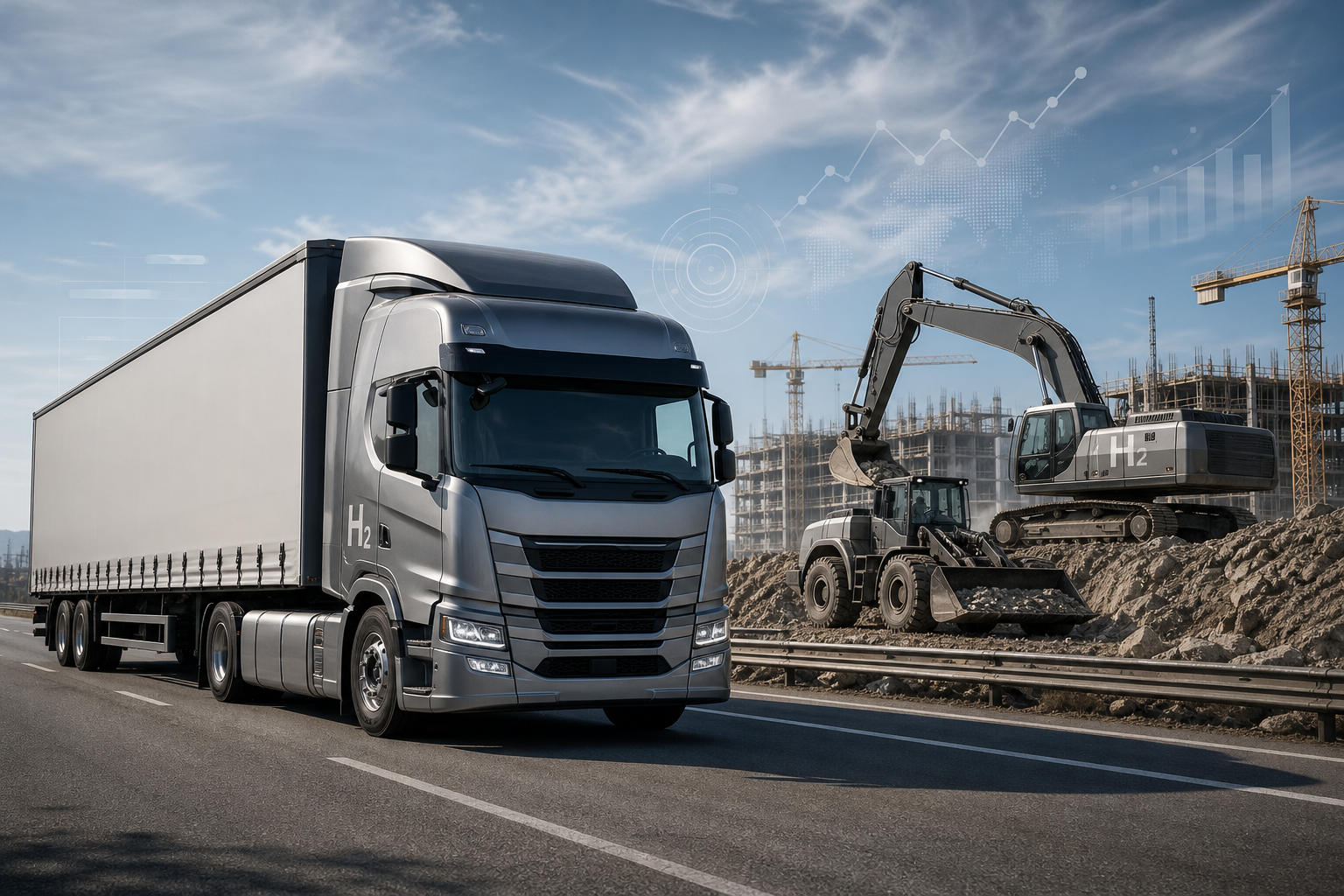
Hydrogen internal combustion engines (H2ICE) are drawing serious attention across heavy industry as companies look for decarbonization pathways that do not require rebuilding fleets from scratch. Transportation accounts for nearly 25% of global greenhouse gas emissions, and sectors that cannot easily electrify are turning to hydrogen combustion as a practical near-term solution.
Unlike battery electric or fuel cell alternatives, H2ICE offers three advantages that matter to operators of long-haul trucks, mining equipment, and construction machinery:
• Compatibility with existing engine manufacturing infrastructure
• Retrofit potential for diesel platforms
• Fast refueling
The Hydrogen Internal Combustion Engine (H2ICE) global market was valued at $345.5 million in 2025 and is projected to reach $2,282.2 million by 2031, a CAGR of 38.1% between 2026 and 2031. That trajectory reflects accelerating regulatory pressure, expanding hydrogen infrastructure investment, and growing OEM commitment to hydrogen combustion as a commercially viable technology rather than a speculative one. It places H2ICE among the fastest-expanding segments of the broader clean energy transition.
The nine companies profiled below form the core of this market, from global truck manufacturers with active on-road testing programs to construction equipment makers that already hold regulatory approvals. Each is making concrete moves in H2ICE development, manufacturing, or both, and together they show the breadth of sectors the technology is beginning to reach.
Market Context: Segments and Regional Leadership
By Vehicle Type
• Trucks and buses hold the largest share, at $232.1 million in 2025 and on track for $1,566.1 million by 2031 (38.5% CAGR), reflecting urgent pressure on commercial road transport to cut emissions.
• Construction equipment is the fastest-growing vehicle segment, with a projected CAGR of 40.7% through 2031, as key OEMs introduce hydrogen-powered machinery to meet carbon targets in off-highway operations.
By Combustion Technology
• Port fuel injection spark ignition holds the dominant share at 66.7% in 2025, favored for its retrofit compatibility and lower cost.
• High-pressure direct injection is the fastest-growing technology, at a 40.1% CAGR, driven by its ability to deliver up to 20% more power and up to 18% more torque than diesel.
Regional Leadership
• Europe leads all regions with a 43.5% share in 2025, underpinned by the EU's heavy-duty vehicle CO2 reduction targets and the European Hydrogen Backbone initiative. The regional market is projected to reach $984.1 million by 2031.
• North America is the fastest-growing region, at a 41.3% CAGR, and is projected to reach $806.3 million by 2031. Growth is supported by the relative ease of converting existing diesel and natural gas engines and by tightening EPA multi-pollutant standards.
• Asia Pacific follows at a projected $423.6 million by 2031 (34.5% CAGR), led by substantial government hydrogen investments in China, Japan, and South Korea.
The Top 9 Companies in the Hydrogen Internal Combustion Engine (H2ICE) Market
1. AB Volvo
• Headquarters: Gothenburg, Sweden
• Founded: 1927
• Revenue: $48,979.7 million (FY2025)
• Employees: 98,844
• Focus: Trucks, buses, construction equipment, marine and industrial power solutions
AB Volvo is one of the most advanced OEMs in H2ICE development for heavy-duty road transport. Its hydrogen combustion program uses High Pressure Direct Injection technology, with on-road testing of heavy trucks beginning in April 2026 as a significant step toward a commercial launch planned for later this decade. Cespira, its joint venture with Westport Fuel Systems established in March 2024, is developing high-pressure gas injection fuel systems for long-haul and off-road applications, deepening Volvo's technical foundation in hydrogen combustion.
2. Ashok Leyland
• Headquarters: Tamil Nadu, India
• Founded: 1948
• Revenue: $5,741.7 million (FY2024)
• Employees: 9,695
• Focus: Commercial vehicles, trucks, buses, light vehicles, power solutions, defense vehicles
Ashok Leyland brings H2ICE development to the South Asian commercial vehicle market, where cost-effective decarbonization pathways are particularly relevant. The company is developing a heavy-duty hydrogen truck range covering 19 to 35 tonnes, using port fuel injection spark ignition combustion technology. With operations in more than 50 countries and ten business verticals spanning logistics, defense, and marine, it is positioned to scale hydrogen adoption across diverse geographies as infrastructure matures.
3. Cummins Inc.
• Headquarters: Columbus, Indiana, U.S.
• Founded: 1919
• Revenue: $33,670 million (FY2025)
• Employees: 67,400
• Focus: Engines, components, distribution, power systems, electrified power and hydrogen production
Cummins plays a central role in the H2ICE supply chain as both an engine developer and a components supplier. In January 2025, it launched its first turbocharger engineered specifically for H2ICE applications and secured a supply contract with a major European OEM. Its 6.7-liter H2ICE project, co-funded by the U.K. Government through the Advanced Propulsion Center, targets medium-duty trucks and buses. H2ICE products are offered through the Accelera segment, which also covers batteries and hydrogen production, giving Cummins exposure across the hydrogen value chain.
4. Daimler Truck AG
• Headquarters: Leinfelden-Echterdingen, Germany
• Founded: 2019
• Revenue: $55,863.6 million (FY2025)
• Employees: 108,476
• Focus: Trucks across North America, Europe, and Asia; buses; financial services
Daimler Truck AG is Europe's largest truck manufacturer by revenue and is investing heavily in zero-emission drivetrain research, with R&D spending up 9.2% in 2025. It is exploring hydrogen combustion through the WaVe development project for special-purpose vehicles, alongside its better-known fuel cell program with the Mercedes-Benz GenH2 and NextGenH2 Truck. The planned launch of 100 NextGenH2 units in 2026 signals a move from test bench to limited series production, adding pressure across the market.
5. Deutz AG
• Headquarters: Cologne, Germany
• Founded: 1864
• Revenue: $2,311.8 million (FY2025)
• Employees: 5,712
• Focus: Diesel and gas engines, hydrogen engines, electric and hybrid-electric drives, mobile rapid charging
Deutz AG is one of the oldest engine manufacturers in the world and is applying that engineering depth to off-highway H2ICE applications. It took part in the HyCET project, delivering hydrogen-powered trucks in collaboration with IAV and a consortium developing hydrogen-based drive concepts. Deutz also groups its H2ICE and alternative drive activities under a dedicated Solutions business line, separate from its core engine operations, to sharpen commercial focus. A 17.8% revenue increase in 2025, driven partly by M&A activity, expanded its capacity to pursue these programs.
6. Toyota Motor Corp.
• Headquarters: Aichi, Japan
• Founded: 1937
• Revenue: $336,801.5 million (FY2025)
• Employees: 390,927
• Focus: Automotive vehicles including passenger cars, trucks, minivans, and SUVs; financial services
Toyota is advancing hydrogen technology on two parallel tracks: fuel cell vehicles and internal combustion engines. In H2ICE specifically, it is developing a three-cylinder hydrogen engine that uses compressed hydrogen at 700 bars, and it announced two advanced hydrogen engine technologies in 2025. R&D investment grew 16.1% year over year, reflecting the scale of its hydrogen commitment. Toyota is also investing in hydrogen refueling infrastructure with governments and industry partners, addressing one of the key constraints on broader H2ICE adoption.
7. HD Hyundai
• Headquarters: Incheon-si, Republic of Korea
• Founded: 1972
• Revenue: $50,166.6 million (FY2025)
• Focus: Construction machinery, engines, power generation, marine, automotive
HD Hyundai is targeting H2ICE commercialization in construction machinery and industrial engines, with a 300 kW (402 HP) hydrogen-powered ICE aimed at mass production in 2025. It has also signed an MOU to develop a 1MW-class H2ICE system by integrating five 200 kW, 11-liter hydrogen combustion engines, a scale that would serve heavy industrial and off-highway applications well beyond what most competitors have announced. Its network of more than 5,000 dealers across 140 countries provides the commercial reach to distribute H2ICE-powered equipment broadly once production ramps.
8. Liebherr-International AG
• Headquarters: Bulle, Switzerland
• Founded: 1949
• Revenue: $16,709.2 million (FY2025)
• Employees: 55,963
• Focus: Cranes, construction machinery, hydraulic excavators, wheel loaders, hydrogen internal combustion engines, spare parts, rentals
Liebherr brings dedicated testing infrastructure to H2ICE development, operating hydrogen-powered test benches at its Swiss facility to refine performance and emissions before commercial deployment. In 2024, it introduced a hydrogen ICE-powered large wheel loader in Salzburg, Austria, capable of supporting machines with operating weights up to 40 tonnes, a concrete demonstration of H2ICE viability in heavy construction. Its H2ICE products address construction machinery, mining equipment, crawler excavators, and heavy-duty off-road machinery, aligning with the fastest-growing vehicle segments in this market.
9. JC Bamford Excavators Ltd.
• Headquarters: Staffordshire, U.K.
• Founded: 1945
• Employees: 19,000
• Focus: Construction, agricultural, and demolition equipment; access platforms; backhoe loaders; hydrogen internal combustion engines
JCB has made one of the most tangible regulatory advances in the H2ICE market: in January 2025, 11 European licensing authorities certified its hydrogen combustion engine, clearing the path for commercial sales across Europe. The company has invested approximately $133.5 million in H2ICE development and offers a port fuel injection spark ignition engine designed for 350-bar gaseous hydrogen storage. In collaboration with Cummins, it is targeting heavy-duty trucks, intercity coaches, and dump trucks, a partnership that combines JCB's equipment expertise with Cummins' engine supply chain depth.
Conclusion
The Hydrogen Internal Combustion Engine market is moving from proof of concept to the edge of commercial viability faster than many observers anticipated. The nine companies above are doing more than running research programs: several have regulatory approvals, active supply contracts, and on-road testing underway. Their collective commitment reflects a growing consensus that H2ICE is a practical, near-term decarbonization tool for heavy industry, particularly where electrification remains technically or economically constrained.
The outlook through 2031 is shaped by two parallel dynamics: regulatory timelines that leave fleet operators less room to delay, and infrastructure investment that is gradually closing the refueling gap. Companies that have secured early positions in combustion technology, component supply, and regulatory approval are building durable advantages. The market is still early-stage at $345.5 million in 2025, but at a 38.1% CAGR, the window for establishing leadership is narrowing quickly.
Learn More and Take Action:
Consider becoming a member of the BCC Research library and gain access to our full catalog of market research reports in your industry. Not seeing what you are looking for? We offer custom solutions too, including our new product line: Custom Intelligence Services.
Contact us today to find out more.