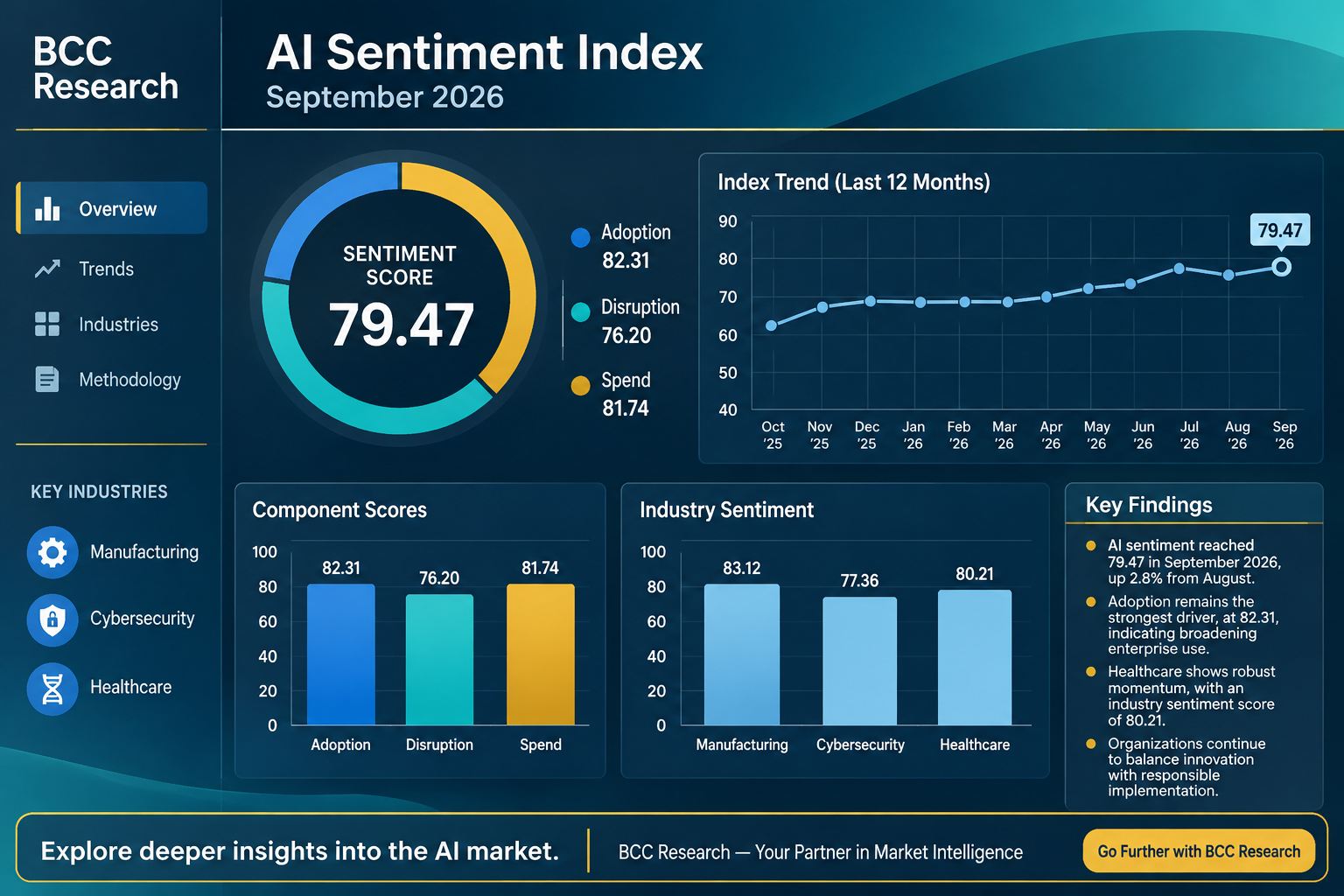
The AI Sentiment Index is not a market sizing exercise. It is a structured attempt to measure how industry professionals actually feel about AI — whether they are adopting it, where they see it disrupting established practices, which use cases they find credible, and how confidently they are spending. The September 2026 edition draws on approximately 40 expert respondents, combining direct analyst interviews, verified industry professionals from the BCC Research subscriber network, and open survey contributions, all weighted by source type and normalized to a 0–100 scale.
The headline number for September 2026 is a weighted AI Sentiment Index of 79.47, up from 77.78 in August. Adoption rose to 83.51 from 80.46, Disruption climbed to 77.14 from 74.35, Use Cases remained broadly stable at 81.29 versus 81.72, and Spend edged up to 75.29 from 74.31. The pattern suggests confidence is broadening — moving from individual applications toward wider integration — rather than concentrating around a few high-profile areas.
What the index also reveals is genuine unevenness. Technology and consumer electronics led all industries with an AI Adoption Sentiment Score of 95.00 in September. Advanced manufacturing remained the most cautious sector across all four dimensions. That spread reflects structural differences in data infrastructure, regulatory exposure, capital cycle length, and the nature of physical versus software-native operating environments.
The Benefits
Strong Digital Infrastructure Accelerates AI Integration
Industries with mature software environments, large datasets, and established analytical workflows can compress the time from early AI experimentation to scalable deployment. When data pipelines and instrumentation are already in place, integrating AI becomes a question of adding capability rather than building foundations. This is why technology and consumer electronics registers an AI Adoption Sentiment Score of 95.00 — the environment is ready, and the incremental cost of adding AI is comparatively low.
The effect is self-reinforcing. Lower integration cost and risk encourage more experimentation, which generates more validated use cases, which justifies further investment. Organizations in digitally mature environments do not simply adopt AI faster — they accumulate experience that makes the next deployment easier.
Expanding AI Use Cases Build Organizational Confidence
The AI Use Cases Sentiment Index held at 81.29 in September, and that stability is itself meaningful. It reflects sustained rather than speculative confidence. Cybersecurity threat detection, predictive maintenance, bioinformatics, and process optimization are not hypothetical — they are being deployed and demonstrating results.
That demonstration effect matters at the organizational level. When a specific application delivers a measurable outcome, it reduces the perceived risk of the next deployment. Budget conversations shift from justifying AI in principle to evaluating which use cases to prioritize next. The September data shows this confidence contributing to broader uplift in both Adoption and Disruption scores.
AI Increasingly Viewed as Competitive Differentiator
The AI Disruption Sentiment Index rose to 77.14 from 74.35 in August, reflecting a shift in how organizations frame AI investment. It is no longer primarily about operational efficiency in isolation. Companies increasingly view AI as a mechanism for faster innovation, improved service delivery, and differentiated competitive positioning.
That framing changes the internal logic of adoption decisions. When AI is understood as a tool for staying competitive rather than simply cutting costs, the justification threshold changes. The pressure to adopt is no longer generated only by ROI calculations — it is also generated by the observation that peers are integrating AI into their products and processes, and the risk of falling behind becomes a real cost.
Research-Intensive Sectors Drive Bioinformatics and Genomics Adoption
Life sciences and healthcare showed particularly strong momentum in September, with an AI Adoption Score of 93.75. The driver is structural: the volume and complexity of biological and clinical data has grown faster than human analytical capacity can address. Genomic sequences, pathology images, and clinical datasets at research scale require computational interpretation that AI is well-positioned to provide.
The practical effect is measurable — shorter research timelines, more consistent interpretation of complex data, and improved decision-making in drug discovery and diagnostics. For organizations competing in precision medicine or advanced therapeutics, deploying AI in bioinformatics and genomics is increasingly a condition of competitive participation rather than an optional enhancement.
Predictive Maintenance Provides Clear ROI in Manufacturing
Among the use cases tracked in September, predictive maintenance stands out for its investment justification clarity. It links AI outputs directly to equipment uptime, maintenance cost reduction, and production reliability — all measurable in financial terms that plant operators and finance teams can independently verify. In asset-intensive industries where unplanned downtime is costly, that directness matters.
The September index reflects this: chemicals and energy recorded a Use Cases Sentiment Score of 83.87 even as their Spend Sentiment Score sat at a more cautious 71.15. Predictive maintenance is central to that gap — strong enough as a use case to sustain confidence even where broader spending remains selective.
The Challenges
Legacy Equipment and Integration Complexity Slow Manufacturing AI
Advanced manufacturing is the most cautious sector across all four sentiment dimensions in September, and the structural reason is clear. Physical manufacturing environments require AI systems to interface with existing plant machinery, legacy control architectures, and instrumentation not designed with AI integration in mind. Integration costs are real, timelines are long, and the risk of disrupting existing operations during implementation is non-trivial.
This is not a problem that better AI software resolves on its own. It requires hardware compatibility work, process modification, and in many cases significant capital expenditure before any AI benefit can be realized. For manufacturers operating on tight margins or conservative capital cycles, absorbing that cost without near-certainty about outcomes is a difficult case to make.
Scientific Validation and Regulatory Requirements Constrain Healthcare AI
Despite strong adoption sentiment in life sciences and healthcare, the path from AI capability to clinical deployment is substantially longer than in less regulated sectors. AI outputs in diagnostic and clinical settings must be validated for reliability, reproducibility, and regulatory compliance before use in patient-facing workflows. That process requires expert oversight, clinical evidence generation, and regulatory engagement — none of which can be accelerated simply by improving the underlying model.
The September data reflects this tension. Life sciences and healthcare shows strong Adoption and Disruption scores, but Spend remains more moderate, consistent with organizations that recognize the potential but are managing deployment within constrained regulatory timelines. The validation requirement is not bureaucratic friction for its own sake — the consequences of diagnostic error are serious — but it does mean that sentiment and practical deployment pace will remain partially decoupled.
Uneven Data Quality and Infrastructure Readiness Limit Deployment
Readiness to deploy AI is not evenly distributed, even within the same industry. Organizations that lack integrated operating data, reliable instrumentation, or historically complete datasets cannot effectively train or run AI systems at scale. The AI is only as useful as the data it can access, and where that data is fragmented or absent, deployment stalls regardless of budget or intent.
This creates a compounding disadvantage. Organizations that are data-ready move ahead, accumulate operational AI experience, and widen the gap. Those that are not must invest in data infrastructure before capturing any AI benefit — a prerequisite cost that does not appear in headline adoption numbers but is a real constraint on practical deployment pace.
High Implementation Costs Restrict Investment in Emerging Areas
For AI applications in early-stage industrial contexts — emerging low-emission energy technologies being a clear example — high project costs and development delays create a difficult investment environment. The operational setting may be genuinely suited to AI-assisted analysis, but if the underlying projects are expensive and long-cycle, layering AI investment on top is hard to justify.
The September index reflects this in chemicals and energy's selective spending posture. Investment is directed toward areas where operational benefits are demonstrable and withheld from areas where overall project economics remain uncertain. AI investment follows project confidence, and where that confidence is low, AI spending follows regardless of technical potential.
Cybersecurity, Governance, and Reliability Requirements Add Complexity
As AI moves from pilot programs into mission-critical and customer-facing environments, governance requirements multiply. Systems operating in production contexts must meet security standards, maintain audit trails, handle failure modes gracefully, and comply with enterprise governance frameworks. Each requirement adds process overhead that does not burden AI deployed in contained experimental settings.
This is particularly relevant in technology and consumer electronics, which leads on adoption scores but must simultaneously manage AI deployment across digital services and infrastructure carrying significant security and reliability obligations. Cybersecurity AI is both a solution to this problem and subject to it — the systems designed to detect threats must themselves be demonstrably robust, auditable, and resistant to adversarial manipulation.
Uncertainty Around Return on Investment Dampens Broad AI Programs
The Spend Sentiment Index is the lowest-scoring dimension in September at 75.29, and the investment pattern it reflects is deliberate rather than absent. Organizations are concentrating spending on targeted applications with clear outcome metrics and holding back from broad AI programs where returns are harder to predict.
This conservatism is rational, but it carries its own risk. Limiting investment to pilots slows the accumulation of operational experience that would eventually justify broader programs, creating a cycle that is difficult to break without either a compelling proof case or a meaningful shift in competitive pressure.
Weighing the Two Sides
The September 2026 AI Sentiment Index describes a market advancing with genuine momentum but doing so unevenly. The strongest signals are concentrated in sectors — technology and consumer electronics, life sciences and healthcare — that combine digital maturity, clear use cases, and either competitive urgency or analytical necessity. The weakest signals come from sectors facing physical integration complexity, regulatory constraints, or uncertain project economics.
The balance would shift meaningfully if two conditions changed: wider availability of high-quality operational data would expand the pool of organizations capable of effective AI deployment, narrowing the current disparity in readiness; and demonstrated ROI in currently cautious sectors — particularly advanced manufacturing and chemicals and energy — would lower the perceived risk of broader investment programs. Without those conditions, confidence will continue to accumulate at the frontier while large parts of the industrial economy remain in a holding pattern.
Conclusion
The September 2026 AI Sentiment Index at 79.47 represents a genuine and broadly based improvement in professional confidence about AI. The gains across Adoption, Disruption, and Spend are consistent with a market expanding its practical engagement with AI rather than cycling through enthusiasm.
The honest read, however, is that sentiment and deployment pace are not the same thing. High confidence in specific use cases coexists with real constraints — legacy infrastructure, regulatory timelines, data quality gaps, and investment caution — that will continue to shape who benefits from AI first and by how much. The September index is a useful snapshot of where professional confidence currently sits; the more consequential question is how quickly the structural constraints limiting broader deployment are actually being addressed.
Learn More and Take Action:
Consider becoming a member of the BCC Research library and gain access to our full catalog of market research reports in your industry. Not seeing what you are looking for? We offer custom solutions too, including our new product line: Custom Intelligence Services.
Contact us today to find out more.