The functional foods and beverages market sits at an intersection of two powerful long-term trends: rising consumer focus on preventive health, and growing demand for food products that deliver measurable nutritional or physiological benefits beyond basic sustenance. Across regions and income levels, consumers are increasingly choosing products that address specific health concerns — gut health, cognitive performance, heart health, immunity — rather than simply satisfying hunger or thirst. That behavioral shift is reshaping portfolios at companies of every size, from global food conglomerates to specialized nutrition brands.
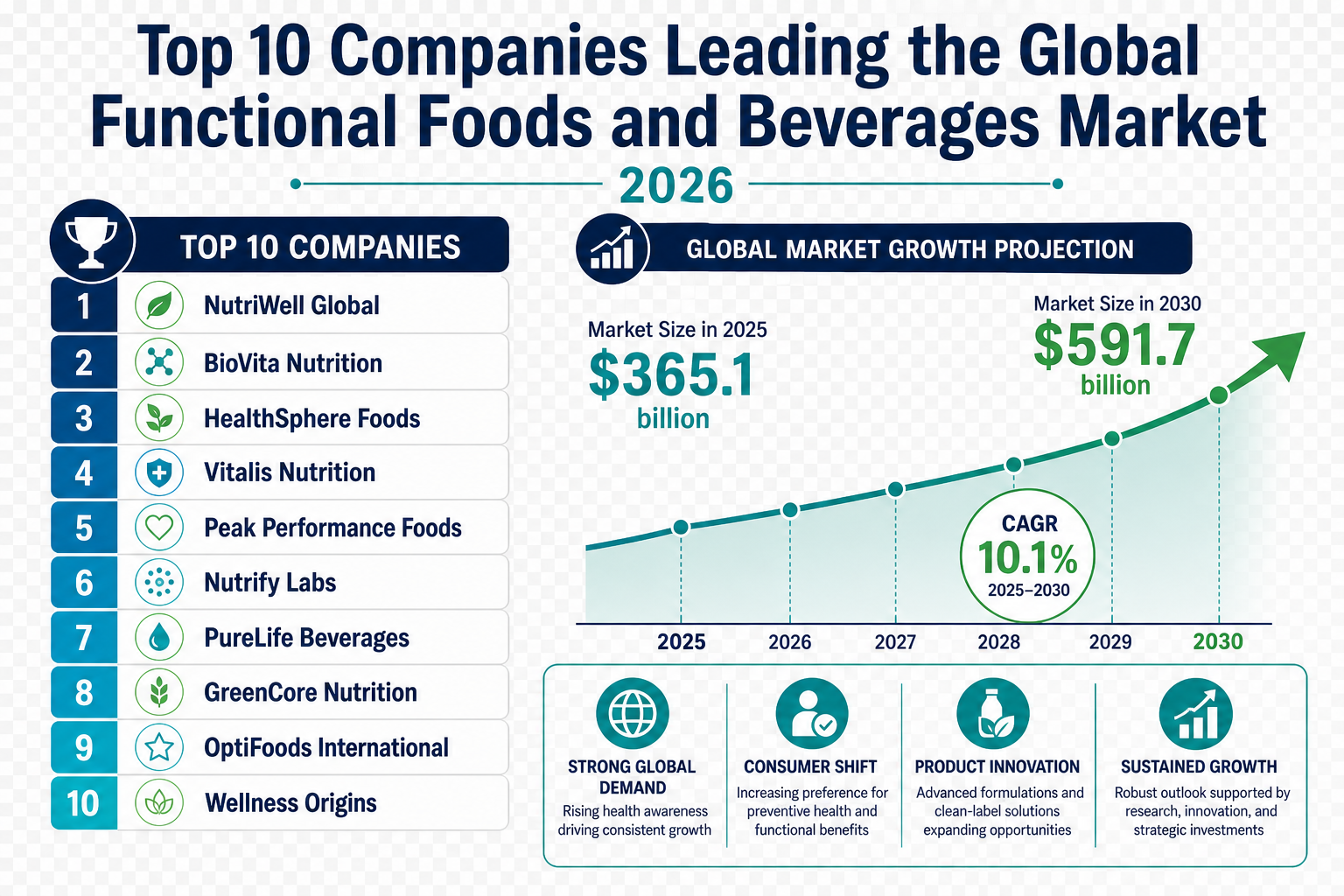
The market was valued at $365.1 billion in 2024 and is projected to reach $591.7 billion by 2030, growing at a compound annual growth rate of 8.6% between 2025 and 2030. That rate reflects both the breadth of the addressable opportunity — spanning beverages, powders, bars, dairy, clinical nutrition, and beyond — and the depth of structural demand drivers including urbanization, aging populations, digital retail expansion, and ongoing innovation in ingredient science and delivery technology.
The companies shaping this market range from diversified multinationals managing billion-dollar nutrition divisions to focused players with deep expertise in specific segments like sports nutrition or probiotic dairy. Below is a look at ten companies positioned at the forefront of the global functional foods and beverages market.
Market Context: Segments and Regions Driving Growth
Within the functional foods and beverages market, ready-to-drink beverages stand out as the dominant product form, reaching $141.0 billion in 2025 at a 9.3% CAGR. The format benefits from shorter innovation timelines and strong consumer appeal across both North America and Asia-Pacific. Supermarkets and hypermarkets remain the leading distribution channel at $151.0 billion in 2025, though online retail and direct-to-consumer platforms are growing faster at a 9.9% CAGR, driven by personalization, subscriptions, and high digital adoption. On the health benefit side, gut and digestive health represents the largest segment globally, while energy and cognitive performance is among the fastest-growing at $69.4 billion in 2025 with a 9.8% CAGR, reflecting sustained urban professional and youth demand.
North America leads all regions with a 34.3% share of the global market, anchored by strong protein beverage and energy drink categories, high consumer health awareness, and intense innovation in nootropic and clean-label formulations. Asia-Pacific is the fastest-growing region at a 9.5% CAGR between 2025 and 2030, propelled by urbanization, rising middle-class incomes, and demand for probiotic dairy, functional hydration, and energy beverages across China, India, and Southeast Asia. Europe grows steadily at an 8.2% CAGR, with Germany the largest single-country European market at $23.6 billion in 2025, supported by EFSA-aligned health claim standards and strong consumer health consciousness.
The Top 10 Companies in Functional Foods and Beverages: Global Markets
1. Nestle
• Headquarters: Vevey, Switzerland
• Founded: 1866
• Revenue: $103,783.5 million (FY2024)
• Employees: 277,000
• Focus: Medical nutrition, infant nutrition, plant-based alternatives, fortified beverages, health science, therapeutic pet nutrition
Nestle is the world's largest food and beverage company and a dominant force in functional nutrition through its Nutrition and Health Science divisions. Its portfolio spans medical nutrition brands, infant formulas, plant-based proteins, and collagen-based functional beverages. In 2026, Nestle integrated its Nutrition and Nestle Health Science units into a single entity in Brazil, committing an additional $650.4 million to scale clinical-to-consumer products. The company also acquired a majority stake in Orgain to accelerate plant-based protein growth and launched the FIBER-IMPACT longitudinal gut microbiome study.
2. PepsiCo
• Headquarters: Purchase, New York, U.S.
• Founded: 1965
• Revenue: $93.9 billion (FY2025)
• Employees: 306,000
• Focus: Sports hydration, functional energy beverages, protein snacks, oat-based nutrition, enhanced water, juice products
PepsiCo has moved deliberately from a traditional beverage company toward a health-focused nutrition provider. Its 2025 acquisitions of Poppi and a majority stake in Celsius Holdings signal a clear commitment to gut health and functional energy, with Celsius, Alani Nu, and Rockstar consolidated under an Energy Captain distribution model. The company is also expanding liquid protein with MUSCLE MILK through its CytoSport subsidiary and launching new zero-sugar electrolyte variants under PROPEL and next-generation GATORADE formulations targeting high-performance athletes.
3. The Coca-Cola Co.
• Headquarters: Atlanta, Georgia, U.S.
• Founded: 1886
• Revenue: $47,941 million (FY2025)
• Employees: 65,900
• Focus: Functional hydration, sports performance beverages, electrolyte drinks, enhanced water, vitamin-fortified drinks, energy beverages
Coca-Cola is expanding its functional beverage portfolio through brand integration and reformulation rather than organic invention. The full integration of BodyArmor strengthens its premium sports hydration position, while Powerade is being extended with next-generation electrolyte formulations across North America and Europe. Smartwater variants incorporating alkaline and antioxidant enhancements broaden the enhanced water category, and Vitaminwater is being updated with revised micronutrient blends. Coca-Cola Ventures is also investing in emerging plant-based hydration startups to build a longer-term innovation pipeline.
4. Abbott
• Headquarters: Abbott Park, Illinois, U.S.
• Founded: 1888
• Revenue: $41,950 million (FY2024)
• Employees: 114,000
• Focus: Adult and pediatric nutrition, specialized therapeutic formulas, hydration solutions, medical devices, diagnostics
Abbott's nutrition division, home to ENSURE, GLUCERNA, and SIMILAC, positions the company as a leader in both consumer and clinical functional nutrition. The company has expanded its ENSURE portfolio with high-protein formulations designed to support muscle health in aging adults, a category with structural demographic tailwinds globally. Following supply disruptions, Abbott collaborated with the FDA to resume and expand SIMILAC infant formula production, restoring confidence in its pediatric nutrition business. Investment in U.S. manufacturing capacity supports supply chain stability across all three major nutrition brands.
5. Danone
• Headquarters: Paris, France
• Founded: 1919
• Revenue: $29,626.6 million (FY2024)
• Employees: 96,000
• Focus: Probiotic dairy and yogurt, plant-based beverages, infant formulas, specialized and medical nutrition
Danone holds a structurally strong position in probiotic dairy and gut-health platforms, two segments at the core of the fastest-growing health benefit categories in the functional foods market. The company invested approximately $392.8 million in R&D in 2024, concentrating on nutritional science and clinical research across digestive health, immunity, early-life nutrition, and disease-related malnutrition. Its portfolio rationalization and pricing discipline contributed to improved operating performance in FY2024. Plant-based beverages and specialized infant nutrition rounds out a portfolio that spans consumer and clinical channels.
6. General Mills Inc.
• Headquarters: Minneapolis, Minnesota, U.S.
• Founded: 1928
• Revenue: $19,486.6 million (FY2024, ended May 31, 2025)
• Employees: 34,000
• Focus: Functional cereals and snack bars, probiotic yogurt, pet nutrition supplements, plant-based and reduced-sugar formulations
General Mills is positioning established brands — Cheerios, Nature Valley, Wheaties, Yoplait — within the functional foods framework through protein enrichment, reduced-sugar reformulation, and gut health positioning. High-protein Cheerios variants and protein granola extensions to Nature Valley reflect a deliberate effort to trade up within mature categories. The 2025 acquisition of Fera Pets Inc. extends the Blue Buffalo brand into pet digestive health and joint support supplements, reflecting a broader understanding that functional nutrition is expanding beyond human consumption into adjacent wellness categories.
7. Glanbia PLC
• Headquarters: Kilkenny, Ireland
• Founded: 1997
• Revenue: $3,839.7 million (FY2024)
• Employees: 5,800
• Focus: Performance nutrition, protein powders, ready-to-drink protein beverages, weight management shakes, amino acid supplements, functional snacks
Glanbia is a focused performance nutrition specialist with Optimum Nutrition and Isopure as its flagship consumer brands. In 2025, the company acquired SlimFast to expand from sports nutrition into the structured meal replacement and weight management segment, broadening its addressable market. Glanbia is simultaneously investing in U.S. production capacity for Optimum Nutrition and divesting non-core direct-to-consumer assets such as Body & Fit, signaling a disciplined shift toward margin-accretive branded and B2B nutrition segments with stronger long-term scale potential.
8. Herbalife International of America Inc.
• Headquarters: Los Angeles, California, U.S.
• Founded: 1980
• Revenue: $4,993.1 million (FY2024)
• Employees: 8,600
• Focus: Meal replacement shakes, protein supplements, weight management products, sports nutrition, functional beverages, digestive health products, energy support
Herbalife operates a direct-selling model distributing functional nutrition across North America, Latin America, Asia-Pacific, and EMEA, with Asia-Pacific representing its primary business region. The company is refreshing its core Formula 1 Nutritional Shake Mix with new flavors and reformulations, while upgraded sports nutrition formulations under the Rebuild Strength line aim to diversify its revenue mix beyond weight management. Investment in North American manufacturing and quality control infrastructure supports capacity expansion for meal replacement shakes and protein beverages, improving supply chain resilience.
9. Arla Foods amba
• Headquarters: Viby J, Denmark
• Founded: 2000
• Revenue: $14,902.1 million (FY2024)
• Employees: 21,895
• Focus: High-protein dairy products, lactose-free milk, probiotic yogurts, early-life nutrition, food ingredients
Arla Foods focuses on functional dairy innovation and premiumization, expanding its Arla Protein range with new ready-to-drink formats and snack products aimed at active consumers. The Arla Lactofree range is being extended through retail partnerships in the U.K. and Germany, strengthening its positioning in digestive health dairy — a segment of growing strategic importance as lactose intolerance awareness rises across European consumer markets. Investment in expanded dairy processing capacity in Denmark supports Arla Protein and Skyr production scalability and long-term margin improvement.
10. Amway Corp.
• Headquarters: Ada, Michigan, U.S.
• Founded: 1959
• Employees: 14,000
• Focus: Plant-based nutrition, dietary supplements, functional foods and beverages, direct selling, health and wellness under the Nutrilite brand
Amway operates one of the longest-established direct-selling platforms in functional nutrition through its Nutrilite brand, which encompasses protein powders, dietary supplements, and plant-based formulations. In 2026, the company launched updated formulations under the Nutrilite Organics range with improved ingredient transparency and plant-based sourcing standards. Manufacturing expansion in the U.S. and Asia in 2025 increased output capacity for protein powders and supplements. A 2024 collaboration with agricultural research partners focused on traceability and sustainable sourcing for Nutrilite plant-based ingredients supports long-term supply quality.
Conclusion
The functional foods and beverages market is one of the most structurally compelling spaces in the global food industry, supported by demographic shifts, mounting scientific evidence linking diet to long-term health outcomes, and distribution channels — particularly e-commerce and direct-to-consumer — that amplify both reach and consumer loyalty. The companies profiled here reflect the full range of strategic approaches active in this market: global FMCG majors retooling existing brand portfolios, specialized nutrition players doubling down on performance and weight management categories, and diversified healthcare companies bridging clinical and consumer nutrition.
What unites them is a shared recognition that functional nutrition is no longer a niche supplement category but a mainstream consumer expectation. The market's trajectory from $365.1 billion in 2024 to a projected $591.7 billion by 2030 reflects the scale of that shift. Companies that can combine ingredient science credibility, regulatory discipline, and distribution agility — across both physical and digital channels — are best positioned to capture the growth ahead.
Learn More and Take Action:
Consider becoming a member of the BCC Research library and gain access to Custom Intelligence Services of market research reports in your industry. Not seeing what you are looking for? We offer custom solutions too, including our new product line: Custom Intelligence Services.