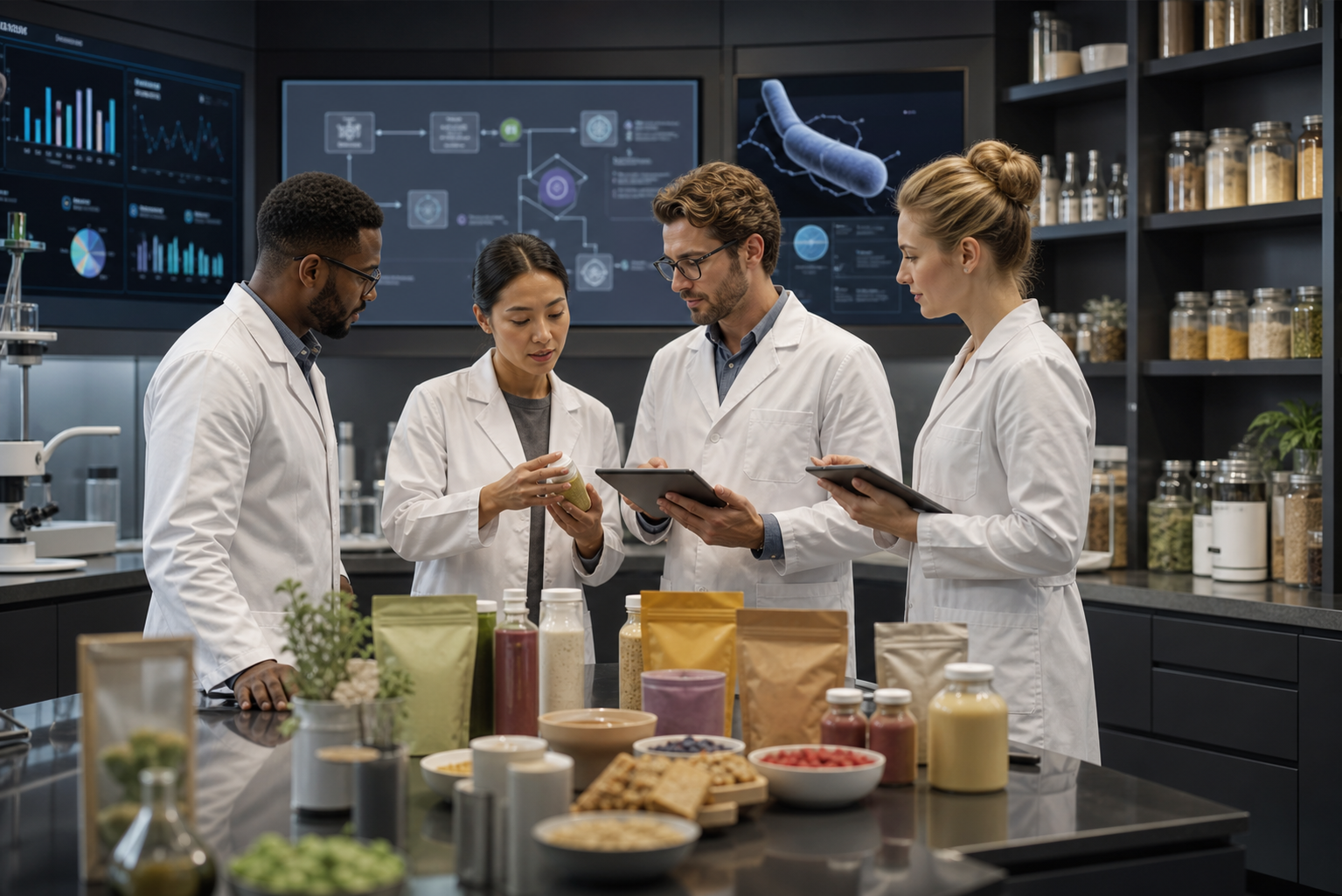
The functional foods and beverages sector has always sat at the intersection of nutritional science, consumer behavior, and industrial manufacturing — a space where getting formulation wrong carries real consequences, and where the distance between a promising bioactive compound and a shelf-ready product has historically been measured in years. Today, artificial intelligence is compressing that distance. Across ingredient discovery, clinical validation, supply chain logistics, and personalized nutrition, AI has moved from a peripheral tool to a core operating layer for the sector's leading companies. Major global players including Nestle, Danone, PepsiCo, Unilever, General Mills, and Archer Daniels Midland are no longer piloting AI in isolated functions — they are integrating it enterprise-wide.
This article traces how that shift happened: from the early problem landscape that made AI adoption necessary, through the specific milestones and use cases that defined the industry's recent transformation, and into the emerging technologies and market conditions that will shape where the sector goes from here.
The Underlying Challenge: Why Functional Foods and Beverages Needed AI
Before understanding the transformation, it helps to understand the structural difficulty of the market these companies were operating in. Functional foods and beverages are not ordinary packaged goods. The bioactive compounds that define their value — probiotics, polyphenols, omega-3 fatty acids, collagen, botanical extracts, and adaptogens — are notoriously difficult to work with. They degrade under heat, react poorly to changes in pH and oxygen exposure, and interact with each other in ways that are difficult to predict through conventional laboratory iteration.
The consumer side presented its own complexity. Individual gut microbiomes vary enormously by genetics, age, diet, geography, medication exposure, and lifestyle. A standardized probiotic formulation targeting broad consumer groups produces inconsistent health outcomes by definition. At the same time, regulatory bodies — particularly the European Food Safety Authority in Europe — demand rigorous scientific substantiation for health claims, raising the cost and timeline of bringing a product to market. Competitive pressures, driven by social media trend cycles and rapidly shifting health priorities, only intensified the need to move faster. The traditional pipeline, from ingredient screening through clinical validation to commercialization, was not built for the pace the market demanded.
2024–2025: Enterprise-Wide Integration Takes Hold
The period from 2024 to 2026 marked a decisive inflection point. What had previously been selective or experimental use of AI within specific functions became coordinated, enterprise-wide integration across the sector's major players.
In 2025, Nestle initiated an upgrade of its global digital core beginning in Zone AOA — its Asia, Oceania, and Africa division — to deploy AI at scale. The initiative automated recipe harmonization and used digital dashboards to optimize ingredient sourcing for the company's health and nutrition platforms. This was not a single-product project; it represented a structural rearchitecting of how Nestle manages its formulation and supply functions globally.
Also in 2025, Unilever deployed its proprietary "Recipe Intelligence" AI tool for its Food Solutions division. The system provides optimized ingredient lists and preparation steps for functional recipes, calibrated to specific dietary needs and trends. Archer Daniels Midland integrated AI into its "Byte-Sized Revolution" strategy during the same period, applying machine learning to flavor development, multisensorial experiences, and seed genetics to enhance the nutritional profiles of crops entering the functional ingredient supply chain. PepsiCo simultaneously announced a 2026 launch for Doritos Protein and expanded its Naked brand functional line, using AI-driven price testing and consumer insights to balance functional positioning against affordability pressures in an inflationary environment.
2026: AI Shapes Product Identity, Not Just Process Efficiency
By 2026, AI was no longer being applied primarily to internal operations. It was beginning to shape the identity and targeting of the products themselves.
General Mills announced investment in AI systems designed to build "digital personas" — simulated consumer profiles that generate feedback on products before physical testing occurs. These personas informed the development and launch of Honey Nut Cheerios Protein and Ghost Performance nutrition bars, the latter explicitly targeted at users of GLP-1 medications such as semaglutide. This represented a notable shift: AI was being used not merely to optimize existing formulations, but to define the health positioning and audience targeting of entirely new functional product lines. The ability to simulate consumer response at scale, before committing to physical production and clinical trials, materially changes the economics of functional innovation.
This same period saw Danone investing in microbiome research and AI-enabled personalization tools to refine probiotic strain selection and improve efficacy modeling across its gut-health beverage portfolio. The application of predictive analytics to strain selection — analyzing microbiome sequencing data, dietary inputs, and metabolic markers — represents one of the more technically sophisticated uses of AI in the sector, moving formulation decisions from empirical iteration toward model-driven precision.
The Market Today: Segments and Regions Driving AI Adoption
This report covers the AI Impact on Functional Foods and Beverages as a qualitative and strategic market — it does not carry traditional market sizing data — but the scope of activity across segments and geographies makes clear that adoption is broad and accelerating.
The eight functional areas where AI is driving measurable change span the full product lifecycle. In ingredient discovery and early R&D, AI is analyzing biochemical, nutritional, and clinical datasets to identify promising bioactive compounds from plant extracts, marine sources, fermentation processes, and emerging protein systems before physical testing begins. In formulation design, machine learning simulates constituent interactions, sensory outcomes, and stability profiles for probiotics, vitamins, polyphenols, and adaptogens. In clinical validation and regulatory strategy, AI forecasts the evidence quality required for health claims and identifies compliance gaps early. In manufacturing, computer vision and predictive maintenance are improving batch uniformity and fermentation parameter control. Supply chain, personalized nutrition, retail analytics, and sustainability lifecycle assessment round out a set of applications that now touch every stage from field to consumer.
Regionally, North America leads in AI implementation, supported by mature nutraceutical industries, high venture investment in digital health, and strong consumer demand in the U.S. and Canada. Europe's adoption is driven by the specific demands of EFSA compliance, clean-label requirements, and the need for rigorous clinical substantiation — making AI an operational necessity rather than an optional upgrade. Asia-Pacific is among the fastest-growing regions, propelled by aging populations, rising disposable income, rapid urbanization, and a robust e-commerce infrastructure in China, Japan, South Korea, India, and Southeast Asia that generates the real-time consumer data AI systems require. South America, particularly Brazil, Argentina, and Chile, is deploying AI primarily in supply chain forecasting, product localization, and social media sentiment analysis for natural energy drinks, collagen products, and protein beverages. The Middle East and Africa region is growing in AI adoption, with a focus on demand forecasting, supply chain optimization, and product adaptation for regional nutritional challenges including vitamin D fortification.
Where the Market Goes Next: Drivers, Technologies, and Emerging Priorities
Several converging forces will determine the trajectory of AI adoption in functional foods and beverages over the coming years.
On the demand side, the shift toward personalized nutrition is accelerating. Consumers increasingly expect products that reflect their individual health circumstances — informed by dietary data, microbiome profiles, and health metrics — rather than broad-population formulations. AI-driven microbiome personalization platforms, which analyze sequencing data and lifestyle factors to recommend specific probiotic strains or synbiotic combinations, are positioned to make this expectation commercially viable at scale. The business model implications are significant: subscription-based personalized nutrition services generate more durable revenue than conventional retail transactions, and AI is the enabling layer.
The regulatory environment will continue to drive adoption, particularly in Europe. AI tools capable of simulating regulatory outcomes, modeling the evidentiary requirements for health claims, and flagging compliance gaps before submission reduce the cost and timeline of regulatory approval — a substantial competitive advantage in a market where failed submissions are expensive.
On the technology side, natural language processing for consumer trend forecasting is becoming a standard planning tool. NLP systems process social media, e-commerce transaction data, patent filings, and scientific publications in real time to identify emerging ingredient trends before they peak, giving formulation and marketing teams early signals that traditional research methods cannot provide. AI-driven lifecycle assessment and sustainability simulation tools are gaining importance, particularly in Europe, where corporate sustainability commitments and ESG reporting requirements are creating demand for tools that can model the carbon footprint and water intensity of ingredient sourcing and reformulation decisions.
Government funding in the U.S., EU member states, China, Japan, and South Korea for AI-enabled nutrition research and digital health ecosystems is lowering the cost of adoption for industry players and building the evidence base that supports AI-informed health claims. This public investment creates a positive feedback loop: better-funded research generates richer datasets, which improve the accuracy and reliability of AI models across the sector.
The macroeconomic environment introduces a counterweight. Input cost volatility and inflationary pressures strain procurement planning and raise questions about sustained capital allocation to AI platforms. In emerging markets, less developed digital and retail infrastructure limits the pace of adoption, even where the demand conditions for functional products are strong.
Conclusion
The integration of AI into functional foods and beverages has not followed a single, linear path. It has moved through distinct phases — from recognizing the structural limitations of traditional formulation and regulatory processes, to selective digital experimentation, to the enterprise-wide deployment that characterizes the sector's leading companies today. In a relatively compressed window between 2024 and 2026, AI shifted from a supporting capability to a defining feature of how the industry innovates, manufactures, and connects with consumers.
What makes this transformation particularly significant is that AI is not substituting for scientific rigor in this sector — it is enabling more of it. The ability to simulate bioactive interactions before physical testing, model regulatory outcomes before submission, and tailor probiotic formulations to individual microbiome profiles represents a genuine expansion of what manufacturers can do and how quickly they can do it. The companies that have moved furthest in this direction are already seeing that advantage reflected in their product pipelines and their capacity to respond to shifting consumer health priorities.
Learn More and Take Action:
Consider becoming a member of the BCC Research library and gain access to our full catalog of market research reports in your industry. Not seeing what you are looking for? We offer custom solutions too, including our new product line: Custom Intelligence Services.
Contact us today to find out more.