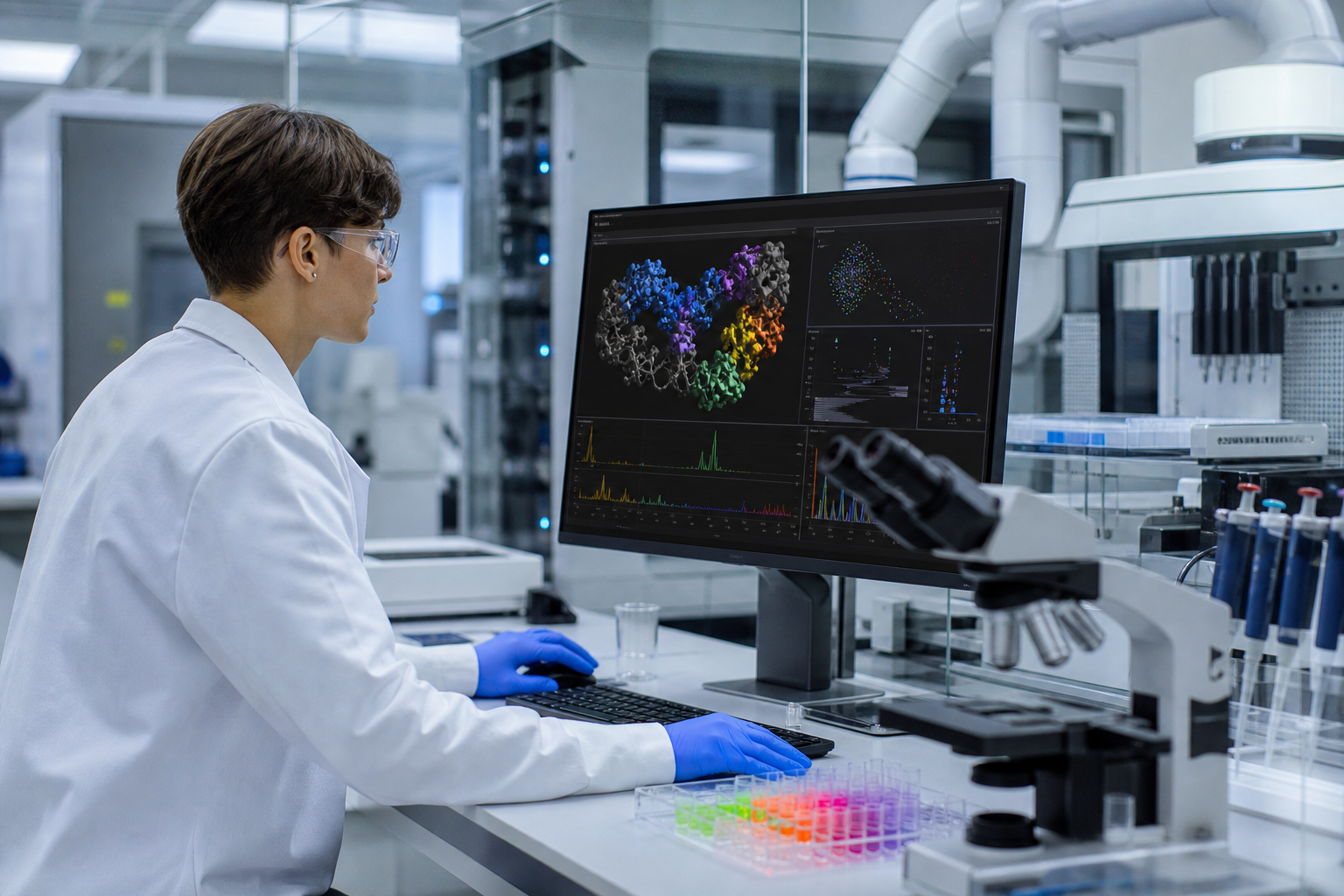
For decades, protein labeling was treated as a preparatory step — something you did before the real science started. Attach a fluorescent dye, run your panel, move on. But as multiplex workflows have scaled into dozens of simultaneous markers per sample, that framing has quietly broken down. The data coming out of modern multiplex immunofluorescence and spatial proteomics experiments has grown too complex, too high-dimensional, and too expensive to interpret manually. Something had to change.
That something is AI — and it's reshaping the protein labeling market from the ground up.
What's interesting here isn't just that AI is being bolted onto existing workflows. It's that AI integration is fundamentally redefining what protein labeling *is*. The market is moving away from ad hoc reagent purchases toward integrated solutions that bundle labeling chemistries, standardized protocols, automation, and built-in analytics. Protein labeling is becoming a quantitative data-generating process in its own right, with repeatability, throughput, and data reuse as the metrics that matter.
The investment signals are telling. In April 2025, Akoya Biosciences and Enable Medicine launched a multimodal spatial proteome atlas backed by AI-enabled analysis tools for multiplex immunofluorescence datasets. Bruker Corporation followed in February 2025 with a 1,000-plex GeoMx protein test and enhanced computational capabilities. These aren't incremental upgrades — they reflect a structural shift in where value is being created. Vendors are embedding AI modules directly into cytometry software and imaging pipelines, while CROs are building analytics-ready labeling workflows designed to scale across instruments and sites. North America leads adoption, though APAC is accelerating fast.
The challenges — spectral overlap, QC limitations, EU AI Act compliance — are real, but they're also creating competitive differentiation for vendors who solve them well.
Want the full picture? Download the free overview of our report AI Impact on Protein Labeling Market - BCC Pulse Report for an in-depth look at the technologies, investment trends, and strategic dynamics reshaping this space.