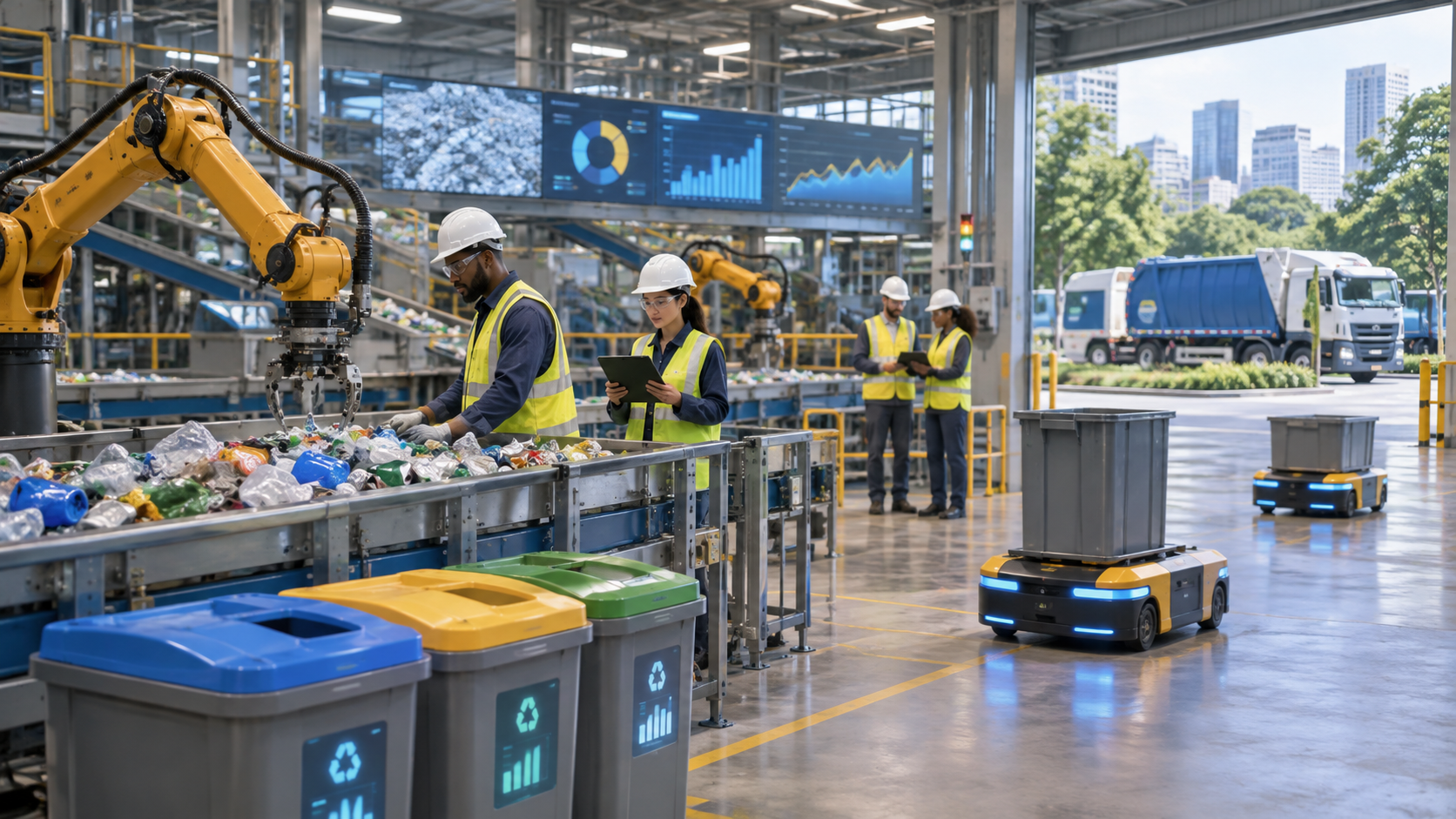
Waste management systems are under unprecedented pressure. Rapid urbanization, rising waste volumes, and tighter environmental regulation are exposing the limits of conventional collection and sorting, while labor shortages at recycling and material recovery facilities make manual operations harder to sustain. AI is filling that gap through robotic sorting, IoT-enabled smart bins, computer vision platforms, and predictive analytics, transforming an industry that has historically been slow to digitize.
According to BCC Research, the Global Market for AI In Waste Management was valued at $44.0 billion in 2025 and is projected to reach $86.8 billion by 2031, a CAGR of 11.9% over 2026–2031. The growth reflects a fundamental shift in how municipalities, waste operators, and industrial facilities approach collection efficiency, recycling purity, and regulatory compliance. Regulatory mandates, ESG investment pressure, and demonstrable cost savings are accelerating adoption across the public and private sectors.
The companies driving this market range from global automation and industrial technology giants to purpose-built AI waste analytics startups. What they share is a focus on using AI to make waste management smarter, more efficient, and more aligned with circular economy goals. The ten companies below are key players shaping the market.
Market Context: Segments and Regional Dynamics
Application Segments
• Smart Waste Collection: $14,675.0 million in 2025, growing at a 10.1% CAGR.
• Automated Sorting and Recycling: $11,184.1 million in 2025, growing at a faster 15.9% CAGR, driven by labor shortages and circular economy mandates.
Technology Segments
• Robotics and Automation: the standout growth category at a 20.6% CAGR, as AI-powered robotic arms replace hazardous manual sorting with 24/7 automated operations.
• Hardware: a 14.8% CAGR, reflecting rising deployment of smart bins, optical sorting systems, and autonomous collection vehicles.
End-Use Segments
• Commercial: led with $11,371.7 million in 2025 and a 14.0% CAGR.
• Residential: $8,584.6 million in 2025 and a 13.4% CAGR.
Regional Dynamics
• North America: the largest region, with 44.1% of the total. The U.S. alone generated $16,761.5 million in 2025 and is projected to reach $30,215.9 million by 2031 at a 10.8% CAGR.
• Europe: the second-largest region, growing at a 12.6% CAGR from $11,821.9 million to $23,449.7 million, propelled by the EU Circular Economy Action Plan, the PPWR, and the forthcoming Digital Waste Shipment System.
• Asia-Pacific: the fastest-growing region at a 17.0% CAGR, rising from $8,394.0 million to $21,132.2 million. India records the highest country-level growth at 22.0% CAGR, accelerated by new Construction and Demolition Waste Management Rules mandating AI-driven monitoring and EPR compliance.
The Top 10 Companies in the Global Market for AI In Waste Management
1. ABB
• Headquarters: Zurich, Switzerland
• Founded: 1988
• Revenue: $33,220 million (FY2025)
• Employees: 111,900
• Focus: Electrification, Motion, Automation
ABB brings deep industrial automation and AI capabilities to waste management through a series of targeted partnerships and acquisitions. A 2026 MoU with Syre aims to jointly develop textile-to-textile recycling technologies in Vietnam, while a 2024 partnership with Molg supports robotic microfactories for e-waste disassembly. The 2024 acquisition of Real Tech added optical sensor and AI-driven analytics for smart water and wastewater management. ABB applies AI, machine learning, and intelligent automation across automotive, mining, and infrastructure sectors.
2. Casella Waste Systems Inc.
• Headquarters: Rutland, Vermont, U.S.
• Founded: 1975
• Revenue: $1,836.8 million (FY2025)
• Employees: 5,600
• Focus: Solid Waste Collection and Disposal, Transfer Services, Recycling Services, Organics Services
Casella Waste Systems operates across three regional segments — Eastern, Western, and Mid-Atlantic — and is integrating AI-enabled technology throughout its collection operations. The company deploys AI-assisted routing systems to minimize unnecessary stops, AI-enabled in-cab safety technology, and advanced collision mitigation systems on its collection trucks. Its recycling business model is structured to reduce exposure to commodity price volatility. An aggressive acquisition strategy complements these operational investments as a primary driver of revenue growth.
3. Clean Harbors Inc.
• Headquarters: Norwell, Massachusetts, U.S.
• Founded: 1980
• Revenue: $6,030.8 million (FY2025)
• Employees: 22,155
• Focus: Hazardous and Non-Hazardous Waste Management, Environmental Services, Safety-Kleen Sustainability Solutions
Clean Harbors is expanding its AI capabilities through its proprietary Waste Information Network (WIN) system, which integrates AI to improve waste tracking, packaging safety, route optimization, and operational monitoring across its hazardous waste network. The company is also deploying proprietary hands-free robotics and AI-powered equipment to accelerate cleaning efficiency and reduce safety risks. Advanced data analytics and automation support compliance management and disposal efficiency across its North American industrial and environmental service operations.
4. IBM Corp.
• Headquarters: Armonk, New York, U.S.
• Founded: 1911
• Revenue: $67,535 million (FY2025)
• Employees: 286,800
• Focus: Software, Consulting, Infrastructure
IBM applies AI, hybrid cloud, and data-driven analytics to waste management through platforms including Watson and AI-powered environmental intelligence tools. The company integrates machine learning and cloud-based analytics to support waste management monitoring, resource optimization, and sustainability reporting. R&D expenditure grew 11.2% in 2025, reflecting accelerated investment in AI, hybrid cloud, and quantum computing. IBM's consulting and software divisions position it as an enterprise-level enabler for organizations digitizing waste operations and environmental compliance management.
5. Microsoft
• Headquarters: Redmond, Washington, U.S.
• Founded: 1975
• Revenue: $281,724 million (FY2025)
• Employees: 228,000
• Focus: Productivity and Business Processes, Intelligent Cloud, More Personal Computing
Microsoft addresses waste management through its Azure IoT Waste Management platform, Sustainability Data Solutions in Microsoft Fabric for ESG and waste tracking, and Microsoft Sustainability Manager for environmental impact monitoring. The company signed a $1.7 billion deal to purchase organic waste — including manure and agricultural waste — as part of a carbon removal strategy targeting carbon negativity by 2030. Its Circular Centers initiative focuses on processing and repurposing decommissioned data center hardware, embedding circularity into its own infrastructure operations.
6. Republic Services
• Headquarters: Phoenix, Arizona, U.S.
• Founded: 1996
• Revenue: $16,591 million (FY2025)
• Employees: 42,000
• Focus: Non-Hazardous Solid Waste Collection, Recycling, Landfill Management, Environmental Solutions
Republic Services committed approximately $800 million to digital transformation in Q1 2025, deploying AI-powered sorting across its Material Recovery Facilities and predictive maintenance AI across a fleet of 17,000 trucks. Smart Operations initiatives include IoT smart bins, fill-level sensors, and GPS fleet management to optimize collection and reduce emissions. A partnership with Oshkosh produced AI-equipped electric garbage trucks capable of scanning incoming waste loads for lithium-ion batteries — a direct response to the growing fire risk at recycling facilities.
7. Terex Corp.
• Headquarters: Norwalk, Connecticut, U.S.
• Founded: 1933
• Revenue: $5,421 million (FY2025)
• Employees: 10,700
• Focus: Environmental Solutions, Materials Processing, Waste and Recycling Solutions
Terex expanded its waste management footprint significantly through the $2 billion acquisition of Environmental Solutions Group in 2024, strengthening its position across North American markets. The company's AI-powered product portfolio includes ZenRobotics 4.0, a fourth-generation waste-sorting robot with upgraded AI for material recovery, and the 3rd Eye AI-powered camera system for fleet safety and route efficiency. Terex also provides lifecycle support and complementary digital solutions to help customers improve return on investment across recycling and waste processing operations.
8. TOMRA Systems ASA
• Headquarters: Asker, Norway
• Founded: 1972
• Revenue: $1,491 million (FY2025)
• Employees: 5,791
• Focus: Collection, Recycling, Food Sorting, Horizon Digital Solutions
TOMRA is one of the most technology-focused companies in the AI waste management market. In 2025, it launched Omra, a plastic sorting and recycling facility in Norway processing 90,000 tons annually using sensor-based sorting and machine learning. In 2026, it introduced FINDER, a flexible metals sorting platform with built-in AI for broader metal recycling applications. The 2024 acquisition of 80% of C-Trace GmbH added digitalization capabilities across the recycling value chain. R&D investment reached $41.6 million in 2025.
9. AMP
• Headquarters: Louisville, Colorado, U.S.
• Founded: 2014
• Focus: AI-Driven Waste Sorting, Robotics, Municipal Solid Waste Processing, Plastics and E-Waste Recycling, Carbon Removal Credits
AMP designs, builds, and operates AI-driven robotic sorting systems for material recovery facilities handling municipal solid waste, plastics, e-waste, and construction debris. In 2025, a partnership with Waste Connections Inc. established an advanced recycling facility in Commerce City, Colorado, targeting 62,000 tons of single-stream recyclables annually using AMP ONE and AMP Smart Sortation technologies. A 2026 capacity expansion in Virginia under SPSA raised the Portsmouth facility to 108,000 tons of MSW annually. AMP also partners with Google to sell biochar-based carbon removal credits.
10. Greyparrot AI
• Headquarters: London, U.K.
• Founded: 2019
• Focus: AI Waste Analytics, Computer Vision Waste Monitoring, Recycling Facility Optimization, Packaging Recyclability Intelligence
Greyparrot AI uses computer vision to monitor and classify waste streams in real time across 111+ waste categories via its Greyparrot Analyzer platform. Its Deepnest product enables consumer goods brands to assess packaging recyclability using real-world data drawn from over 40 billion waste objects processed annually through material recovery facilities. A strategic partnership with Bollegraaf integrates Greyparrot's AI software into recycling plants globally. Greyparrot Sync connects waste analytics directly with recycling machinery, supporting the broader digitization of facility operations.
Conclusion
The AI in waste management market is being shaped by three groups of companies: industrial automation leaders applying existing technology portfolios to waste streams, established waste operators investing in digital transformation at scale, and specialized AI startups building purpose-built analytics and robotics for recycling facilities. Investment is accelerating across all three at once, driven by regulation, ESG commitments, and the straightforward operational economics of AI-optimized collection and sorting.
The projected growth from $44.0 billion in 2025 to $86.8 billion in 2031 shows how broadly AI adoption is expected to spread, from urban municipalities deploying smart bins and fleet management systems to industrial operators integrating robotic sorting into core manufacturing value chains. The companies profiled here illustrate the range of approaches competing for that opportunity, from hardware-led robotics and sensor systems to software platforms focused on analytics, compliance, and circular economy accountability.
Learn More and Take Action:
Consider becoming a member of the BCC Research library and gain access to our full catalog of market research reports in your industry. Not seeing what you are looking for? We offer custom solutions too, including our new product line: Custom Intelligence Services.
Contact us today to find out more.