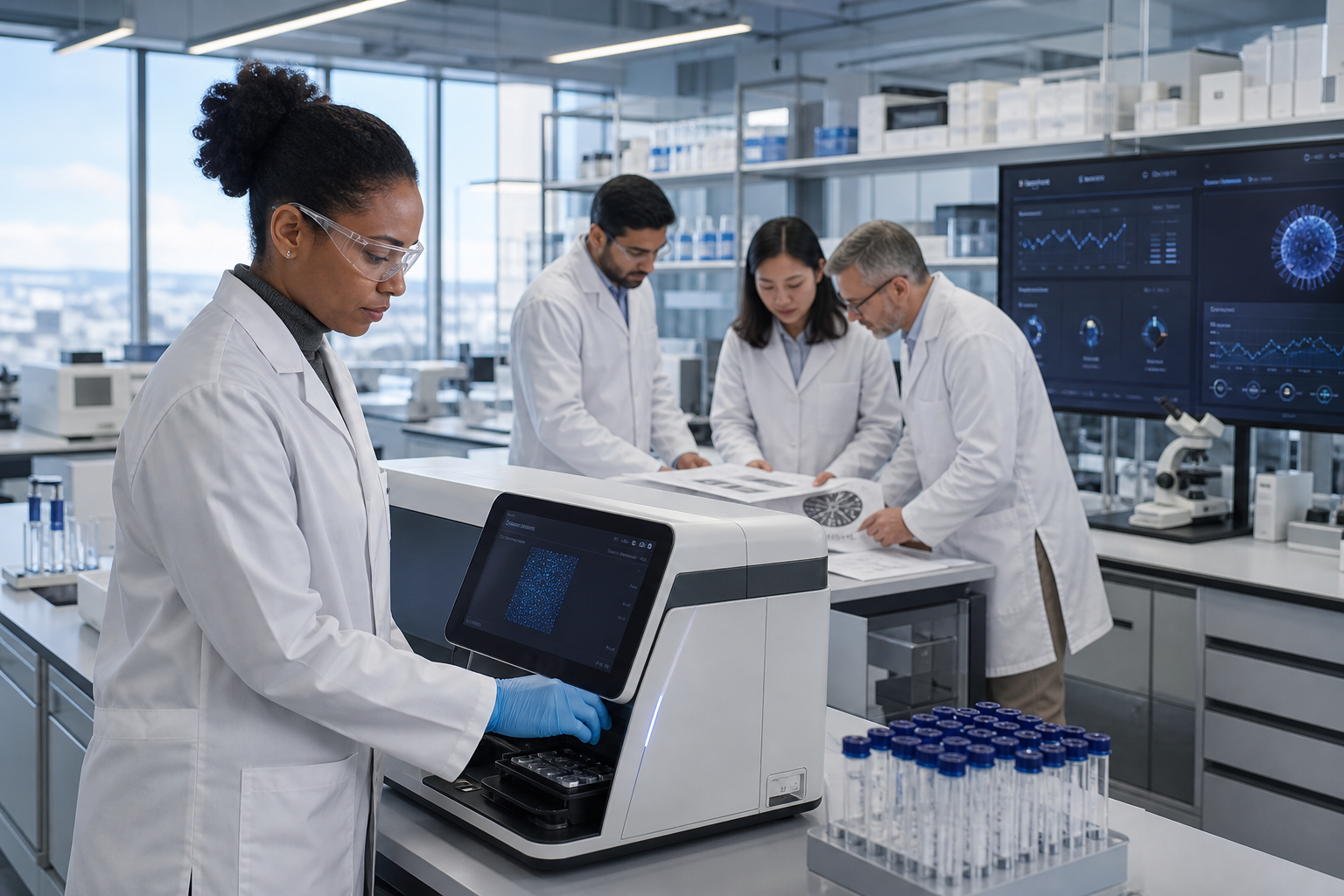
The United States remains the world’s most active market for biodefense investment, where diagnostics, surveillance, and medical countermeasures are increasingly viewed as strategic priorities. The 2001 anthrax letter attacks triggered a major reassessment of the country’s detection and response infrastructure, while the COVID-19 pandemic exposed additional gaps in rapid-response capacity. Together, these events reshaped government priorities and permanently elevated spending on rapid pathogen identification and biodefense treatments.
The U.S. market for biodefense-related rapid pathogen identification and treatments was valued at $7.8 billion in 2025 and is projected to reach $12.1 billion by 2031, expanding at a CAGR of 7.5% from 2026 to 2031. This growth reflects sustained federal funding, continued advances in molecular diagnostics, and broader adoption across clinical, military, and public health settings.
The companies shaping this market operate across diagnostics equipment, sequencing platforms, contract research services, vaccine development, and laboratory reagents. Below is a closer look at ten leading players and the roles they play in strengthening the U.S. biodefense ecosystem.
Market Context: Key Segments and Regional Dynamics
Detection devices represent the largest segment by product type, generating $3.3 billion in 2025 and expanding at an 8.0% CAGR. Among device types, installed systems led with a 36.7% share of the detection device market in 2025, reflecting their central role in continuous monitoring across military, hospital, and public health infrastructure. The fastest-growing device category is portable devices at a 9.7% CAGR, driven by demand for deployable, field-ready platforms in decentralized biodefense and emergency settings. Sensors contributed $2.0 billion in 2025 and are growing at a 6.2% CAGR, supported by applications in environmental surveillance and early warning systems for airborne and waterborne pathogens.
Among testing methods, PCR holds the largest share at 37.4% of the market in 2025 and a 7.5% CAGR, valued for its specificity and multiplexing capability. Sequencing is the fastest-growing method at a 9.4% CAGR, underpinned by federal agency preference for pathogen-agnostic detection tools capable of identifying novel or unknown organisms. On the end-user side, government and defense agencies form the largest segment at $3.8 billion in 2025 and an 8.1% CAGR, with hospitals accounting for $1.8 billion and pharmaceutical and biotechnology companies contributing $1.3 billion.
The Top 10 Companies in the U.S. Market for Biodefense-Related Rapid Pathogen Identification and Treatments
1. Abbott
• Headquarters: Abbott Park, Illinois, U.S.
• Founded: 1888
• Revenue: $44,328 million (2025)
• Employees: 115,000
• Focus: Medical devices, diagnostics, nutritional products, established pharmaceuticals
Abbott operates one of the most comprehensive infectious disease diagnostic portfolios in the market, spanning rapid near-patient tests, high-throughput central-lab platforms, and advanced informatics. The company holds the highest number of WHO-prequalified IVD assays for viral infectious diseases. In 2024, the WHO listed Abbott's Alinity MPXV assay — the first monkeypox IVD — under its Emergency Use Listing procedure. Strategic R&D priorities center on global disease surveillance, precise pathogen detection, and intelligent diagnostic solutions.
2. Agilent Technologies Inc.
• Headquarters: Santa Clara, California, U.S.
• Founded: 1999
• Revenue: $6,948 million (FY2025)
• Employees: 18,100
• Focus: Life sciences and diagnostics instruments, laboratory services, applied market solutions
Agilent supports the biodefense diagnostics market through mass spectrometry, liquid chromatography, target enrichment panels, and automated sequencing workflows. The company has expanded its capabilities through acquisitions, notably Sigsense in 2024, which adds AI-powered laboratory operations technology to its portfolio, and Biovectra for biologics manufacturing support. Agilent's growth strategy centers on instruments, software, consumables, and services that span the full laboratory workflow, with companion diagnostics and lab automation as key expansion areas.
3. bioMerieux
• Headquarters: Marcy l'Etoile, France
• Founded: 1963
• Revenue: $4,603.3 million (FY2025)
• Employees: 15,000
• Focus: Clinical and industrial diagnostics, molecular biology tools, microbiology, immunoassays, food safety testing
bioMerieux holds the number-two competitive ranking in the U.S. market for biodefense-related rapid pathogen identification and treatments. The company's BioFire Defense division anchors its biodefense sensor presence, while its BioFire Spotfire Respiratory/Sore Throat panels received FDA 510(k) clearance in 2024 for point-of-care multiplex PCR testing. A 2025 partnership with the AI Institute Mila applies machine learning to diagnostics workflows. R&D spending reached $573.9 million in 2025, representing 12.5% of sales.
4. Bio-Rad Laboratories Inc.
• Headquarters: Hercules, California, U.S.
• Founded: 1952
• Revenue: $2,583.2 million (FY2025)
• Employees: 7,400
• Focus: Life science research tools, clinical diagnostics
Bio-Rad is strengthening its position in PCR-based pathogen detection through a focused expansion of its digital PCR portfolio. The 2025 acquisition of Stilla Technologies, a French-American specialist in digital PCR, adds capabilities relevant to cell and gene therapy, cancer, and infectious disease testing. The company's broader diagnostics offering includes thermal cyclers, PCR detection kits, blood typing, quality control products, and wastewater testing solutions used in public health surveillance programs.
5. Charles River Laboratories
• Headquarters: Wilmington, Massachusetts, U.S.
• Founded: 1947
• Revenue: $4,015 million (FY2025)
• Employees: 19,700
• Focus: Preclinical research models, discovery and safety assessment, biologics manufacturing support
Charles River Laboratories occupies a contract research and manufacturing support role across the biodefense value chain, from basic research through regulatory compliance. The company's Manufacturing Solutions segment supports quality, safety, and regulatory compliance for biologics and advanced therapies, while its microbiology and endotoxin products serve vaccine production and infectious disease research. Charles River also offers NGS-based pathogen testing services, including GMP-compliant genetic characterization of cell lines and comprehensive data analysis.
6. F. Hoffmann-La Roche Ltd.
• Headquarters: Basel, Switzerland
• Founded: 1896
• Revenue: $74,221.1 million (FY2025)
• Employees: 112,774
• Focus: Pharmaceuticals, diagnostics
Roche brings substantial scale to both the diagnostics and pharmaceutical sides of the biodefense market. In 2024, the company acquired LumiraDx's point-of-care technology to extend its decentralized diagnostics reach into primary care and pharmacy settings. In 2025, Roche launched sequencing-by-expansion (SBX) technology, a next-generation ultra-speed sequencing platform, with an NGS product planned for early 2026. Its Diagnostics Division is simultaneously expanding pathology and molecular solutions globally across clinical and research applications.
7. GenScript
• Headquarters: Piscataway, New Jersey, U.S.
• Founded: 2002
• Revenue: $959.5 million (FY2025)
• Employees: 6,165
• Focus: Gene synthesis, protein engineering, antibody development, biologics development services, industrial synthetic biology
GenScript serves the research and development backbone of biodefense through gene synthesis, peptide and oligonucleotide synthesis, genome editing, and molecular diagnostics reagents. The company launched its FLASH gene service in 2024, delivering sequence-to-plasmid synthesis in under four days. R&D spending rose 32.4% in 2025 to $71.2 million, reflecting investment in automation and digitalized workflows. GenScript operates across more than 100 countries with a growing base of pharmaceutical and biotechnology customers.
8. GSK plc
• Headquarters: London, U.K.
• Founded: 2000
• Revenue: $43,069.4 million (FY2025)
• Employees: 66,841
• Focus: Specialty medicines, vaccines, general medicines
GSK is advancing one of the most active mRNA vaccine pipelines with direct relevance to biodefense preparedness. Programs include a multivalent seasonal influenza vaccine (GSK4382276), a second-generation mRNA COVID-19 vaccine (GSK4396687) developed with CureVac, an H5N1 mRNA influenza candidate (GSK5536522) in Phase I/II trials, and a combination influenza/COVID-19 mRNA vaccine (GSK5475152). The company invested $9.9 billion in R&D in 2025 across a pipeline of 58 assets, with a licensing agreement with Touchlight to use enzymatic dbDNA technology for mRNA product manufacturing.
9. Illumina Inc.
• Headquarters: San Diego, California, U.S.
• Founded: 1998
• Revenue: $4,343 million (FY2025)
• Employees: 8,600
• Focus: Next-generation sequencing instruments and consumables, array-based genomic analysis, oncology testing, multi-omics
Illumina is the defining platform company in the sequencing segment, which is projected to grow at the highest CAGR of 9.4% through 2031 within this market. Sequencing revenue accounts for approximately 92% of total company revenue. The 2024 spin-off of GRAIL improved gross margins to 66.1% in 2025, and the 2025 acquisition of SomaLogic extends Illumina's reach into proteomics and biomarker discovery. Federal agencies including BARDA actively fund sequencing-based agnostic diagnostics, a trend that directly benefits Illumina's core platform.
10. Johnson & Johnson
• Headquarters: New Brunswick, New Jersey, U.S.
• Founded: 1887
• Revenue: $94,193 million (FY2025)
• Employees: 140,800
• Focus: Innovative medicines spanning immunology, infectious diseases, oncology, neuroscience, and cardiovascular; medical devices
Johnson & Johnson brings scale and a diversified pharmaceutical portfolio to the biodefense-adjacent therapeutics landscape. Its Innovative Medicine segment generated $60.4 billion in sales in 2025, a 6.0% increase from 2024, with infectious diseases among the covered therapeutic areas. A notable recent milestone is EC and FDA approval of Edurant (rilpivirine) for HIV-1 treatment in pediatric patients. The MedTech segment contributed $33.8 billion in 2025, reflecting broad healthcare infrastructure reach relevant to clinical biodefense settings.
Conclusion
The ten companies profiled here collectively illustrate the breadth of the biodefense-related rapid pathogen identification and treatments market. The competitive landscape spans platform diagnostics companies scaling portable and multiplexed detection, sequencing specialists responding to federal demand for pathogen-agnostic surveillance, CROs enabling the research and manufacturing pipeline, and pharmaceutical companies advancing next-generation vaccine platforms. No single technology or product category dominates; the market is defined by the interplay of multiple disciplines working toward faster, more accurate, and more accessible threat detection and response.
The forecast period through 2031 will be shaped by how effectively companies navigate regulatory timelines, capitalize on sustained government funding, and translate emerging technologies — particularly mNGS, CRISPR-based diagnostics, and mRNA therapeutics — from development into deployed products. The companies that can align commercial strategy with federal procurement priorities and clinical adoption curves are best positioned to capture a meaningful share of a market expected to reach $12.1 billion by 2031.
Learn More and Take Action:
Consider becoming a member of the BCC Research library and gain access to our full catalog of market research reports in your industry. Not seeing what you are looking for? We offer custom solutions too, including our new product line: Custom Intelligence Services.
Contact us today to find out more.