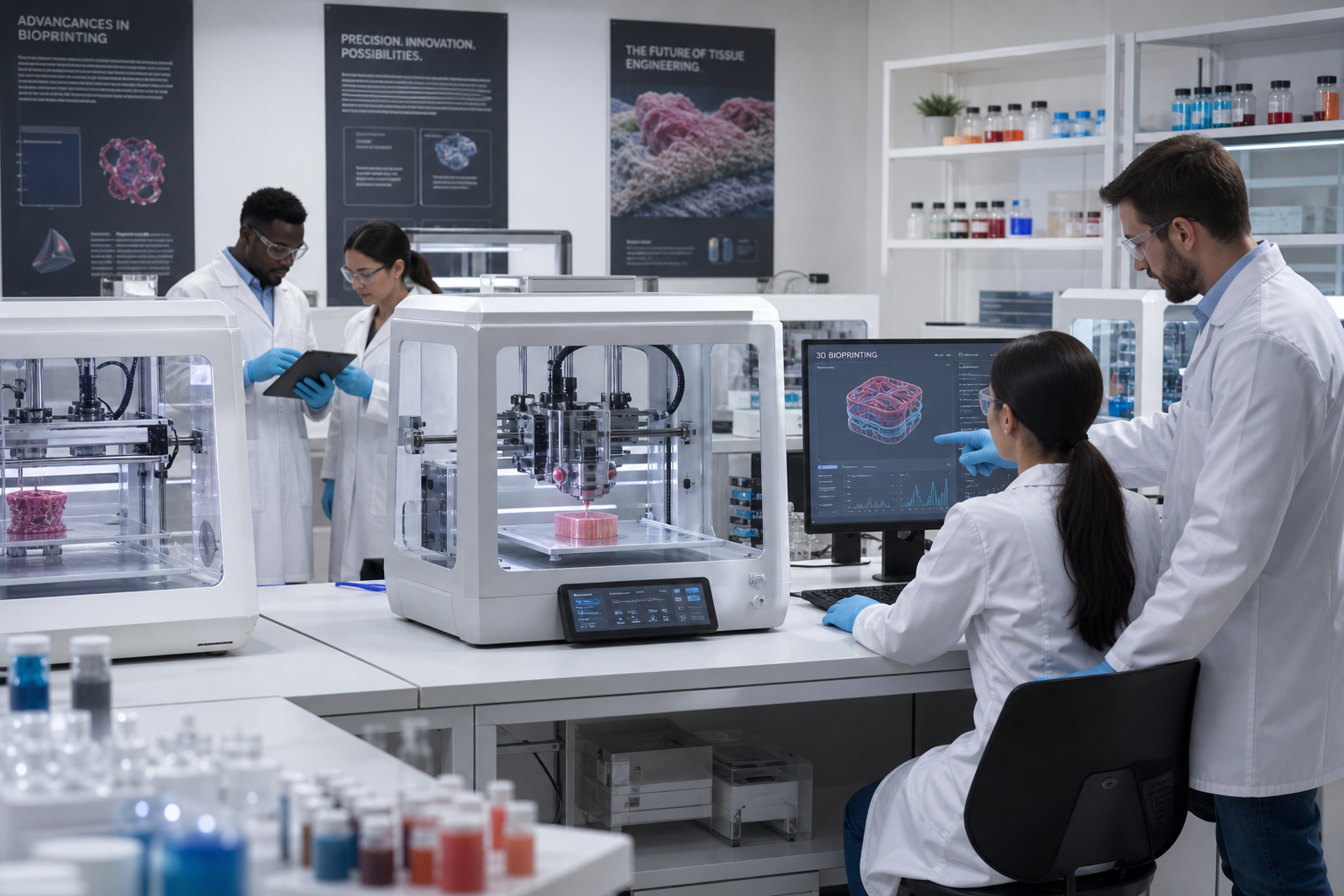
The global bioprinting market sits at a compelling intersection of biology, materials science, and precision manufacturing. Demand is rising across pharmaceutical research, regenerative medicine, and organ transplantation as bioprinted tissue constructs prove their value as alternatives to animal models and donor tissues. Legislative pressure on animal testing in cosmetics, a persistent organ donor shortage, and the growing cost burden of clinical drug development are all accelerating adoption. At the same time, advances in bioink formulations, AI-assisted process control, and new printer hardware are steadily expanding what is technically achievable.
Market sizing from BCC Research's report Current Bioprinting Prospects and Future Innovations: Global Markets places the global bioprinting market at $2.1 billion in 2024, with a forecast of $5.1 billion by 2030, reflecting a CAGR of 16.1% over the 2025–2030 period. That growth rate is consistent across all major product and technology segments, pointing to broad-based expansion rather than a single dominant driver. Bioinks are the fastest-moving segment, growing at 17.4% CAGR, while bioprinters remain the largest single product category at $964.2 million in 2024.
The companies shaping this market range from established medical technology firms with large revenue bases to focused startups advancing a single clinical application. What follows is a look at ten players that collectively span the width of the bioprinting value chain — from hardware and software through bioinks, cell culture products, and clinical-stage tissue therapeutics.
Market Context: Segments and Regional Leadership
Bioprinters account for the largest share of 2024 revenues at $964.2 million, with extrusion-based systems at $447.7 million representing the dominant technology within that category. Desktop bioprinters, valued at $339.8 million, are gaining ground quickly as research institutions and academic programs seek accessible, high-resolution options. Bioinks, the second-largest segment at $676.8 million, are growing faster than hardware, driven by natural bioinks ($321.3 million, 17.9% CAGR) and cellular bioinks ($202.9 million, 17.2% CAGR). On the application side, tissue engineering and regenerative medicine is the largest end-use category at $754.6 million, followed closely by drug discovery and toxicology testing at $654.2 million — reflecting the pharmaceutical industry's strong appetite for in vitro alternatives to animal models.
North America holds approximately 38% of the global market, valued at $801.8 million in 2024, underpinned by a dense concentration of leading bioprinting firms, a robust pharmaceutical industry, and strong research infrastructure. The U.S. alone accounts for $681.5 million and is projected to reach $1.7 billion by 2030. Europe, at roughly 31% and $654.1 million, is supported by institutional R&D investment and an active academic sector. Asia-Pacific is the fastest-growing region at a 17.3% CAGR, led by China's 18.3% growth trajectory and substantial government funding in regenerative medicine. Germany is Europe's largest country market at $228.9 million, while the U.K. and India are both posting above-average growth rates driven by regulatory reforms and expanding research ecosystems.
Ten Companies Shaping the Bioprinting Market
1. 3D Systems Inc.
• Headquarters: Rock Hill, South Carolina, U.S.
• Founded: 1986
• Revenue: $440.1 million (FY2024)
• Employees: 1,833
• Focus: 3D printers and materials across metal, plastic, dental, and healthcare verticals; bioprinting via Allevi
3D Systems is one of the largest and most broadly established companies in additive manufacturing, with bioprinting forming a focused component of its healthcare portfolio through its Allevi platform. Ranked among the top bioprinting companies, the firm is active in patent filings covering high-efficiency transport architectures for organ systems and modular print bed technologies. Operations span the U.S., Europe, Middle East and Africa, and Asia-Pacific, with collaborations and acquisitions used to extend its bioprinting capabilities.
2. CollPlant Biotechnologies Ltd.
• Headquarters: Rehovot, Israel
• Founded: 2006
• Revenue: $0.515 million (FY2024)
• Employees: 58
• Focus: Plant-derived rhCollagen, bioinks, and 3D bioprinting materials
CollPlant produces plant-based recombinant human collagen (rhCollagen) that serves as a foundational bioink material. The company gained notable visibility in 2025 when Mayo Clinic researchers used its rhCollagen to develop the first fully humanized 3D bioprinted skin model. CollPlant is expanding its North American footprint through a new U.S.-based logistics facility and has entered an expanded agreement with STEMCELL Technologies to allow clinical-scale use of its rhCollagen beyond research applications.
3. 3D Biotek LLC
• Headquarters: Warren, New Jersey, U.S.
• Founded: 2007
• Focus: 3D cell culture devices, porous scaffolds, bioreactors, stem cell and tissue engineering, drug discovery
3D Biotek applies its Precision 3D Micro-Fabrication and Advanced Bio-Manufacturing technologies to produce cell culture devices used in tissue engineering, drug discovery, and cell biology research. Its product line includes 3D Insert-PS porous scaffolds compatible with standard multi-well plates, the 3D Cell Expansion System for large-scale anchorage-dependent cell culture, and a 3D Perfusion Bioreactor supporting long-term cultures. Products are distributed globally through partners including Sigma-Aldrich, with reach across North America, Europe, Asia, and Africa.
4. Advanced Solutions Life Sciences LLC
• Headquarters: Louisville, Kentucky, U.S.
• Founded: 2013
• Focus: Bioprinting hardware, software platforms, bioapps, organoid development, vascularization solutions
Advanced Solutions Life Sciences (ASLS), a subsidiary of Advanced Solutions Inc., develops the BioAssemblyBot (BAB) platform alongside supporting software and bioapps for biofabrication. Its tools enable researchers to create vascularized organoids and sophisticated 3D tissue models. In 2025 the company launched Organoid 360, a pre-configured automation platform for organoid operations, following the 2023 introduction of the Single Cell Dispense BAB Hand. The company also holds patents in bone graft fabrication and multi-material dispensing.
5. Brinter
• Headquarters: Santa Monica, California, U.S.
• Founded: 2020
• Focus: Modular bioprinters, bio-synthetic implants, orthopedic and soft tissue applications, bioink distribution
Brinter develops modular 3D bioprinting hardware and bio-synthetic implants designed to replicate the biomechanical properties of natural tissue for applications including meniscus repair and tendon and ligament rebuilding. R&D is conducted at the Wake Forest Institute for Regenerative Medicine. In 2023, Brinter signed a distribution agreement for GrowInk bioinks from UPM Biomedicals, broadening its materials offering. A 2025 patent application reflects the company's continuing work on additive manufacturing methods for bio-mimetic nanocomposite scaffolds.
6. Cellbricks
• Headquarters: Berlin, Germany
• Founded: 2016
• Focus: Light-based biofabrication, AI-driven tissue engineering, bioprinted adipose tissue, regenerative medicine
Cellbricks operates a stereolithography-based bioprinting platform achieving up to 10-micrometer resolution and integrates AI-driven fluid dynamics with deep learning process control for tissue engineering. In April 2025 the company reached a significant milestone: preclinical mouse studies demonstrated complete tissue integration and vascular development with no fibrosis using its bioprinted adipose tissue graft. To support clinical translation and access to capital and talent, the company opened a U.S. subsidiary in Cambridge, Massachusetts in November 2024.
7. CELLINK
• Headquarters: Gothenburg, Sweden
• Founded: 2016
• Focus: Bioprinters, bioinks, software, support services for academic and pharmaceutical laboratories
CELLINK, a subsidiary of BICO Group AB, serves more than 1,600 laboratories across 65 countries, making it one of the most internationally distributed bioprinting companies in the market. Its product range covers bioprinters, bioinks, software, and customer support throughout the bioprinting workflow. CELLINK collaborates with the University of California, San Diego, on a 3D Bioprinting Center of Excellence targeting tissue engineering, cancer research, and drug development. The company is also active in patent filings covering bioprinter hardware and modular nozzle technologies.
8. Foldink
• Headquarters: Yerevan, Armenia
• Founded: 2018
• Focus: Bioinks, customizable bioprinters, living tissue fabrication for cancer research, drug screening, and transplantation
Foldink develops proprietary bioinks — including mColMA formulations and hydrogels — alongside customizable bioprinter systems to help researchers produce living tissues and vascularized organs in laboratory settings. The company's applications include cancer research, medication screening, and transplantation. Operating in both Armenia and the U.S., Foldink competes in a market where collaborations, partnerships, and continuous materials innovation are central competitive factors.
9. Precisebio
• Headquarters: Greensboro, North Carolina, U.S.
• Founded: 2015
• Focus: Bioprinted corneal implants, retinal patches, proprietary ECM-based bioinks for ophthalmic applications
Precisebio is advancing its PB-001 bioprinted corneal implant through clinical trials, with the first patient successfully treated at Rambam Medical Center in Haifa, Israel in 2025 as part of an ongoing Phase 1 trial. The company's platform uses proprietary bioink formulations incorporating extracellular matrix for structural integrity, growth factors for cell viability, and cross-linking materials. Its focus on cornea grafts and retinal patches positions it as a clinical-stage company targeting ophthalmic tissue replacement as an alternative to donor tissue.
10. PrintBio Inc.
• Headquarters: New York, U.S.
• Founded: 2024
• Focus: Living tissue implants, 3D-printed resorbable surgical mesh, regenerative medicine, material technology
PrintBio develops living tissue implants designed to address complex diseases and congenital defects. Despite being founded in 2024, the company has moved quickly through regulatory milestones: an earlier product, 3DMatrix, received FDA 510(k) clearance in May 2024 as the first 3D-printed resorbable surgical mesh for soft tissue reinforcement, followed by clearance for 3DMatrix DynaFlex, which incorporates Uniflex unidirectional flexible mesh technology for plastic and reconstructive surgery applications.
Conclusion
The bioprinting market in 2024 is far from monolithic. It encompasses large-revenue hardware and materials businesses, clinical-stage companies pursuing first-in-human trials, and research-focused suppliers serving pharmaceutical and academic customers. What connects them is exposure to the same structural tailwinds: growing pharmaceutical demand for in vitro alternatives to animal models, persistent organ donor shortages, and rapid advances in bioink materials and AI-assisted process control. The 16.1% CAGR projected through 2030 reflects genuine momentum, not speculative optimism.
Regional dynamics will matter increasingly as the market scales. North America holds its leadership position through infrastructure and commercial density, but Asia-Pacific's 17.3% growth rate — led by China and supported by India's regulatory reforms — signals where new demand will emerge. Meanwhile, clinical milestones like Precisebio's corneal implant trial and Cellbricks' adipose tissue integration results are beginning to move bioprinting from a predominantly research-oriented market toward one with tangible therapeutic outputs. Companies that can navigate regulatory pathways while continuing to reduce the cost and complexity of their platforms are best positioned to capture that transition.
Learn More and Take Action:
Consider becoming a member of the BCC Research library and gain access to our full catalog of market research reports in your industry. Not seeing what you are looking for? We offer custom solutions too, including our new product line: Custom Intelligence Services.
Contact us today to find out more.