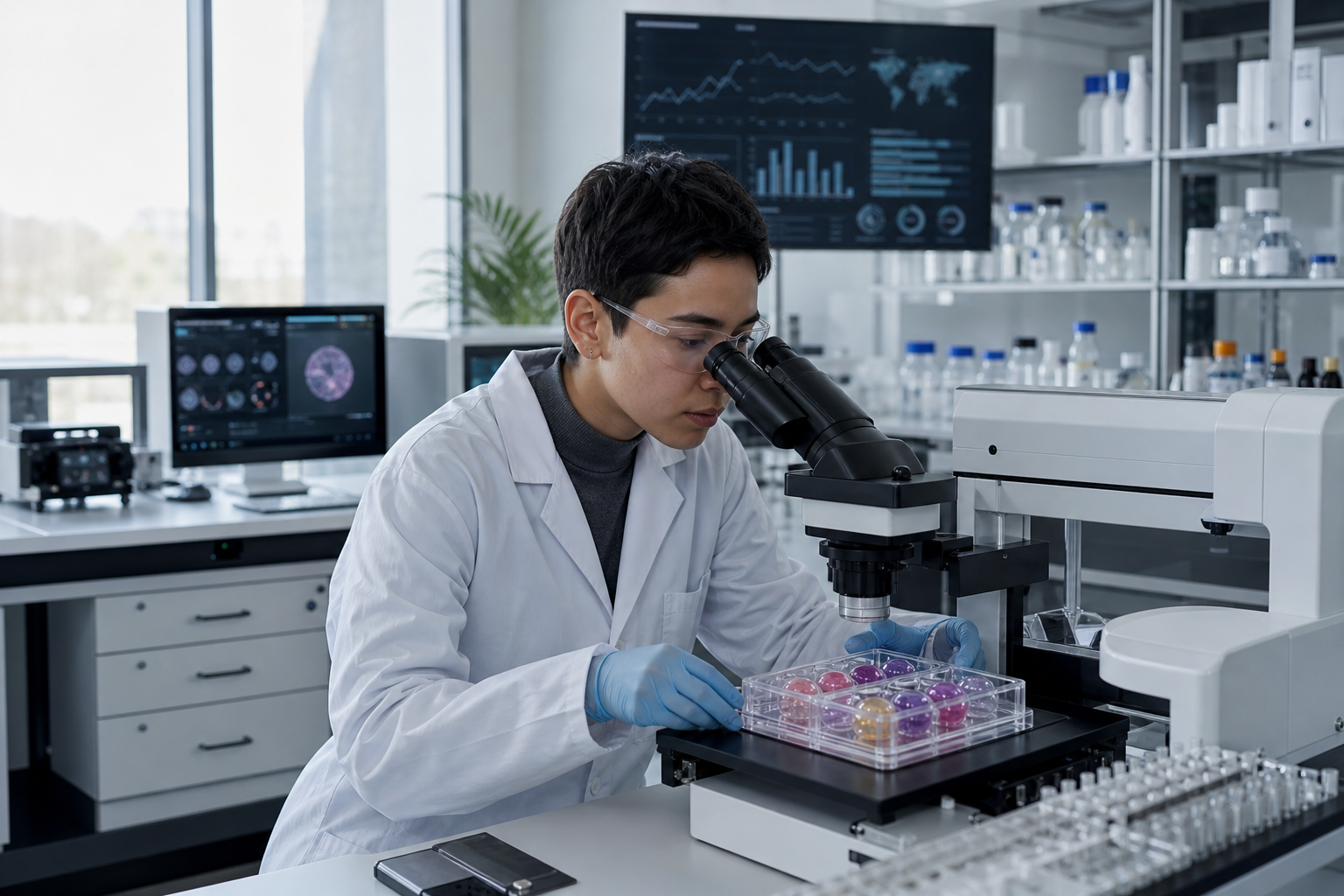
The global organoids and spheroids market stands at $1.3 billion in 2025, a figure that reflects decades of biological discovery, technical refinement, and shifting expectations about what preclinical research should look like. What began as exploratory work in developmental biology has expanded into a platform technology that pharmaceutical companies, academic institutions, and contract research organizations now treat as essential infrastructure for drug discovery and disease modeling.
This article traces that journey — from the foundational science that made three-dimensional cell culture possible, through the regulatory and commercial milestones that shaped today's market, to the forces driving growth toward an estimated $2.8 billion by 2031.
The Scientific Foundations: Why 3D Culture Mattered
For much of the twentieth century, cell biology depended on two-dimensional culture — cells grown flat on plastic or glass surfaces. The approach was practical and reproducible, but it came with a fundamental limitation: cells in a monolayer behave differently from cells in living tissue. They lose the physical and chemical relationships with neighboring cells and the surrounding matrix that govern how they grow, divide, respond to drugs, and develop resistance. The result was a persistent gap between what happened in the laboratory and what happened in patients.
The concept of three-dimensional cell culture addressed this gap directly. Spheroids — compact, self-organizing aggregates of cells — were among the earliest 3D models to gain traction in research settings. Multicellular tumor spheroids in particular attracted attention in oncology because they replicate aspects of solid tumor biology that monolayer cultures cannot, including oxygen and nutrient gradients, cell-cell signaling, and the kinds of drug resistance mechanisms seen in clinical tumors. Researchers recognized early on that a tumor spheroid was a closer approximation of a real tumor than any flat culture could be.
Organoids developed as a conceptually related but more architecturally ambitious approach. Rather than simply aggregating cells into a sphere, organoid technology aims to grow miniature, self-organized structures that recapitulate the cellular diversity, spatial organization, and functional properties of specific organs. The intestine, liver, brain, kidney, lung, and pancreas all have organoid counterparts that have been established and validated in research settings. This capacity to reproduce organ-level structure made organoids especially powerful for disease modeling, drug discovery, and developmental biology.
The 2010s: Commercialization Begins to Take Shape
The translation of organoid and spheroid science from academic curiosity into commercial product lines accelerated during the 2010s as the pharmaceutical industry's dissatisfaction with conventional preclinical models became harder to ignore. High failure rates in clinical trials — particularly in oncology — focused attention on the predictive limitations of both animal models and 2D cell culture, and created genuine commercial demand for better alternatives.
Established life science companies began building or acquiring capabilities in 3D cell culture. Platforms for ultra-low attachment culture, specialized extracellular matrices, and defined culture media became commercial products rather than laboratory recipes. Companies including Thermo Fisher Scientific, Corning, Lonza, and STEMCELL Technologies expanded their portfolios in this direction. Specialized players such as InSphero focused specifically on spheroid-based liver and pancreas microtissues for toxicity testing, occupying a niche that larger companies had not yet filled.
The adoption of automated high-content imaging also played an important role during this period. Pharmaceutical companies running large compound libraries needed the ability to analyze spheroid and organoid responses at scale, and high-content imaging platforms provided the throughput to make that feasible. The combination of improved 3D culture products and better analytical tools made spheroid-based screening a viable option for routine drug discovery workflows, not just specialized research projects.
The 2020s: Regulatory Recognition and Accelerating Investment
The most consequential shift of the early 2020s was regulatory in nature. Drug development agencies in multiple jurisdictions began formally acknowledging that human-relevant, cell-based models could and should play a greater role in preclinical evaluation — a recognition that carried significant commercial implications for the organoid and spheroid sector.
In January 2024, China's National Medical Products Administration formally recognized organoids as supportive tools for evaluating stem cell products. This was a meaningful regulatory milestone for organoid commercialization in one of the world's largest biomedical markets. The significance deepened in 2025, when China's NMPA took further steps, recognizing organoids as non-clinical models for rare disease drug development and introducing regulations governing emerging biomedical technologies. For companies seeking to commercialize organoid platforms in China, these regulatory frameworks provided clarity and legitimacy that had previously been absent.
Other national initiatives reinforced the direction of travel. South Korea's Ministry of Food and Drug Safety launched a national organoid consortium in 2025 involving industry, academia, and research institutions, with an explicit mandate to expand organoid use as alternatives to animal testing. In Australia, the New South Wales Government funded the launch of the NSW Organoid Innovation Centre with $2.5 million from its Emerging Industry Infrastructure Fund, combining robotics, artificial intelligence, and stem cell technologies to enable standardized organoid production. France's 2030 initiative allocated $54.7 million over six years to its Organs and Organoids-on-Chips program. The pattern across these initiatives was consistent: governments treating organoid infrastructure as a strategic research asset rather than purely a commercial concern.
Corporate activity kept pace with the policy environment. In 2025, Merck KGaA acquired HUB Organoids B.V. to enhance its Life Science portfolio and expand access to HUB's organoid technologies, consolidating its position in a market where scale and proprietary platforms increasingly determine competitive standing. Merck also partnered with Promega Corp. to develop advanced technologies for drug screening and discovery, combining capabilities in organoids and synthetic chemistry with Promega's assay and reporter technologies for real-time monitoring of cellular activity in 3D cell culture models. In April 2023, PerkinElmer Inc. adopted the Revvity name following divestiture of non-core businesses, sharpening its focus on life sciences and diagnostics including organoid and spheroid screening services.
The Market Today: Size, Segments, and Geography
The global organoids and spheroids market reached $1.3 billion in 2025 and is projected to grow to $2.8 billion by 2031 at a compound annual growth rate of 14.1% from 2026 to 2031.
Organoids are the larger segment at $765.8 million in 2025, commanding 61.2% market share and growing at 15.9% CAGR. Their dominance reflects their structural and functional sophistication — the ability to replicate organ architecture, cellular diversity, and physiological function gives organoids a level of biological relevance that simpler models cannot match. Intestinal organoids represent a major sub-segment, reflecting the maturity of intestinal organoid science and its established role in disease modeling and drug discovery workflows globally.
Spheroids contribute $486.3 million in 2025 and grow at 12.0% CAGR. Their advantages are different from organoids but equally real: simpler culture methods, higher reproducibility, lower costs, and compatibility with automated high-throughput screening platforms have made spheroids the default choice for many oncology and toxicity testing applications. Multicellular tumor spheroids lead the spheroid sub-segment with 40.1% market share, reflecting the sustained demand from cancer drug discovery.
By application, drug discovery and personalized medicine is the largest and fastest-growing segment at $376.8 million and 16.2% CAGR, followed by developmental biology at $305.6 million and disease pathology studies at $242.1 million. Drug toxicity and efficacy testing contributes $195.1 million, with regenerative medicine at $132.6 million. Pharmaceutical and biotechnology companies are the largest end user group at $513.0 million — 41% of the market — while academic and research institutes represent the fastest-growing end user segment at 15.3% CAGR.
North America leads geographically with 43.5% of the market and $544.9 million in 2025, projected to reach $1,208.7 million by 2031 at 14.3% CAGR. The U.S. accounts for the bulk of this at $465.5 million in 2025. Europe holds 27.4% at $342.7 million, with Germany as the largest national market and the U.K. projected to achieve the highest European CAGR of 15.8%. Asia-Pacific, at 20.3% and $254.3 million in 2025, is the fastest-growing region with a 15.4% CAGR to 2031, led in growth rate by Japan at 17.2% and India at 16.4%.
Where the Market Goes Next
Several converging forces are expected to sustain the market's growth trajectory through 2031 and beyond.
The structural shift from 2D to 3D cell culture is ongoing. Pharmaceutical companies continue to seek preclinical models that reduce late-stage clinical failures, and organoids and spheroids consistently outperform monolayer cultures on the metrics that matter: physiological relevance, predictive accuracy, and the preservation of patient-specific tumor characteristics. The broader regulatory movement toward New Approach Methodologies — human cell-based systems as alternatives to animal testing — reinforces demand from the top down.
Technology is addressing the sector's main constraints. Automated high-throughput organoid platforms combining robotic liquid handling, AI-based image analysis, and microplate-based screening are tackling the scalability and reproducibility problems that have historically limited organoid use in high-volume pharmaceutical workflows. Three-dimensional bioprinting offers more precise control over tissue architecture than self-organization-based culture, enabling vascularized and compartmentalized organoid designs with better consistency. CRISPR genome editing integrated with organoid models is enabling investigation of cancer progression, rare genetic diseases, and inherited disorders in human tissue models — a capability with significant implications for both drug discovery and precision therapeutics. AI-enabled image analysis platforms are improving the throughput and accuracy of organoid-based drug screening, reducing the manual burden that has constrained adoption in smaller laboratories.
On the application side, rising global cancer burdens continue to drive demand for patient-derived organoid models in precision oncology, where organoids allow drug response testing specific to an individual patient's tumor. Government funding programs in France, South Korea, Australia, and the Gulf states are building the research infrastructure needed to expand adoption beyond the largest academic centers. In Asia-Pacific, government investment in precision medicine and rapidly growing biotechnology sectors in China, Japan, South Korea, and India are creating new demand centers that are projected to outpace established markets in growth rate.
Conclusion
The organoids and spheroids market has moved in a relatively short period from specialized academic science to a commercial infrastructure supporting pharmaceutical R&D, precision oncology, toxicity testing, and disease modeling at global scale. The $1.3 billion market of 2025 is the product of converging biological insight, technological refinement, regulatory evolution, and investment — from both public funders and industry participants who recognize that better preclinical models translate directly into better drug development outcomes.
The trajectory toward $2.8 billion by 2031 reflects a market that is still in the process of broadening its reach — into new geographies, new application areas, and new end user segments. As automation, artificial intelligence, and bioprinting lower the technical and economic barriers to adoption, the question is less whether organoids and spheroids will become standard tools in biomedical research and drug development, and more how quickly and completely that transition will occur.
Learn More and Take Action:
Consider becoming a member of the BCC Research library and gain access to our full catalog of market research reports in your industry. Not seeing what you are looking for? We offer custom solutions too, including our new product line: Custom Intelligence Services.
Contact us today to find out more.