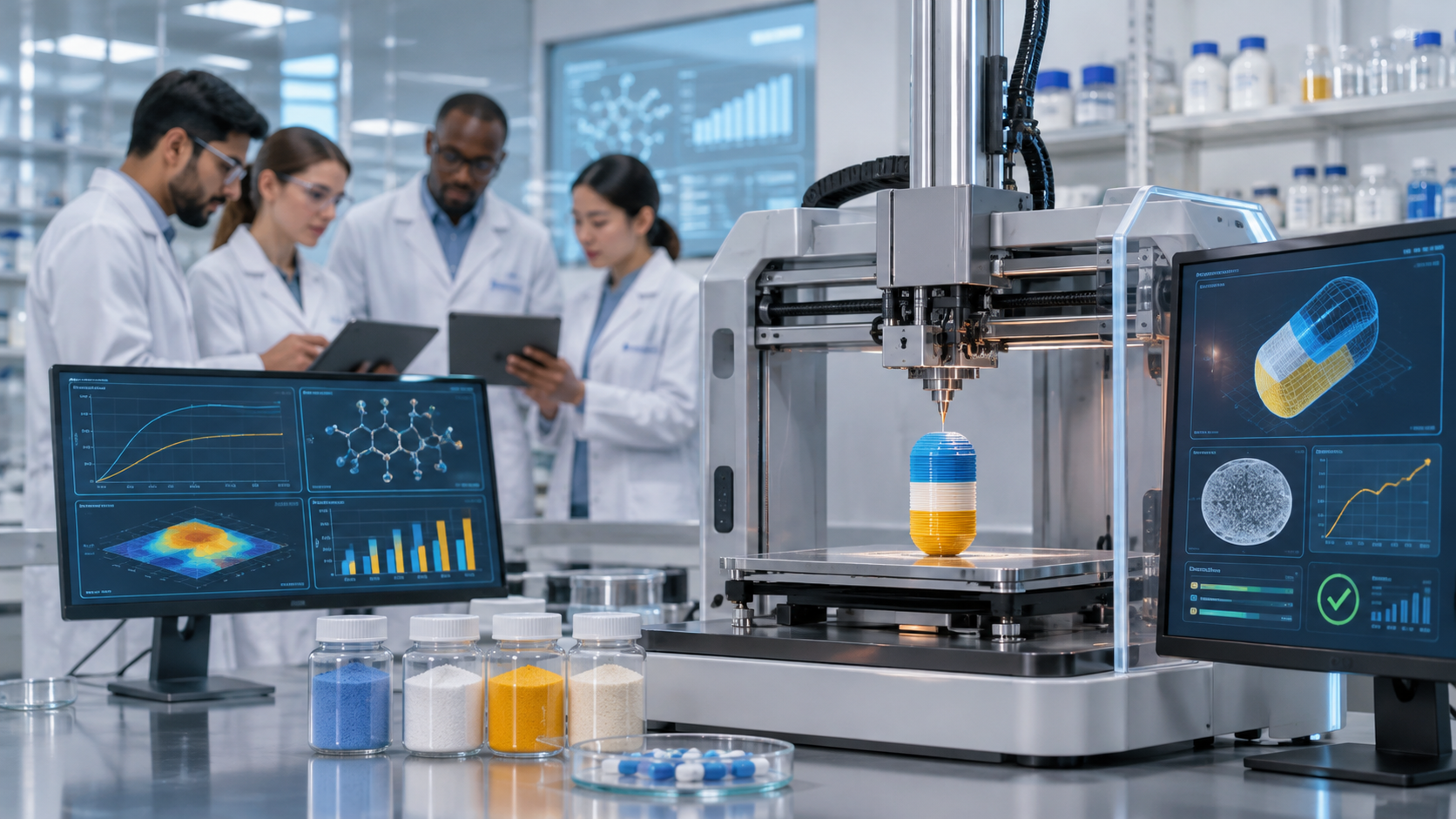
The pharmaceutical industry is shifting from standardized batch manufacturing toward patient-specific formulations tailored to an individual's biology, age, and disease profile. At the center of this shift is the convergence of artificial intelligence and 3D printing, which is moving from academic research into clinical and commercial deployment.
Why This Convergence Matters Now
Investment signals confirm the scale of the shift:
• AI-focused businesses attracted 61% of worldwide venture capital in 2025 ($258.7 billion of $427.1 billion), more than double their 30% share in 2022.
• Triastek raised over $85 million across funding rounds between 2020 and 2023 to develop AI-enabled 3D-printed oral drug delivery, and BioNTech partnered with the company in 2025 on 3D-printed RNA therapeutics.
• CurifyLabs secured $7.3 million in funding plus $6.1 million in EU grant financing in 2025 to scale its automated pharmaceutical 3D printing platform.
These are not speculative bets. They reflect a growing consensus that AI-integrated pharmaceutical 3D printing offers a credible path to faster, more precise, and more individualized drug development. This pulse report examines the six technologies driving the convergence, where adoption is concentrated, and how the market is likely to move toward commercialization.
Six Technologies Driving the Shift
1. Conditional Generative Adversarial Networks (cGANs): Formulation Design Without the Lab Work
cGANs are AI models trained on existing pharmaceutical formulation datasets to generate novel, viable drug formulations computationally. Instead of iterative physical experiments, they explore formulation parameters in silico and produce candidates that meet target performance criteria before any material is ordered or printed. Because formulation development has historically required repeated physical testing, this compresses the process substantially.
• Generating new 3D-printable fused deposition modeling (FDM) drug formulations without physical trial runs
• Designing personalized, multilayer 3D-printed capsules with specific release profiles
• Simulating drug-dissolution behavior digitally before production begins
• Reducing experimental effort and shortening development timelines for complex dosage forms
• Supporting automated, data-driven manufacturing workflows
2. AI-Based Printability Prediction Models: Eliminating Trial and Error
Machine learning frameworks such as M3DISEEN are trained on experimental data linking formulation compositions and printing parameters. They predict printability, mechanical properties, and drug release behavior before a single print is attempted, acting as a screening layer that filters out formulations likely to fail. Since temperature variation, extrusion speed, and material differences can cause defects, uneven drug release, and waste, these models are a meaningful quality and cost control.
• Distinguishing printable from nonprintable formulations at the screening stage
• Predicting mechanical strength and drug-release characteristics from composition data alone
• Optimizing process conditions for both FDM and semi-solid extrusion printing
• Minimizing material waste by reducing failed print runs
• Improving scalability and consistency across batch sizes
3. AI- and IoT-Integrated Real-Time Process Optimization: Continuous Control
These systems combine AI, machine learning, and Internet of Things sensors to monitor and adjust the printing process as it happens. Rather than relying on post-production inspection, they analyze production data continuously and make predictive adjustments that keep each run stable and uniform. The result is less batch-to-batch variability, a persistent problem in pharmaceutical 3D printing, and support for the scalable, automated manufacturing that commercial deployment requires.
• Identifying defects in real time so corrective action can be immediate
• Forecasting formulation stability before problems appear
• Dynamically optimizing parameters such as temperature and extrusion speed
• Reducing waste through continuous correction rather than end-of-batch rejection
• Supporting consistent output quality at scale
4. AI-Driven Melt Extrusion Deposition (MED) Platforms: Designing Complex Tablets Digitally
These platforms embed AI in the full manufacturing workflow for complex oral dosage forms, using digital modeling and simulation to optimize internal tablet geometry and drug release kinetics before physical production. Triastek's MED platform, applied to gastroretentive and controlled-release tablets from 2023 onward, shows how close the technology is to commercial readiness, culminating in the 2025 partnership with BioNTech. The approach enables spatially controlled release, multiple active ingredients in defined geometries, and robotic production with real-time monitoring, which conventional manufacturing struggles to achieve.
• Designing gastroretentive tablets with optimized internal geometry for site-specific release
• Manufacturing controlled-release oral forms with precisely defined kinetic profiles
• Enabling robotic, real-time monitored production at commercial scale
• Supporting personalized controlled-release tablets for conditions such as Parkinson's disease and epilepsy
• Advancing 3D-printed RNA therapeutics through AI-driven drug design
5. AI-Based Machine Vision for Quality Control: Inline Inspection Instead of Post-Production Testing
Machine vision and image analysis models assess dose accuracy and structural integrity during or immediately after production, reducing reliance on traditional post-production testing. University College London's 2024 work on AI-based image analysis showed that the approach can reliably verify both the dose in a printed tablet and the physical structure of the dosage form. In hospital pharmacies, where point-of-care printing of patient-specific doses is growing, this capability is directly tied to regulatory compliance and patient safety.
• Ensuring dose accuracy through inline image analysis
• Verifying structural integrity before dispensing
• Supporting compliance in hospital pharmacy settings, including Gustave Roussy's use of FabRx technology
• Cutting testing costs and development time by replacing end-of-line destructive testing
• Enabling safe, scalable deployment of 3D-printed medicines in decentralized settings
6. Advanced Bioprinting with AI Optimization: Regenerative Medicine and Drug Testing
AI-guided bioprinting systems optimize scaffold design and cell positioning to build complex biological structures for drug testing and delivery. While the other five technologies focus mainly on oral dosage forms, this one extends the application space into regenerative medicine and preclinical research, enabling tissue-engineered delivery systems and organ-on-a-chip models that are more physiologically accurate than traditional cell culture. More predictive preclinical models reduce late-stage failures, which contribute heavily to the average drug development cost of $879.3 million per approved therapy.
• Optimizing scaffold design for regenerative medicine through AI-guided cell positioning
• Developing organ-on-a-chip models for more accurate efficacy testing
• Creating tissue-engineered delivery systems with tailored release characteristics
• Reducing late-stage trial failures with more predictive preclinical models
• Advancing personalized medicine through patient-specific biological constructs
Where Adoption Is Concentrated: Regional and Investment Landscape
North America
North America leads in ecosystem maturity, driven by company platforms, research institutions, and early clinical translation. Innovation is concentrated in California and Massachusetts, and deal sizes reflect a well-capitalized environment. Strong AI venture funding provides tailwinds across pharmaceutical applications, yet AI-focused drug delivery startups account for only about 0.8% of all AI-biopharma VC deals, so this segment remains significantly underfunded relative to its potential.
Europe
Europe is advancing through structured regulatory and institutional frameworks, built around safe clinical deployment and digitally connected, decentralized production:
• The European Partnership for Personalized Medicine launched in 2023.
• The UK Medicines and Healthcare products Regulatory Agency introduced a 2025 framework supporting distributed manufacturing of 3D-printed medicines.
• Hospitals such as Gustave Roussy are implementing FabRx technology.
Asia-Pacific
Asia-Pacific is developing rapidly. Singapore General Hospital hosted the APAC 3D Printing in Hospitals Forum in 2025, and National University Hospital is implementing AI-supported point-of-care workflows, though regional regulatory frameworks are still evolving.
Latin America, the Middle East, and Africa
Adoption remains at the research and capacity-building stage. Countries such as Nigeria and South Africa are conducting early feasibility work without full clinical implementation.
Conclusion
The convergence of artificial intelligence and pharmaceutical 3D printing is no longer a research concept. It is an active investment and deployment priority across multiple geographies and institutions. The six technologies examined here are distinct but complementary:
• Computational formulation design through cGANs
• Predictive quality screening through ML-based printability models
• Continuous process control through AI-IoT integration
• Precision oral dosage manufacturing through MED platforms
• Inline quality verification through machine vision
• Expanded biological applications through AI-guided bioprinting
Through 2030, three variables will matter most: regulatory harmonization across regions, lower per-use-case implementation costs (currently $25,000 to $100,000), and greater capital flowing into drug delivery AI, a segment that remains disproportionately small within AI-biopharma investment.
The infrastructure for commercialization is being built: funding is accumulating, regulatory frameworks are taking shape in leading markets, and hospital implementations are generating real-world evidence. The question is not whether AI-integrated pharmaceutical 3D printing becomes a mainstream manufacturing model, but how quickly the barriers to scale are cleared across geographies and institution types.
Learn More and Take Action:
Consider becoming a member of the BCC Research library and gain access to our full catalog of market research reports in your industry. Not seeing what you are looking for? We offer custom solutions too, including our new product line: Custom Intelligence Services.
Contact us today to find out more.