

Jan 1, 2026
Blog energy-and-resources Biofuels: Global Markets, Powering a Cleaner Energy Future
As nations work to balance economic growth with climate responsibility, biofuels have emerged as one of the most practical solutions in the global energy transition. Unlike many alternative energy sources that require entirely new infrastructure, biofuels can be blended with conventional fuels and used in existing engines, making them an immediate and scalable option for reducing carbon emissions worldwide.
Biofuels are produced from renewable biological materials such as crops, agricultural residues, used cooking oil, and organic waste. Their greatest advantage lies in their ability to lower greenhouse gas emissions while supporting energy security. For fuel-importing countries, biofuels reduce dependence on crude oil, while for agricultural economies, they create new value chains and rural employment opportunities.
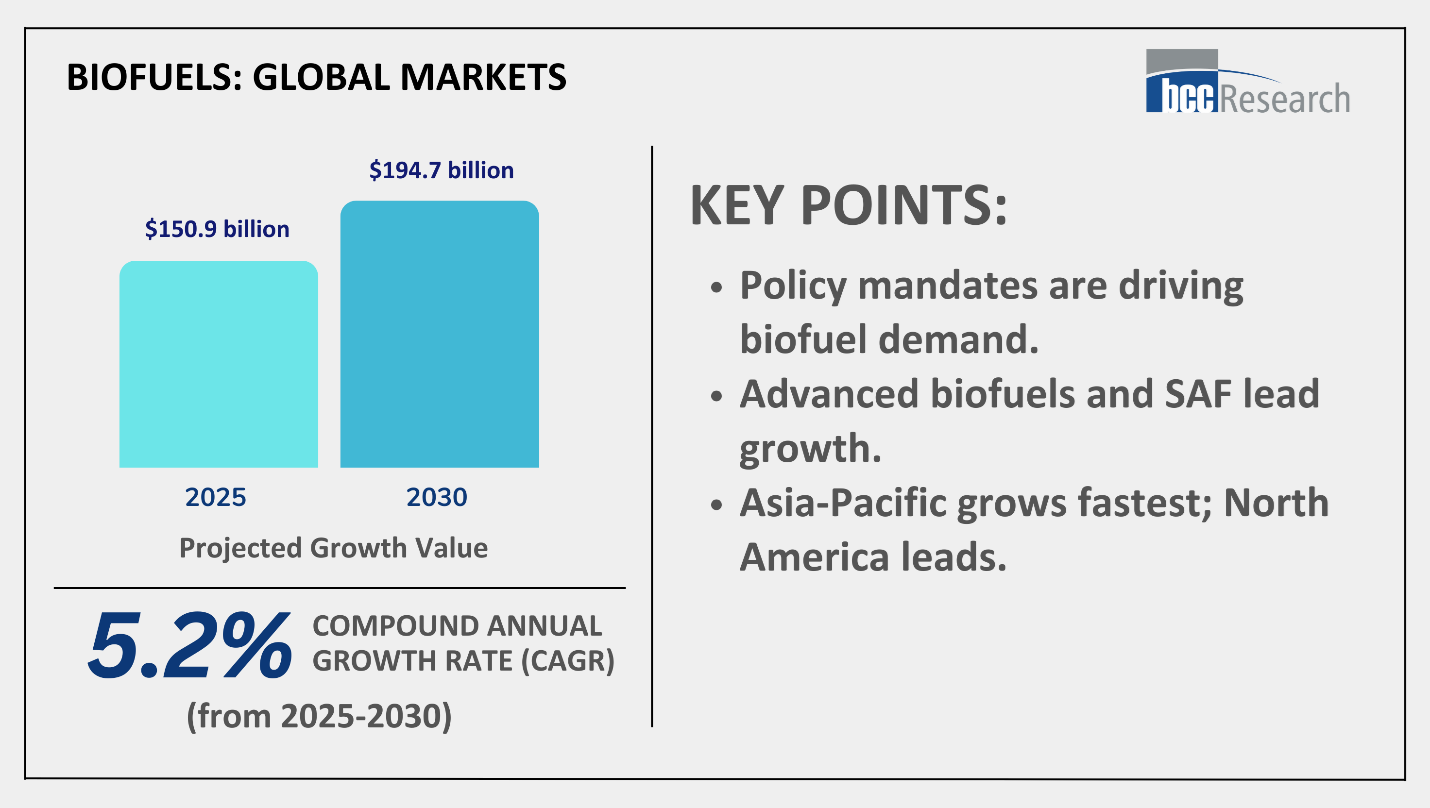
According to BCC Research, Biofuels: Global Markets is expected to grow from $150.9 billion in 2025 to reach $194.7 billion by the end of 2030, at a compound annual growth rate (CAGR) of 5.2% from 2025 through 2030.
The market is currently dominated by first-generation biofuels, including ethanol and biodiesel, which are widely used in transportation blends. However, the industry is rapidly shifting toward advanced biofuels made from non-food feedstocks such as crop residues, waste oils, and forestry by-products. These fuels address sustainability concerns and offer better carbon performance, making them central to future market growth.
North America remains a major force in biofuel production, supported by strong regulatory frameworks and abundant feedstock availability. Brazil continues to set global benchmarks in sugarcane-based ethanol, combining efficiency with low production costs. Europe’s market is driven by strict emission targets and a growing focus on sustainability-certified fuels. In Asia-Pacific, rising fuel demand and supportive government policies are accelerating investments in domestic biofuel production.

The global market for biofuels is expected to grow from $150.9 billion in 2025 to reach $194.7 billion by the end of 2030, at a compound annual growth rate (CAGR) of 5.2% from 2025 through 2030.
Road transport continues to account for the largest share of biofuel consumption, but the fastest growth is coming from aviation. Sustainable aviation fuel (SAF) has become a priority for airlines seeking to meet emission reduction commitments without disrupting operations. Biofuels are also gaining momentum in marine transport as shipping companies respond to tightening global emission regulations.
Government policies play a decisive role in shaping the biofuels market. Blending mandates, tax incentives, renewable fuel standards, and carbon reduction targets provide long-term visibility for producers and investors. At the same time, stricter sustainability criteria are pushing the market toward cleaner feedstocks and advanced production technologies.
Technological progress is redefining how biofuels are produced and deployed. Companies are investing in renewable diesel, bio-jet fuel, and integrated biorefineries that improve efficiency and reduce emissions. Partnerships between energy firms, technology providers, airlines, and agricultural companies are accelerating commercialization and scaling efforts.
Despite strong growth prospects, the biofuels market faces challenges such as feedstock price volatility, infrastructure limitations, and competition from electric and hydrogen-based alternatives. Long-term success will depend on continuous innovation, stable policy support, and the ability to deliver sustainable fuels at competitive costs.
Biofuels are not a temporary solution—they are a strategic bridge toward a lower-carbon future. Their ability to decarbonize hard-to-electrify sectors ensures they will remain a vital part of the global energy mix. As advanced biofuels gain traction and sustainability standards evolve, the global biofuels market is poised for steady, long-term growth.
Consider becoming a member of the BCC Research library and gain access to our full catalog of market research reports in your industry. Not seeing what you are looking for? We offer custom solutions too, including our new product line: Custom Intelligence Services.
Contact us today to find out more.
Divya Dhamija is a Senior Executive of Marketing Operations at BCC Research, with a master’s degree in business. She specializes in optimizing marketing strategies and content creation and is dedicated to driving organizational growth through strategic marketing initiatives.
As the world accelerates toward clean energy solutions, Solid Oxide Fuel Cells (...
The global market for Solid Oxide Fuel Cells (SOFCs) is experiencing significant...
For much of the 20th century, the Middle East and North Africa (MENA) regions we...
We are your trusted research partner, providing actionable insights and custom consulting across life sciences, advanced materials, and technology. Allow BCC Research to nurture your smartest business decisions today, tomorrow, and beyond.
Contact UsBCC Research provides objective, unbiased measurement and assessment of market opportunities with detailed market research reports. Our experienced industry analysts assess growth opportunities, market sizing, technologies, applications, supply chains and companies with the singular goal of helping you make informed business decisions, free of noise and hype.